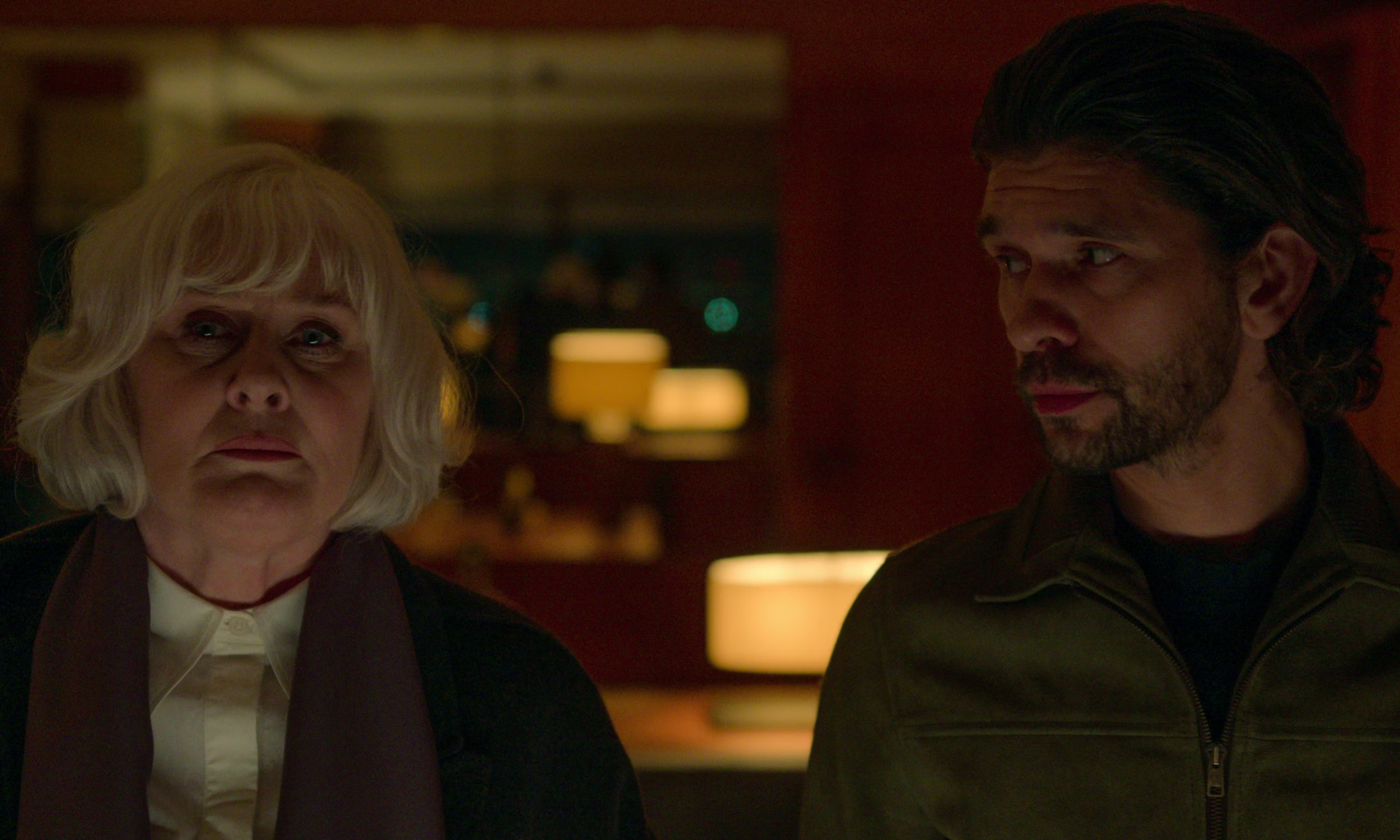
THE HIGH-STAKES SPY THRILLER ON NETFLIX THAT SARAH LANCASHIRE AND BEN WHISHAW IN A MASTERCLASS OF POWER DYNAMICS!
When your commander becomes your most dangerous enemy. On NETFLIX, Sarah Lancashire and Ben Whishaw deliver a powerhouse performance as Reed and Sam, caught in a high-tension standoff where one wrong word means instant death. The shocking truth revealed behind Reed’s unannounced visit proves…
In the glittering, blood-soaked world of Netflix’s Black Doves, trust is the rarest commodity and loyalty the most lethal weapon. While Keira Knightley’s Helen Webb may be the face of the series—the elegant politician’s wife who has spent a decade selling her husband’s secrets to the highest bidder—it is the electric, knife-edge dynamic between Sarah Lancashire’s icy spymaster Reed and Ben Whishaw’s conflicted assassin Sam that elevates the show from stylish Christmas thriller into something far more unsettling.
Reed is the embodiment of quiet, absolute authority. Dressed in sharp tailoring, speaking in a soft, precise northern cadence that never needs to rise, she runs the Black Doves with the calm certainty of someone who has ordered deaths over breakfast and never lost a night’s sleep. Lancashire, long celebrated for the raw vulnerability of Happy Valley, here becomes something colder and more terrifying: a woman who smiles while deciding whether the people in front of her live or die. Every scene she occupies feels like a pressure chamber. One raised eyebrow can silence a room. One carefully chosen silence can rewrite a life.
Opposite her stands Sam Young, played by Ben Whishaw with the perfect mixture of charm, weariness and barely controlled violence. Sam is the “triggerman”—the elegant killer who drinks champagne, calls everyone “love,” and carries the weight of every life he has taken. He left the game years ago after a job went catastrophically wrong. When Reed summons him back to protect Helen, he returns not as a loyal soldier but as a man who knows exactly how dangerous his former commander can be. Whishaw makes every hesitation, every wry half-smile, every sudden flash of steel feel lived-in and costly. You believe this man has killed for Reed. You also believe he is no longer sure he would do it again.
Their scenes together crackle with the specific tension that only exists between people who know each other’s worst secrets. Reed does not need to threaten Sam overtly. The history between them does the work. She is the one who once pointed him toward the life of a professional killer. She is the one who can still pull him back into it with a single phone call. And when she appears without warning—arriving unannounced at a moment when Sam believes he has finally found a fragile pocket of safety—the air changes. The camera holds on their faces. The dialogue becomes sparse, almost polite. Every word is a calculation. One wrong answer, one misplaced look of defiance, and the consequences will be immediate and irreversible.
This is the masterclass the series delivers so brilliantly: power that does not announce itself with raised voices or dramatic speeches, but with the quiet understanding that the person across the table has already decided your fate and is simply waiting to see whether you will make it easy or difficult. Lancashire never overplays the menace. She does not need to. The threat is structural. Reed controls the organisation, the information, the money, and, when necessary, the cleaners who erase evidence. Sam understands this better than anyone. His body language shifts the moment she enters a room. The easy charm he deploys with Helen or Michael tightens into something more careful, more watchful.
The brilliance of the writing and the performances is that the relationship is never purely antagonistic. There is a strange, twisted form of respect—perhaps even a residual affection—buried under years of mutual usefulness and mutual danger. Reed values Sam’s particular skills. Sam still answers when she calls, even after everything. Yet the series never lets the audience forget that this history can turn lethal in an instant. When the power dynamic tips, when the commander who once protected and directed suddenly becomes the most immediate threat, the stakes feel genuinely existential.
Black Doves thrives on these quiet escalations. While the plot races through Christmas London with assassinations, geopolitical brinkmanship, and double-crosses involving Chinese diplomats, CIA assets and London’s criminal underworld, the emotional and psychological centre remains the relationship between Reed and the people she controls. Helen may be the asset walking the most dangerous tightrope—leaking secrets while married to a rising politician—but Sam is the one who has already lived through the consequences of Reed’s decisions. His return is not a simple recruitment. It is a reminder that the organisation does not easily release those it has claimed.
What makes the dynamic so compelling is the absence of melodrama. There are no shouted confrontations or last-minute redemptions. Instead, Lancashire and Whishaw play the long game of people who understand the rules of their world better than almost anyone else. Reed’s unannounced appearance lands like a silent detonation. The camera does not need to underline the danger. The performances do it. A slight shift in posture. A pause that lasts half a second too long. The knowledge, shared by both characters and the audience, that one wrong word really could mean death.
As the series moves toward its second season—already confirmed and with Lancashire’s role reportedly expanding—the questions surrounding Reed only intensify. How far will she go to protect her position within the Black Doves when that position itself comes under threat? What does it mean when the person who once commanded absolute loyalty becomes the source of the greatest danger? And how does a man like Sam, who has already tried to walk away once, respond when the call comes again?
Sarah Lancashire and Ben Whishaw turn these questions into something electric. In a genre often dominated by gadgets, gunfights and globe-trotting spectacle, Black Doves finds its sharpest tension in two people sitting across from each other, speaking in measured tones, while the possibility of violence hangs in the air between them like a held breath. When your commander becomes your most dangerous enemy, the real thriller is no longer about who is chasing whom through the streets of London. It is about whether the next sentence spoken will be the last one that matters.
That is the high-stakes game Black Doves plays so well. And Lancashire and Whishaw play it like masters.