NETFLIX PRESENTS A MASTERCLASS IN PSYCHOLOGICAL THRILLER AND HISTORICAL CRIME THIS SEPTEMBER
Forty whacks with an axe and a trial that divided a nation. On Netflix, Ella Beatty delivers a powerhouse performance as Lizzie Borden, alongside star-studded cast members Vicky Krieps, Charlie Hunnam, and Rebecca Hall. The bloodstained evidence discovered that morning in Fall River would haunt America for more than a century — and now Ryan Murphy is turning it into the most anticipated true-crime season of the year.
On the morning of August 4, 1892, the quiet streets of Fall River, Massachusetts, were shattered by a crime so brutal it still echoes through nursery rhymes. Andrew Borden, a wealthy but notoriously frugal businessman, and his second wife Abby were found hacked to death inside their modest home on Second Street. The weapon was an axe. The number of blows became legend: “Lizzie Borden took an axe and gave her mother forty whacks. When she saw what she had done, she gave her father forty-one.”
Lizzie Andrew Borden, the 32-year-old unmarried daughter who lived in the house, was the only person with clear opportunity. She claimed she had been in the barn looking for fishing sinkers when the murders occurred. She was arrested, tried in one of the most sensational court cases of the 19th century, and acquitted by an all-male jury that simply could not believe a respectable, church-going young woman of means was capable of such savagery. She walked free. The case was never solved. And the questions never stopped.
Now, more than 130 years later, Netflix is handing that unanswered mystery to Ryan Murphy and Ian Brennan for the fourth installment of their hit anthology series Monster. Titled Monster: The Lizzie Borden Story, the eight-episode season premieres September 17 and marks a major shift for the franchise. After Jeffrey Dahmer, the Menendez brothers, and Ed Gein, this is the first season centered on a woman — and the only one of Murphy’s “monsters” who was never convicted.
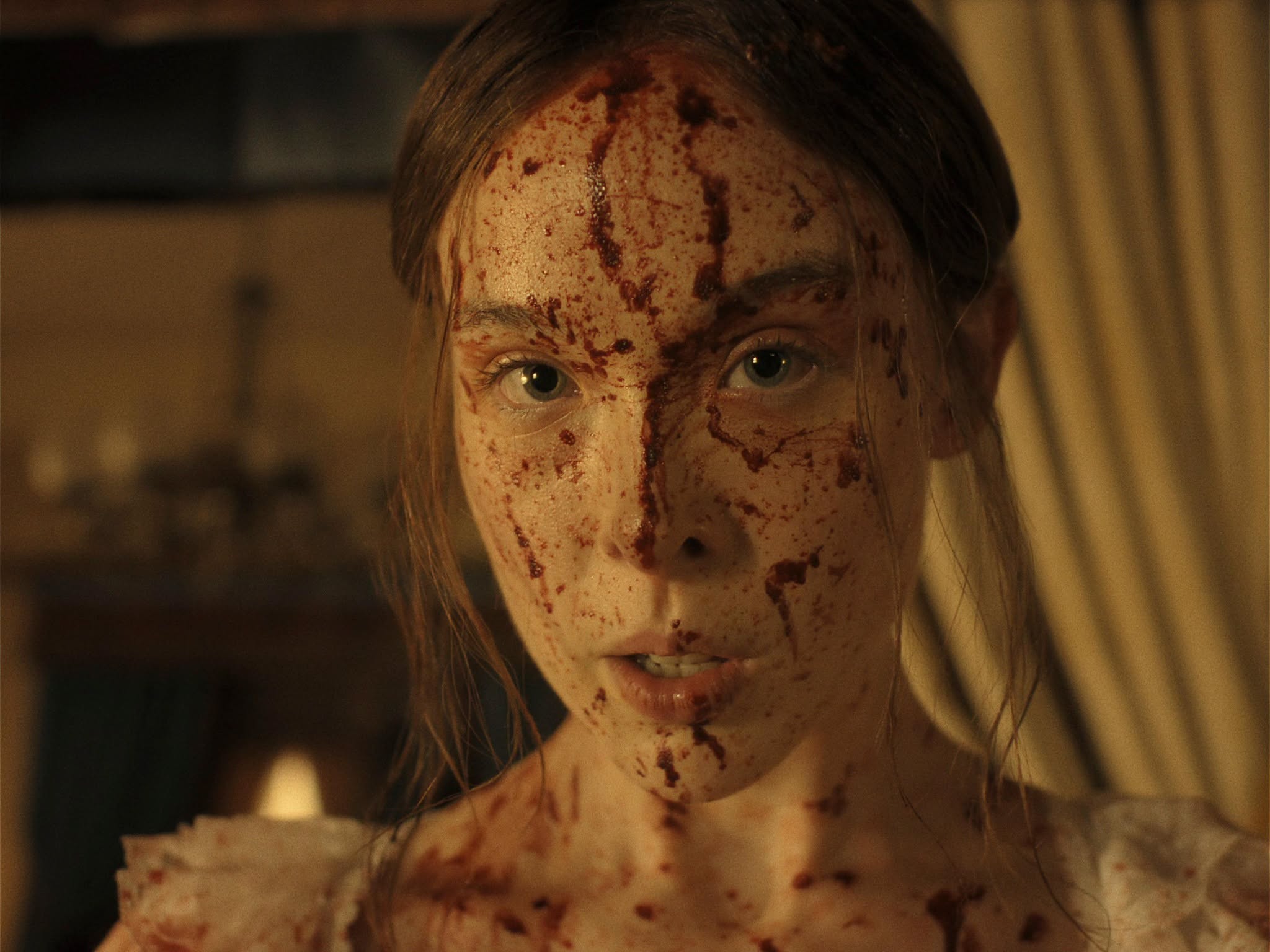
At the center of it all is Ella Beatty. The daughter of Warren Beatty and Annette Bening, Beatty made her screen debut in Murphy’s Feud: Capote vs. the Swans and recently appeared in the critically praised If I Had Legs I’d Kick You. Casting directors searched extensively before landing on her for the role of Lizzie. Early first-look images released by Netflix show her face and clothing spattered with blood, eyes wide with something between terror and calculation. In interviews, Beatty has described the part as an exploration of “female rage and repression,” calling the case “almost mythic in proportion.”
She is not alone. Vicky Krieps, fresh from Monster: The Ed Gein Story and long admired for her work in Phantom Thread, plays Bridget Sullivan, the Bordens’ live-in Irish maid — known in the household as Maggie. In Murphy’s version, Bridget is no silent servant. The official logline frames the story around “the repressed daughter of a wealthy New England family and her rebellious maid” who find themselves trapped in “a house built on humiliation and cruelty.” Together they escape into a fantasy of sex, power, and revenge. The relationship between Lizzie and Bridget has long been the subject of speculation among historians and true-crime obsessives. Murphy appears ready to lean into that tension with characteristic intensity.
Charlie Hunnam, who earned an Emmy nomination for his chilling turn as Ed Gein in the previous season, returns to the Monster universe as Andrew Borden — the miserly, controlling father whose thrift and emotional coldness created the pressure cooker inside 92 Second Street. Rebecca Hall, one of the most precise dramatic actresses of her generation, plays Abby Borden, the stepmother Lizzie never fully accepted. Completing the core family is Billie Lourd as Emma Borden, Lizzie’s older sister, who was conveniently out of town on the day of the murders. Jessica Barden appears as Nance O’Neil, the actress who later became one of Lizzie’s closest companions and whose intimate friendship has fueled additional theories over the decades.
What makes the Borden case so enduring is not just the gore. It is the social fault lines it exposed. In 1892 America, a woman of Lizzie’s class was presumed incapable of such violence. The prosecution had no murder weapon with her fingerprints, no blood-soaked dress (though a dress was later burned), and a defendant who remained composed under relentless questioning. The defense painted a picture of a pious young woman trapped in a loveless, penny-pinching household. The jury bought it. The public never fully did. For generations, the case has served as a Rorschach test for attitudes about gender, class, sexuality, and the limits of respectable femininity.
Murphy’s series arrives at a moment when audiences are hungry for stories that interrogate those same tensions. Previous Monster seasons mixed meticulous period detail with psychological excess and modern stylistic flourishes. Early reports suggest The Lizzie Borden Story will do the same, complete with anachronistic music choices and a darkly comic edge that refuses to treat its central figure as a simple villain or simple victim. The tagline lands like a provocation: the murders “don’t just shock the world — they give birth to an icon who refuses to live imprisoned in a cage, choosing instead to forge her own legend: shocking, monstrous, and gloriously free.”
Whether that framing will satisfy historians or outrage descendants remains to be seen. What is already clear is the scale of ambition. First-look photographs show carefully reconstructed Victorian interiors, blood-slicked wooden floors, and a cast that looks locked in a pressure cooker of repressed desire and mutual suspicion. Directors Max Winkler and Sarah Adina Smith are said to be emphasizing the claustrophobia of the Borden house — a place where every locked door, every withheld dollar, and every simmering resentment becomes part of the crime scene.
The bloodstained evidence discovered that August morning — the positions of the bodies, the timing of the attacks, the absence of forced entry, the strange behavior of the surviving daughter — has been dissected in books, documentaries, podcasts, and previous film adaptations. None of them have closed the case. Murphy’s version does not promise to solve it either. Instead it asks a more unsettling question: what happens when a woman is told she is incapable of monstrosity, and then the world is forced to confront the possibility that she was not?
For viewers who have followed the Monster anthology from Dahmer’s Milwaukee apartment to the Menendez mansion to Gein’s Wisconsin farmhouse, the shift to Fall River in 1892 feels both inevitable and overdue. An axe. A closed house. A trial that refused to deliver the ending the public demanded. And a young woman who walked out of the courtroom free, only to live the rest of her life under a shadow she could never fully escape.
Ella Beatty’s Lizzie Borden is about to step into that shadow on September 17. The bloodstained evidence is waiting. The nation, once again, will have to decide what it is willing to believe a woman is capable of.