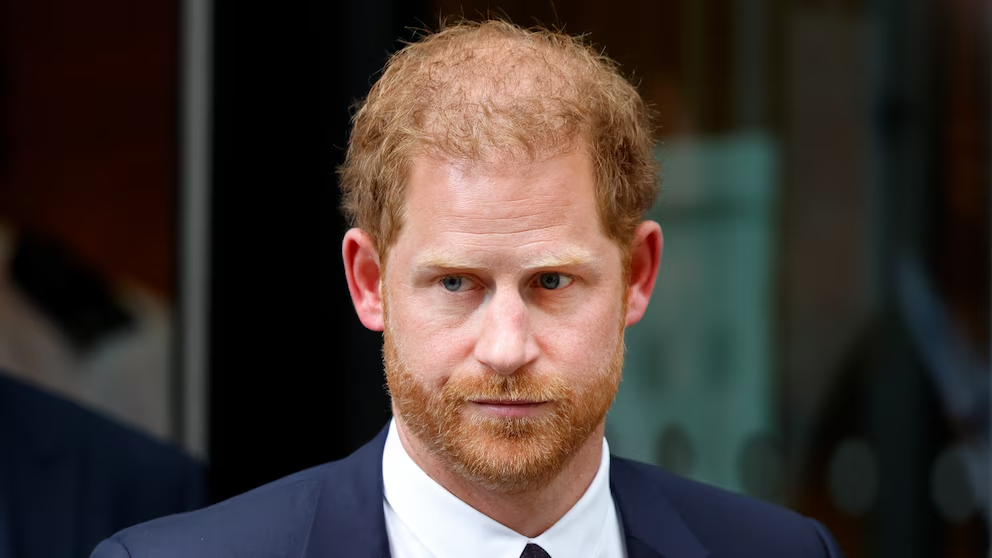
HARRY ACCUSED OF CREATING A “MEDIA CIRCUS” OVER UK SECURITY AS REFUSES BUCKINGHAM PALACE STAY, DEMANDS ARMED GUARDS INSTEAD!
Royal expert Emily Andrews has publicly slammed Prince Harry following his latest security demands during his return to the UK. Speaking to media outlets, Andrews questioned why the Duke flatly rejected safe accommodation arranged inside Buckingham Palace while claiming his family isn’t secure. The sharp accusation made by experts regarding Harry’s real motive behind turning down the King’s offer was that he deliberately engineered a public spectacle to keep himself at the centre of the narrative and pressure the institution he left behind.
In the days surrounding Prince Harry’s July 2026 visit to Britain for Invictus-related engagements, what should have been a carefully managed homecoming descended into familiar chaos. King Charles had extended an offer of accommodation at a royal residence—widely reported as Buckingham Palace—where the Duke and his family would have been under the protection of armed police already stationed at the site. Harry’s team initially delayed, then declined, then attempted a late acceptance after scrambling to arrange private security following RAVEC’s decision that full taxpayer-funded police protection would not be provided outside royal residences. By the time he signalled willingness, the Palace said it was too late: staffing and logistical arrangements could no longer be made. The invitation was withdrawn.
Harry’s side insisted the issue had “never been accommodation.” Risk, they argued, “follows the person, not the place.” They wanted proportionate protective security—including armed officers—for the entirety of the visit, not merely while inside the palace gates. Private bodyguards the Sussexes employ in California cannot lawfully carry firearms in the UK. Without Metropolitan Police protection or equivalent, Harry maintained it was not safe to bring Meghan, Archie and Lilibet. In the end, the Duchess and the children did not join him for the London portion of the trip.
Royal commentator Emily Andrews has been unsparing in her assessment. In recent commentary she described Harry’s handling of the episode as “dithering, paranoia and indecision” that turned the entire visit into “a circus.” She noted that the Duke genuinely appears to believe his wife and children are unsafe in Britain without armed guards, a conviction she links to the lasting trauma of his mother’s death. Yet she questioned the proportionality of the demand. The offer of a secure royal residence with safe passage in and out, she argued, was not enough for him. “He is no longer a working royal. And so can’t act like one,” Andrews wrote, accusing him of trying to bounce the Home Office into providing the same level of protection afforded to those still performing official duties.
That charge—that Harry engineered a media circus—has gained traction among royal observers. Critics point to a pattern. By publicly framing the security refusal as a near-existential threat, leaking details of private risk assessments, and issuing statements that cast the Palace and the government as obstructive, the Sussex camp kept the story dominant for days. Headlines about “11th-hour” decisions, “distraught” reactions, and children potentially missing a meeting with their grandfather flooded coverage. The narrative of a father desperate to protect his family against an uncaring establishment played powerfully. Whether intentional or not, the effect was to keep Harry at the centre of attention precisely when a quieter visit might have allowed space for private family contact.
The deeper question experts raise concerns motive. Some argue the rejection of the Palace offer was less about pure security calculus and more about control of the story. Accepting accommodation inside Buckingham Palace would have placed Harry under the practical authority of the household he has repeatedly criticised. It would also have made it harder to sustain the claim that Britain is fundamentally unsafe for his family. By turning down—or appearing to turn down—the most secure option available and then framing the subsequent withdrawal of the invitation as further evidence of bad faith, Harry kept the grievance alive. The circus, in this reading, was not an accidental by-product; it was the point.
Others note the practical realities. RAVEC, the committee that assesses protective security for royals and VIPs, has long operated on the principle that Harry’s status changed when he stepped back from royal duties and relocated primarily to the United States. Protection is now considered case-by-case rather than automatic. Harry lost his legal challenge on this point in 2025. Subsequent reviews and risk assessments have not restored the previous arrangement. Private security can be hired, but it operates under strict legal limits in Britain. The Palace offer was, in institutional terms, a reasonable compromise: secure housing under existing armed protection without reopening the broader policy question of taxpayer-funded continuous security for a non-working royal living abroad.
Harry’s team has consistently rejected the idea that the accommodation offer solved the problem. They point to the need for protection during travel between engagements, private visits, and public appearances. They highlight past incidents involving stalkers and the elevated profile that comes with Harry’s own public revelations, including details in his memoir. From their perspective, the Palace and government created conditions that made a normal family visit nearly impossible, then criticised him for the resulting publicity.
Andrews and other commentators counter that the publicity was amplified by Harry’s own choices. Public statements, carefully timed briefings, and the decision to keep the security dispute in the open ensured maximum coverage. The result was days of conflicting accounts, competing statements, and renewed speculation about the state of relations between Harry and the rest of the royal family. What might have been a low-key return for charity work and a possible private meeting with the King became another instalment in the long-running drama.
The episode has left both sides bruised. Palace sources have privately expressed frustration at the last-minute changes and the public airing of internal arrangements. Harry’s camp remains convinced that the refusal of full security reflects institutional hostility rather than measured risk assessment. Emily Andrews’s public critique crystallises a broader sentiment among some royal watchers: that Harry’s security demands, however sincerely felt, have become a vehicle for sustained public pressure and narrative control.
As the dust settles on the July visit, the fundamental disagreement remains unresolved. Harry continues to insist that appropriate security is a non-negotiable precondition for bringing his family to Britain. The British authorities maintain that protection decisions are made on rigorous, proportionate grounds and that former working royals living overseas cannot expect the same automatic arrangements as those who remain in the system. The King’s offer of a secure royal residence was an attempt to bridge that gap. Harry’s rejection of it—and the media storm that followed—has only widened it.
Whether the real motive was genuine parental fear, a strategic effort to force a policy change, or a combination of both, the outcome is the same. Another chapter has been written in the story of the Duke of Sussex and the institution he left. And once again, the circus came to town.