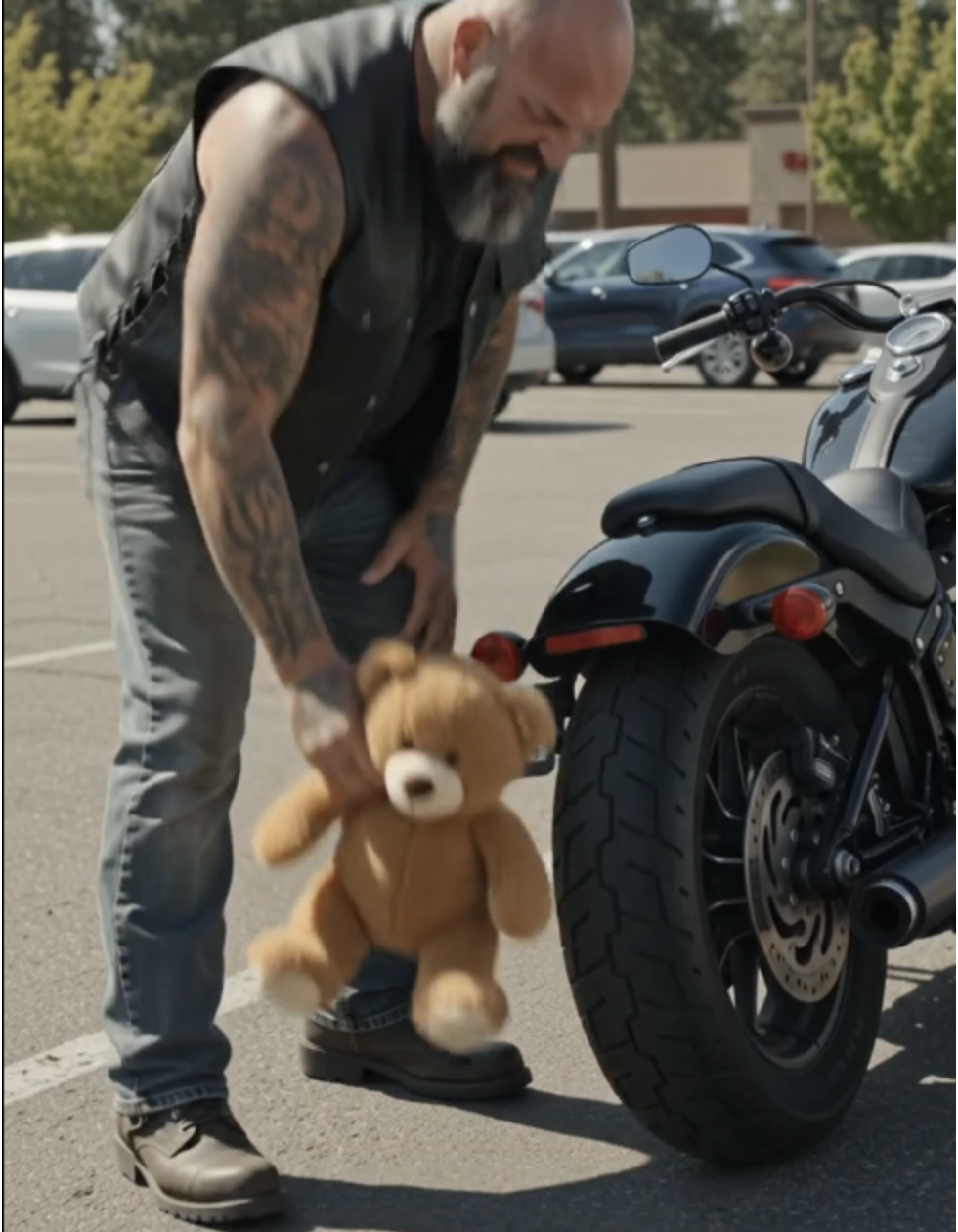
A Biker Bought a Brand-New Teddy Bear and Crushed It Beneath His Harley — Then a Hospital Nurse Revealed Why a Little Girl Could Never Accept It New
Part 5 — What the Riders Found at the Transfer Station
The medical-waste truck had not reached the processing facility. A mechanical failure forced it into a secured transfer yard twelve miles south of the hospital, where its cargo waited for another vehicle.
That did not mean anyone could open it.
The bags were regulated medical material. Some contained contaminated dressings, needles and biological waste. Boone’s contacts could identify the route, but they could not legally search the load. Sergeant Ruiz called the hospital administrator, who called the contractor, who called a regional safety officer in Phoenix.
Every minute required permission from someone who did not know Lucy.
Hammer never shouted.
That surprised Claire more than anyone.
The Hammer she remembered would have treated delay as an enemy, kicked a door, threatened a supervisor and confused action with control. This man sat beside Lucy’s room and made telephone calls in a low, careful voice. When told to wait, he waited.
When told no, he asked what would make the answer lawful.
It took two hours and seventeen minutes.
By then, Lucy had drifted into medicated sleep with the replacement bear beneath her left arm. Her right side remained weak, though the surgeon said swelling could explain it and recovery might unfold over weeks. Claire sat near the bed, counting breaths.
Hammer stayed outside.
I learned more about him from Boone during those hours than Hammer would have told me in a year.
After Ben’s mother left, Hammer tried to raise his son while working nights at a motorcycle shop. For nearly three years, he remained sober. He packed school lunches badly, washed red shirts with white ones and once sent Ben to class wearing two left shoes because he had purchased mismatched pairs from a thrift store.
But he showed up.
Then Boone asked Hammer to ride protection during a dispute between two clubs. Nobody died. Nobody even fired a weapon. Still, Hammer returned to the language of intimidation because it made him feel useful in a way fatherhood never did.
He began disappearing on weekends.
Alcohol followed.
When Ben was twelve, Hammer struck a man outside a bar while the boy waited in a pickup truck. The assault sent Hammer back to prison for eighteen months.
Ben moved in with an aunt.
Hammer wrote every week. Ben returned every letter unopened.
After his release, Hammer joined Boone’s Riders and built his life around rules: no drinking before a ride, no violence around families, no club business near schools. People called it discipline.
Ben called it too late.
The two men met only three times during Ben’s adulthood. Their last conversation occurred in the parking lot of a hardware store, where Hammer saw three-year-old Lucy sitting in a shopping cart and approached without permission.
Ben stepped between them.
“You don’t get to practice being good on my daughter,” he said.
Hammer handed him a tiny blue bear patch he had sewn himself.
Ben dropped it on the pavement.
Hammer picked it up after they left.
That was the patch inside his vest.
When Ben died, Claire discovered forty-seven letters in a locked toolbox. Hammer had written one every month after the hardware-store encounter but never mailed them. They contained no requests for forgiveness. Mostly, they described small things: a desert tortoise crossing Highway 89, a diner that served pie the way Ben liked it, a loose chain on a boy’s bicycle that Hammer repaired outside a gas station.
Claire burned the first ten.
She kept the rest.
That was why she had Hammer’s number when Lucy entered surgery.
“You called because of the bear?” I asked her.
Claire looked through the glass at Hammer. “I called because I was alone, and I hated that he was the only other person alive who had loved Ben before I did.”
The replacement bear rested under Lucy’s cheek.
“I thought he’d find the same model,” she continued. “I didn’t think he’d run over it.”
“He wasn’t trying to fool her.”
“I know.”
That seemed harder for Claire to accept than if he had failed.
At 5:26 p.m., Boone received permission to accompany a hospital infection-control officer to the transfer yard. The sealed cart from Lucy’s operating floor was separated from the rest of the load. Workers in protective equipment inspected each labeled bag.
They found the bear near the bottom.
Boone sent no photograph.
He called Hammer directly.
“Don’t bring it here,” Hammer said after listening.
Claire stood. “Why?”
Hammer ended the call.
“They found Boone?”
“Yeah.”
“Then tell them to bring him.”
“No.”
“You don’t decide that.”
“Bear’s torn open. Fluid got through the bag. One side burned from chemical treatment.”
Claire gripped the back of a chair. “Lucy needs to know we found him.”
“She needs the truth. Doesn’t need the sight.”
“She’ll ask.”
“Then we tell her.”
Claire stepped closer until she had to tilt her head to meet Hammer’s eyes. “You spent twenty-seven years keeping things because you were afraid to face what they looked like. Don’t do that to her.”
The accusation landed.
Hammer looked through the window at Lucy. “Ben kept asking if I was coming home. I’d tell him yes before I knew if I meant it.”
“And now?”
“Now I don’t make clean promises.”
Claire asked Boone to bring the original bear in its sealed recovery container. The hospital agreed to preserve it until a specialist could determine whether any part could be safely restored.
It arrived after sunset.
Boone carried the clear hard-sided box with both hands. Six Riders walked behind him, not in formation but with the quiet awkwardness of men entering a church where they did not know the prayers.
The original Boone Bear barely resembled a toy.
Its left side had split. Much of the stuffing was gone. The fur was dark, matted and discolored by hospital fluid and chemical exposure. One eye remained. The folded ear had torn halfway from the head.
Kayla’s words from the parking lot returned to me.
You’re sick.
Hours earlier, she had meant Hammer. Now I understood why he had crushed the new bear instead of presenting Lucy with something flawless. A perfect replacement would have denied every mile the original had traveled.
The damaged copy was not an imitation of death.
It was an acknowledgment of survival.
Boone placed the container on a table outside Lucy’s room. Hammer stared at the ruined toy for a long time.
Then he noticed something beneath the torn fabric.
“Open the chest,” he said.
The infection-control officer refused until they moved to a controlled room. Hammer waited behind the glass while gloved technicians separated the stained stuffing.
They recovered the old bell.
They also found a folded strip of paper sealed inside a tiny plastic sleeve.
Nobody knew it existed.
The handwriting belonged to Ben.
The note was dated three days before his death.
It contained seven words:
If she gets scared, take her home.
Beneath the sentence, Ben had written a telephone number.
Hammer’s.
Part 6 — The Number Ben Never Called
Claire read the note four times.
She recognized Ben’s handwriting, the way his capital H leaned backward and the way he crossed the final letter of a word as if he were angry at the page. She also recognized the plastic sleeve. Ben used the same kind to protect emergency cash inside his work boots.
“He put this in Boone without telling me,” she said.
Boone Mercer looked at Hammer. “Ben knew your number.”
Hammer did not answer.
For years, he believed his son had erased him completely. He carried that belief because it required no risk. A dead son could not contradict it, and an estranged granddaughter could remain safely beyond reach.
The note proved Ben had left a door open.
Not wide.
Not without conditions.
But open.
If Lucy became frightened and Claire could not help her, Ben wanted someone to call the man he had refused to forgive. Perhaps he trusted Hammer. Perhaps he only trusted that fear would make him come.
Neither possibility erased what happened between them.
Both mattered.
When Lucy woke after midnight, Claire told her the original Boone had been found. She did not show photographs. She explained that the bear had been hurt during the same emergency that brought Lucy to the hospital, and specialists would try to save whatever could be saved.
Lucy held the replacement.
“Did the motorcycle hurt him too?”
Hammer stood in the doorway. “That was me.”
“Why?”
“Thought you needed his scars.”
Lucy ran her fingers across the flattened cheek. “He has too many.”
“Can fix some.”
“No.”
She tapped the new bear’s stomach and listened to the spare bell.
“Leave this one.”
Hammer nodded.
“What’s his name?” Claire asked.
Lucy thought for almost a minute.
“Little Boone.”
The original became Big Boone.
Technicians recovered his brass bell, three fabric panels from his back, part of the folded ear and the paw containing seven intact stitches. Everything else had to be destroyed safely.
Hammer watched them document each piece.
Then he asked if the preserved fabric could be sewn inside Little Boone rather than displayed in a box. The textile conservator warned that the original material could not touch Lucy until it had been cleaned, stabilized and enclosed.
“Do it right,” Hammer said.
It took six weeks.
During those weeks, Lucy relearned balance, strengthened her right hand and practiced recognizing objects when her vision blurred. Some days she remembered the nurses’ names. Other days she called her mother by a teacher’s name and became angry when corrected.
Hammer visited only when invited.
The first invitation lasted four minutes.
He stood beside the door while Lucy asked why his fingers were crooked. He told her he had used them badly when he was young.
The next visit lasted eleven minutes. She made him tap the home signal on the bedrail.
Two quick.
Three slow.
Two quick.
On the third visit, she asked him to bring his Harley so she could hear it from the window.
Hospital policy did not allow engines directly beneath pediatric rooms. Hammer parked across the street instead. Boone and the Riders waited with him, but only Hammer started his motorcycle.
The low V-twin rumble traveled through the glass.
Lucy pressed Little Boone against the window and tapped its chest.
Hammer could not see the motion from the street.
He tapped the same rhythm against his fuel tank anyway.
Two quick.
Three slow.
Two quick.
Claire stood behind her daughter and understood what neither of them could hear clearly.
They were asking each other the same question.
Part 7 — Two Bears and the Road Home
Lucy left the hospital forty-three days after Hammer crushed the teddy bear in our parking lot.
She walked with a brace on her right leg and held Claire’s hand when the ground felt uneven. Her hair had begun growing over the surgical scar. Little Boone traveled beneath her left arm, still flattened on one side, coffee-stained across the stomach and imperfect around the eye.
Inside him were the cleaned pieces of Big Boone.
The seven-stitched paw rested behind the new bear’s chest. Part of the folded ear had been sealed beneath a protective lining. The original bell remained beside Hammer’s spare, so every tap produced two slightly different sounds.
Lucy called them Daddy’s heartbeat and Grandpa’s heartbeat.
Hammer disliked the second name.
Not because he rejected it.
Because he believed it belonged to a better man.
Lucy used it anyway.
The Riders lined the hospital drive without blocking traffic. No one revved an engine. No one displayed a banner or recorded her departure. Boone Mercer removed his leather cut and held it against his side so the club patches would not dominate the photographs Claire took.
Hammer waited beside his Harley.
He wore the same vest, faded jeans and heavy boots I had seen inside the toy store. The blue bear patch was no longer hidden near his heart. Lucy had asked him to sew it outside, below his left shoulder.
The stitching was crooked.
She approved.
Claire stopped several feet from him. For a moment, the old distance remained between them—Ben’s funeral, the jail cell, the burned letters and every apology that had arrived too late.
Then she handed Hammer a folded sheet of paper.
It was not forgiveness.
It was a schedule.
Lucy had physical therapy on Tuesdays, occupational therapy on Thursdays and a follow-up scan every second Monday. Claire had written the approved visiting hours beneath them.
“Miss one without calling,” she said, “and we go back to zero.”
Hammer studied the page.
“Understood.”
“No club business around her.”
“Understood.”
“No promises you can’t keep.”
He looked at Lucy.
“That one I understand.”
Lucy approached the motorcycle and placed one hand on the warm fuel tank. Hammer guided her away from the exhaust without grabbing her arm.
“Can Boone ride?” she asked.
“Needs a helmet.”
“He’s a bear.”
“Road doesn’t care.”
The next morning, Hammer returned to my store and purchased the smallest toy helmet we sold. It was designed for a plastic doll, not a teddy bear, but he cut the strap, added brown elastic and fitted it between Little Boone’s damaged ears.
He paid for the scissors this time.
Kayla apologized for calling him sick.
Hammer looked at her, then at the faint tire mark still visible on the bear’s cheek.
“Looked that way,” he said.
Every second Monday after that, a black Harley arrived outside Lucy’s therapy clinic at 7:40 a.m. Hammer never entered unless Claire waved him in. Sometimes he drove them home in Claire’s car while another Rider took the motorcycle. Sometimes Lucy was too tired to see him.
He came anyway.
A year later, Lucy could run for short distances. Her right hand remained slower, and loud unexpected noises still made her freeze. Hammer taught the Riders to shut down their engines before she crossed a parking lot.
Nobody complained twice.
On the second anniversary of her surgery, Lucy climbed onto the passenger seat of Hammer’s stationary Harley. Claire stood beside her, one hand on the child’s back. Little Boone sat inside a clear pouch attached to the tank, wearing his ridiculous helmet.
Hammer did not start the motorcycle until Lucy tapped his vest.
Two quick.
Three slow.
Two quick.
He looked at Claire.
She nodded.
The engine rolled awake beneath them, deep and steady. Lucy pressed her cheek against the blue bear patch on Hammer’s back and tapped the signal again.
Are we going home?
Hammer covered her small hand with his scarred one.
Then the Harley moved gently toward Route 66.
Follow our page for more unforgettable biker stories about intimidating Riders, misunderstood choices and the quiet acts of love hidden beneath leather and road dust.