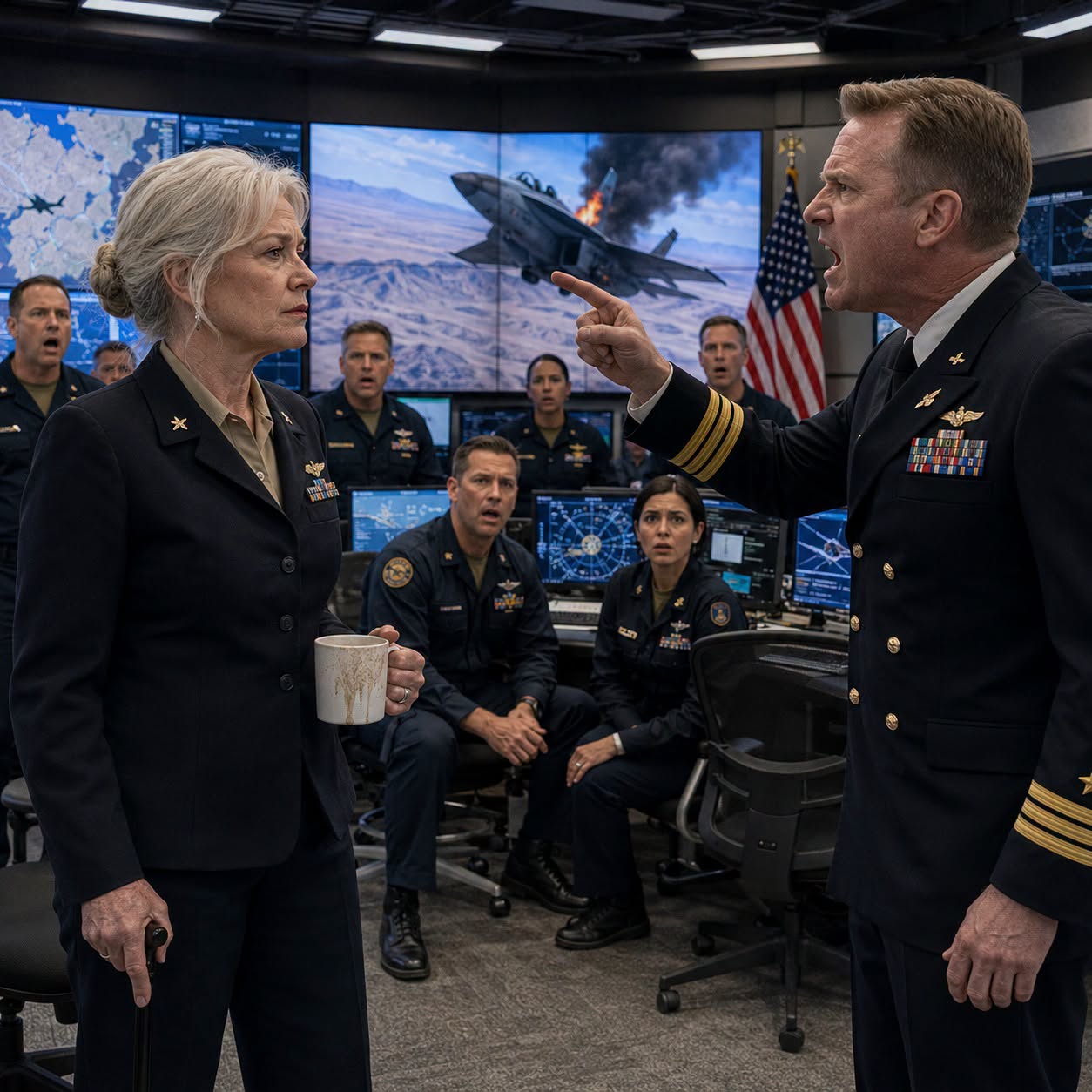
The Gray-Haired File Clerk They Mocked, Humiliated, and Treated Like Dirt for Six Long Years Until a Young Pilot Began Falling From the Sky and Screamed One Forgotten Name Over the Radio — Ghost — Forcing the Truth About a Corrupt Commander and a Sabotaged Jet Into the Light
PART 1
Commander Wade Mercer did not bother lowering his voice.
“Get that gray-haired file clerk out of my control room before she kills a pilot.”
He pointed across the operations floor as though I were something that had dripped from a leaking pipe and refused to dry. The laughter that followed was soft, practiced, the kind that never needed to be loud to cut.
I stood where I always stood—half a step behind the threshold of the glassed-in tower room, holding a coffee mug whose brown ring at the bottom had become permanent years ago. Fifty years old. Cheap glasses. A limp that announced itself every time the weather shifted. Amara Kessler, civilian records specialist, Naval Air Station Fallon. The woman who corrected flight logs and made sure the numbers on paper matched the numbers in the air. Or tried to.
No one in that room knew the other name.
Ten years earlier the sky had still belonged to me. I had flown prototypes that most of these officers would never be cleared to sit in. I had nursed an F-15 through cascading electrical failure over the Mojave and brought an experimental Hornet home with half its tail missing. Young pilots used to ask for me by one word when the warning lights painted the cockpit red and the checklist stopped making sense.
Ghost.
Then a hydraulic defect turned a routine test flight into a long, cold fall into the Pacific. I stayed with the jet long enough to push it clear of a fishing boat before I ejected. The impact shattered my back in three places. The Air Force gave me medals, a medical retirement, and a surgeon’s quiet sentence that still woke me some nights: You will never fly again.
I changed my last name after the divorce, took the records job, and let Ghost become a rumor people told around hangars when the beer was cheap. Silence had seemed cheaper than pity.
Mercer either did not know or preferred not to.
That Tuesday began the way most of them did—burnt diner coffee and the smell of Danny Ruiz’s breakfast burrito leaking grease across a desk that already held too many unfinished forms. Outside, the Nevada sun bleached the runway white. An American flag snapped on its pole, the rope tapping a steady, impatient rhythm.
I was reviewing the morning’s Super Hornet packets when the same anomaly appeared for the third time.
Fuel-control inspections marked complete. Pressure-test numbers identical across four different aircraft.
Machines do not produce identical numbers. People do.
I carried the paperwork into Mercer’s office. He sat with polished boots crossed on a filing cabinet, laughing with two young pilots. A silver nameplate on the desk was large enough to read from the hallway.
“Commander, these engine-control checks need to be repeated before launch.”
He barely glanced at the pages.
“You’re the records clerk, Ms. Kessler. File the records.”
“The numbers were copied.”
He took the report, tore it once, and dropped the pieces into the trash can beside his chair.
“The Navy did not spend eighty million dollars on jets so a limping civilian could ground them over a decimal point.”
The room went quiet in that particular way rooms do when someone has been publicly reduced. I did not argue. Cruel men always reveal more when they believe they have already won.
I noted the security camera above his door, the maintenance supervisor lingering in the hallway, and the message lighting up Mercer’s phone from Vantage Aeronautics:
APPROVAL BONUS CLEARS AFTER TODAY’S SORTIE.
I returned to my desk and wrote everything down.
At 10:40 the emergency channel detonated.
“Fallon Tower, Hornet Three. Total engine flameout. Both engines dead.”
Danny’s burrito hit the floor. Chairs scraped. Phones began ringing in overlapping waves. Through the glass I watched Lieutenant Aaron Peters snatch the emergency checklist. His hands shook hard enough that the pages slapped against the console.
“Altitude and heading?”
“Fourteen thousand. Heading two-two-zero. Controls heavy. Losing altitude fast.”
I knew the voice. Lieutenant Ethan Cole. Twenty-seven. Married three years. New baby girl whose hospital photograph he had shown me only days earlier while I fixed a pay discrepancy on his paperwork. She had been wearing a pink knitted cap.
Now her father was falling out of the sky.
Mercer stormed in, barking orders that sounded decisive and meant almost nothing.
“Tell him to restart.”
“He tried twice,” Peters said.
“Tell him again.”
“Do not waste battery power,” I said from the doorway. “He needs best glide now.”
Mercer turned as if he had been waiting for the interruption.
“There she is. Our filing-cabinet fighter ace.”
Ethan’s voice cracked over the radio.
“I’m at eleven thousand. I can’t make the field. Somebody give me a glide profile.”
Peters flipped pages that could not fly the jet for him.
Then Ethan shouted the sentence that changed the temperature of the room.
“We need call sign Ghost. My instructor said if I ever lose everything, find Ghost. Does anyone at Fallon know Ghost?”
No one moved.
Mercer laughed—a short, dismissive sound. “Ghost was probably three drunk pilots stitched into one campfire story.”
I walked to the console.
“Give me the headset.”
Mercer stepped in front of me.
“No.”
“Ethan is below ten thousand feet.”
“You are not touching military communications.”
Commander Elias Hale, the senior watch officer, looked at me then. He was older than Mercer, and something in his face shifted as if a door long closed had suddenly been kicked open.
“Kessler,” he said quietly. “What was your name before Kessler?”
“Voss.”
Hale went pale.
He had served at Edwards during the classified joint-flight program. He had heard the stories.
“Give her the headset.”
Mercer’s jaw tightened. “Sir, she is a civilian employee.”
Hale stepped closer, voice low and absolute.
“She is Colonel Amara Voss. Air Force test pilot. Joint tactical evaluation lead. Call sign Ghost.”
The room changed in an instant. Faces lifted. Conversations died. The woman they had walked past beside the vending machines for six years was no longer invisible.
I took the headset.
“Hornet Three, this is Ghost.”
For two heartbeats there was only static.
Then Ethan breathed my name like a man who had just been handed a rope while falling.
“Ghost. Thank God.”
“Do not thank anybody yet. Put the nose down two degrees. Hold two hundred knots. Your aircraft is not dead. It is simply quiet.”
“I’m at eighty-eight hundred feet. Twelve miles southwest.”
I ran the numbers without paper. Wind. Weight. Terrain. The cost of every turn.
He was short.
Not hopeless. Short.
“Ethan, you get one chance. No hard turns. No panic. And no listening to anyone else in this room.”
Mercer reached for the spare microphone.
I covered the transmit switch with my hand and looked at him.
“If you speak over me, he dies.”
For the first time that morning, Wade Mercer closed his mouth.
Then a red maintenance alert flashed across the side monitor.
FUEL CONTROL FAULT — PREVIOUSLY REPORTED.
My report had not merely been correct.
Someone had known the jet could fail before Ethan Cole ever left the runway.
PART 2
The red alert pulsed on the side monitor like a second heartbeat.
FUEL CONTROL FAULT — PREVIOUSLY REPORTED.
I kept my eyes on the radar track and my voice level.
“Ethan, listen carefully. You’re not fighting a dead airplane. You’re flying a glider that still has some manners left. Keep the nose where I told you. Two degrees down. Two hundred knots. Do not touch the throttles again.”
“Copy.” His breathing was tight, controlled only by force of will. “Ghost… how bad is it?”
“Bad enough that we don’t waste time asking.”
Around me the control room had gone unnaturally still. Mercer stood three feet away, jaw locked, eyes fixed on the screen as if sheer authority could reverse physics. Hale remained near the door, arms crossed, watching me the way a man watches a storm he once survived.
I calculated again.
Wind from the southwest at twelve knots. Aircraft weight estimated at combat configuration. Terrain rising slowly toward the low ridges twelve miles out. He needed roughly nine thousand feet of altitude to make the field with any margin. He had less than eight thousand and falling.
He was going to come up short.
Not by much. Just enough to die.
“Ethan, I need you to look at your standby instruments only. Primary screens can lie when the buses start shedding. Confirm airspeed and altitude.”
“Two-zero-two knots. Seventy-nine hundred.”
“Good. You’re steady. Now listen. In about ninety seconds you’re going to feel the aircraft want to drop the nose. Do not fight it hard. Ease it. We are going to trade a little speed for a little time.”
Mercer finally spoke, low and sharp.
“You’re going to get him killed with your museum tricks.”
I did not look at him.
“The only thing that will kill him is interference.”
Hale’s voice cut across the room, quiet but absolute. “Stand down, Commander.”
Mercer’s mouth tightened, but he stepped back half a pace.
I returned to the radio.
“Ethan, tell me about the baby.”
A short, startled silence.
“What?”
“Your daughter. The one in the pink hat. Tell me her name.”
His voice cracked once, then steadied. “Clara. Her name is Clara.”
“All right. You’re going to see Clara tonight. That is the only outcome we are discussing. Everything else is noise.”
I watched the track. The numbers were still against us.
“I’m going to have you make one gentle left turn in thirty seconds. Not a combat turn. Just enough to line up with the longer approach. If you bank more than fifteen degrees, we lose the altitude we cannot afford to lose. Understand?”
“Understand.”
The room around me had begun to breathe again—soft radio chatter, the low hum of equipment, the distant sound of sirens starting somewhere on the airfield. None of it mattered. The only thing that existed was the thin thread of a young man’s voice and the cold arithmetic of energy and drag.
“Turning now,” Ethan said.
I watched the heading change on the scope. Clean. Disciplined. The altitude loss was exactly what I expected. No more, no less.
“Good. Now hold it. You’re doing better than most of the people who used to sit in that seat.”
A faint, breathless sound that might have been a laugh. “You taught half of them, didn’t you?”
“Some of them. The ones who listened.”
Mercer shifted again. I could feel the heat of his anger without looking.
Then the second alert appeared.
This one was different.
A maintenance override code flashed across the lower screen—something that should never have been active during flight. A remote diagnostic channel had been opened from the ground less than twenty minutes before Ethan launched. Someone had queried the fuel-control system, seen the fault signature, and closed the channel without logging a grounding order.
I stared at the timestamp.
The same window in which Mercer had received the message from Vantage Aeronautics.
The same window in which he had torn up my report.
My hand tightened on the edge of the console.
Ethan was still speaking, voice thinner now. “Ghost… I’m at sixty-four hundred. The field still looks far.”
“I know. Stay with me.”
I leaned closer to the microphone, lowering my voice so that only he would hear the next words clearly.
“Ethan, there is a dry lake bed three miles short of the threshold. If we cannot stretch the glide, that is where you put it down. Gear up. Canopy jettison on my call. You have practiced this. You know how to walk away from it.”
“I don’t want to walk away from it. I want to land.”
“I know. But we plan for both.”
A new voice cut into the frequency—tower supervisor, tense. “Hornet Three, emergency equipment is rolling. Crash crews are on the approach.”
I ignored it.
“Ethan. Look at your fuel quantity. Both sides.”
“Zero on the left. Right side shows… eight hundred pounds, but the engine is still dead.”
“The gauge is lying. The system has been lying to you since you left the ground.”
Mercer took a sudden step forward.
“That’s enough. You’re sowing panic.”
I turned and looked at him fully for the first time since taking the headset.
“You knew,” I said, soft enough that only those nearest could hear. “The report I brought you this morning. The identical pressure numbers. The bonus that clears after today’s sortie. You knew the control unit was compromised and you still cleared him to fly.”
Color drained from Mercer’s face, then flooded back in ugly patches.
“You have no proof of that.”
Hale was already moving toward the side console, eyes locked on the same maintenance log I had seen.
Ethan’s voice returned, higher now, strained against the edges.
“Ghost—something’s changing. The nose is getting heavier. I can’t hold the attitude.”
I snapped back to him.
“Don’t fight the nose. Let it come down another degree. Trade the altitude. We are not out of options yet.”
But the numbers on the scope no longer agreed with my earlier calculations.
Something else had failed.
A secondary hydraulic trace was dropping. The aircraft was no longer simply a clean glider. It was beginning to decay.
Ethan was running out of both sky and time.
And somewhere behind the glass, Commander Wade Mercer stood with the knowledge that the jet falling toward the desert had not failed by accident.
I pressed the transmit switch again, voice steady, final.
“Ethan, listen to me carefully. We have one last move left. It is going to feel wrong. It is going to feel like the aircraft is trying to kill you. You will do it anyway. On my mark.”
The radar track continued its slow, merciless descent.
Outside, the Nevada sun kept shining as if nothing in the world could ever fall.
PART 3
“On my mark,” I said.
Ethan’s breathing filled the headset—short, controlled, the sound of a man holding himself together by the thinnest of threads.
“The aircraft is decaying,” I told him. “Secondary hydraulics are failing. You’re going to feel the controls go soft, then heavy, then soft again. When I tell you, you will push the nose down harder than feels safe and hold it. We are going to buy the last three hundred feet of energy we need. If you pull up too early, you stall. If you wait too long, you hit short. There is no third option.”
“Copy.”
Mercer’s voice rose behind me, raw now. “You’re gambling with a twenty-seven-year-old pilot on some ghost story—”
Hale turned on him.
“One more word and I will have you removed from this room.”
The room believed him.
I watched the numbers. Sixty-one hundred. Fifty-eight. The dry lake bed was no longer a contingency. It was becoming the only runway left.
“Ethan. Clara is waiting. You do not get to leave her a story about how close you came. You get to walk into that hospital room tonight. Understand?”
“Yes.”
“Mark.”
He pushed.
The radar track steepened. Airspeed climbed. Altitude bled away in a controlled hemorrhage. The aircraft groaned through the frequency—metal and airflow and the thin edge between flight and impact.
“Hold it,” I said. “Do not look at the ground. Look at the airspeed. When it reaches two-thirty, you begin the flare. Not before. Not after.”
“Two-twenty… two-twenty-five…”
The lake bed filled the lower edge of his world. White alkali. Hard. Unforgiving.
“Now.”
He rotated.
The impact when it came was not a landing. It was a long, violent negotiation with the earth. Gear stayed up. The fuselage struck, skipped once, then settled into a grinding slide that threw a rooster tail of dust high enough to be seen from the tower. The canopy jettisoned on the second bounce. The aircraft carved a dark scar across the lake bed for nearly a thousand feet before it finally stopped.
Silence followed—complete, ringing.
Then Ethan’s voice, hoarse and stunned.
“Ghost… I’m down. I’m okay. I think I’m okay.”
I closed my eyes for one full second.
“Stay in the seat until the crash crews reach you. Do not move more than you have to. You did well, Lieutenant.”
“Thank you.” The words cracked. “Thank you.”
I set the headset down carefully, as if it might break.
Around me the control room erupted into motion—phones, orders, the low roar of emergency vehicles already rolling toward the lake bed. Hale was already on a secondary line, speaking in the clipped language of men who understood that certain failures required more than maintenance reports.
Mercer stood frozen near the console. The color had left his face entirely.
I looked at him once.
“You cleared a known fault for a bonus,” I said, not loudly. “A young father is alive because the system you tried to silence still had one person left who remembered how to listen. That is the only mercy you receive today.”
Hale’s voice carried from the far side of the room.
“Commander Mercer. You will remain here. Security is on the way. The maintenance logs, the Vantage message traffic, and the torn report are already being preserved.”
Mercer opened his mouth, then closed it. There was nothing left that authority could say.
I walked out of the control room the same way I had entered it for six years—quietly, with the limp that never quite left, past the vending machines and the scuffed linoleum and the people who had only ever known me as the gray-haired clerk who corrected numbers.
Outside, the Nevada light was still hard and clean. The flag still snapped on its pole. Somewhere beyond the perimeter, dust drifted slowly back to the lake bed where a young pilot sat in the broken shell of an aircraft that should have killed him.
I did not look back.
Ghost had answered when she was called. That was enough.
In the small office at the rear of the building, the coffee mug still waited with its permanent brown ring. I set it in the sink, washed it out for the first time in months, and left it upside down on the drainboard to dry.
Some silences, once broken, do not need to be rebuilt.
THE END