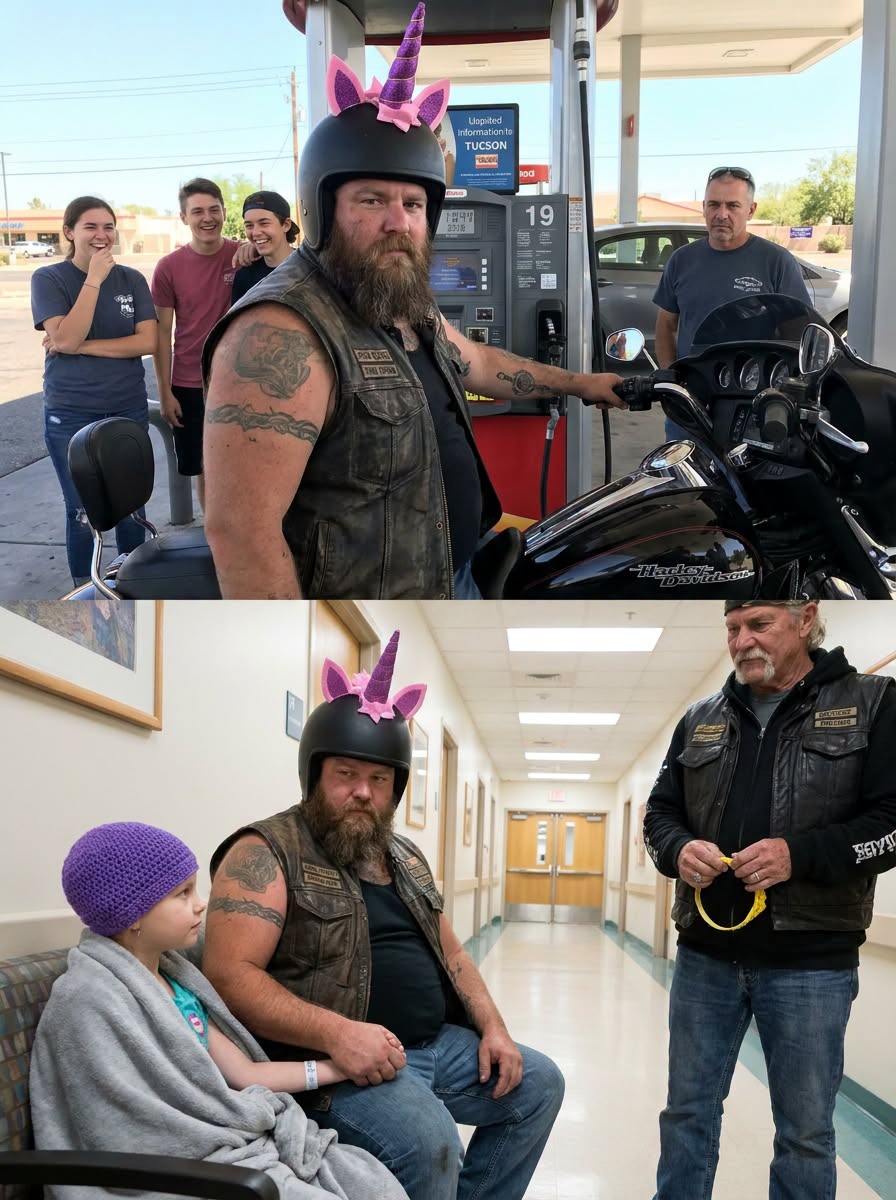
Twenty-Three Tattooed Bikers Laughed When Their 290-Pound Road Captain Walked In Wearing a Homemade Unicorn Horn — Until a Dying Little Girl’s Voice Came Through the Phone and Unearthed an Eleven-Year-Old Secret No One in the Clubhouse Was Ready to Hear
PART 1
The laughter hit me first—raw, rolling, the kind that fills a room when twenty-three hard men decide something is genuinely funny. Then the road captain walked in wearing a unicorn horn, and the sound died the way a engine does when you kill the ignition.
I was that road captain.
The helmet hung under my arm so the horn could not be missed. Nearly ten inches of wrinkled pink foam and silver ribbon rose from the crown, purple glitter still clumped thick along one side where Lily’s small hand had tipped the bottle. It looked absurd against everything else I was: the beard that reached my chest, the faded prison numbers half-hidden under the ink on my left forearm, the burn scar climbing from thumb to wrist, the black leather vest that still carried the ghosts of engine oil, desert dust, and the cigarettes I had quit eight years earlier.
The horn smelled faintly of school glue.
It was Tuesday night at the Iron Vultures clubhouse, an old transmission shop near Tucson’s Miracle Mile. The air conditioner rattled without cooling much. Cold beer sweated on the bar. Outside, twenty-three motorcycles waited under the yellow security lights like patient animals.
I set the helmet on the table. One of the younger riders grinned.
“Ox, you joining a parade?”
Someone else asked whether the horn added horsepower. A third man lifted his phone.
Diesel knocked it out of his hand before the shutter could click.
That should have told me something.
Wade Harlan had ridden beside me for sixteen years. Sixty-one, broad through the shoulders, white beard, a permanently damaged left knee, and the habit of crushing paper coffee cups when something inside him went quiet and dangerous. Everybody called him Diesel because he had kept heavy trucks running for three decades.
He stared at the horn as if it had spoken an insult.
“Take it off before Saturday’s memorial ride.”
“No.”
“Media will be there.”
“Good.”
“We’re escorting a veteran’s widow.”
“I know.”
“You look ridiculous.”
“I know that too.”
The room went still.
I offered no explanation. Lily had asked me to keep the reason between us until she was ready. She was nine. Newly diagnosed with leukemia. Terrified of becoming “the sick girl” everywhere she went. At school she wanted the other children to ask about her unicorn drawings, not why her hair had vanished. At the hospital she wore a purple knit cap and told the nurses she was training to become magical.
Only a few people knew what the horn meant.
The rest saw a spectacle.
For sixty-three consecutive days I had fastened that horn to my helmet before starting the black Road King. I wore it to the towing yard at six in the morning. I wore it to grocery stores, traffic court, tire shops, and every chemotherapy appointment at Banner’s pediatric oncology center. Drivers photographed me at stoplights. A radio host named me “Tucson’s Glitter Outlaw.” Someone turned my image into a meme with a cartoon rainbow blasting from the exhaust. The shop received prank calls. One customer canceled a recovery because he did not want “the circus biker” touching his truck.
I kept wearing it.
The horn had begun in Lily’s hospital room the morning she asked if I was scared. I lied. She saw through the lie before the word finished leaving my mouth.
“Unicorns don’t lie about being scared,” she said. “They’re scared and brave at the same time.”
She made it herself—cereal box, pink foam, ribbon, and the clear plastic tube from a medical dressing package. A child-life volunteer helped with the glue gun, but every crooked line belonged to Lily. When she finished, she held it against my helmet and looked at me with eyes too old for nine.
“Now you can be brave where I can see you.”
I thought I understood. I thought she needed her large, frightening father to look foolish so she would not feel ashamed of the bald head and the bruises and the nights when the ceiling would not let her sleep. I thought the horn was a promise that I would endure strangers laughing if she could endure the needles and the nausea and the mouth sores.
That was only half the truth.
At the clubhouse my phone rang before Diesel could press further. Lily’s nurse. My daughter had spiked a fever during treatment and been moved into isolation.
The nurse placed the phone near her bed.
“Dad?”
“I’m here, Bug.”
“Are you wearing it?”
I looked around the room. Twenty-three men were watching.
“Yeah.”
“Even in front of the club?”
“Especially here.”
Her breath crackled softly through the speaker—thin, careful, as if each word cost something.
“Good. Because I can’t be the brave one tonight.”
No one laughed after that.
Diesel turned away, crushed the empty coffee cup in his fist, and walked out through the garage door without another word. I told myself he was ashamed of having challenged me.
I was wrong.
Two hours later I sat outside Lily’s isolation room, the fluorescent lights humming, the smell of antiseptic sharp in my throat. Diesel appeared in the corridor carrying a locked wooden case he had kept hidden from the club for eleven years. He set it on the plastic chair beside me, unlocked it with hands that were not quite steady, and opened the lid.
Inside lay a child’s drawing of a unicorn—careful, crooked, done in the same pink and purple that now crowned my helmet—and a hospital bracelet bearing a name that was not Lily’s.
His daughter’s name.
That was when I understood the horn had wounded him long before it ever embarrassed him. And that Lily had chosen unicorns for a reason neither of us had yet learned to speak aloud.
PART 2
Diesel didn’t speak at first. He just stood there with the wooden case open between us, the fluorescent lights catching on the old hospital bracelet and the careful, childish lines of the unicorn. The drawing was yellowed at the edges. Someone had folded it once, long ago, and the crease still ran through the creature’s neck like a scar.
I looked at the bracelet. The name was Sarah. The date of admission was eleven years earlier.
“She was eight,” Diesel said finally. His voice had lost the gravel it usually carried in the clubhouse. “Leukemia. Same ward as Lily’s, different wing. They moved the oncology unit years ago, but the smell never really leaves those halls.”
I didn’t answer. Outside the isolation room the monitors kept their soft, relentless rhythm. Somewhere down the corridor a nurse’s shoes squeaked against the linoleum.
Diesel touched the edge of the drawing with one thick finger.
“She made this the week before she stopped talking much. Said unicorns were the only things that could be scared and still keep going. Said they didn’t have to choose. I thought it was just a kid’s way of making sense of the needles and the hair falling out in clumps on the pillow.” He swallowed. “I kept the bracelet. I kept the drawing. I locked them both away the day we buried her and told myself I was done carrying soft things.”
He closed the case slowly, as if the lid itself weighed more than wood.
“When you walked in tonight with that horn on your helmet, it wasn’t the glitter that got to me. It was the fact that another little girl had chosen the same damn creature. And that her father was still walking around with it on his head like it could change anything.”
I stared at the closed case. The glue on Lily’s horn still smelled faintly sweet in my memory. Sixty-three days of wearing it. Sixty-three days of people laughing or taking pictures or looking away. I had thought the hardest part was the mockery. I had been wrong about that, too.
“You never told the club,” I said.
“What was there to tell? That the man they call Diesel used to sit in a pink plastic chair and braid a child’s remaining hair while the chemo dripped? That he used to promise her the horn would keep the bad things away?” He gave a short, humorless breath. “Some things don’t belong in the clubhouse. Some things don’t survive daylight.”
A soft knock sounded against the glass of Lily’s isolation room. The night nurse held up a phone, pointing at me. I stepped closer. Through the intercom her voice came thin and careful.
“Dad… is Diesel still there?”
I glanced at him. He had gone very still.
“Yeah, Bug. He’s here.”
There was a long pause filled only by the soft crackle of her breathing and the distant beep of a monitor.
“Can you ask him something for me?”
“What is it?”
Another pause. When she spoke again her voice was smaller, the way it got when she was trying not to cry and failing.
“Ask him if the unicorns ever get tired of being brave… or if they just get quiet for a while.”
Diesel’s hand tightened on the edge of the wooden case until the knuckles went white. He looked at the closed door of the isolation room as though he could see through it, through the years, through every locked thing he had carried.
I waited.
He didn’t answer right away. When he finally did, his voice was rough enough that I almost didn’t recognize it.
“Tell her…” He stopped, swallowed, started again. “Tell her they get quiet. But they don’t stop. Not all the way.”
I relayed the words. On the other side of the glass Lily was silent for so long I thought the connection had dropped. Then, very softly:
“Okay. Tell him… thank you. And tell him I’m sorry about Sarah.”
The corridor seemed to tilt.
I turned to Diesel. His face had gone the color of old ash. He stared at the phone in the nurse’s hand as if it had spoken a name no living person should have known.
“How the hell does she know that name?” he whispered.
I didn’t have an answer.
But somewhere in the quiet that followed, I understood that the horn on my helmet had never only been about Lily and me. It had opened a door neither of us had meant to touch—and whatever waited on the other side of that door was no longer finished speaking.
PART 3
The silence after Lily spoke Sarah’s name lasted long enough for the fluorescent lights to start buzzing in my ears. Diesel’s face had gone still in a way I had never seen—not angry, not closed, just emptied out.
The night nurse stepped closer to the glass, phone still in her hand. She looked at both of us, then spoke quietly through the intercom.
“She asked about the other unicorn girl last week,” the nurse said. “There’s an old memory book in the playroom. Families sometimes leave drawings or notes. One page has a unicorn almost exactly like the one on your helmet, and the name Sarah written underneath in a child’s hand. Lily found it. She asked if that little girl had been scared too. I told her only that the girl had been very brave, and that her father had loved her very much. I never said the name out loud. Lily must have read it herself.”
Diesel closed his eyes.
I watched the rise and fall of his chest. Eleven years of locked wood and crushed paper cups and silence suddenly made a different kind of sense. He had not been ashamed of the horn. He had been afraid of what it might reopen.
When he finally spoke, his voice was low.
“I put that drawing in the book the week after the funeral. Couldn’t keep it in the house. Couldn’t throw it away either. Thought if I left it there, maybe some other kid would find it and feel less alone. I never once considered that the kid would be yours.”
Lily’s voice came again, softer now, almost sleepy.
“Dad? Is Diesel mad at me?”
I looked at him. He shook his head once, slowly.
“No, Bug,” I said. “He’s not mad.”
“Tell him the unicorns don’t forget each other. Even when they get quiet.”
Diesel’s hand came up and covered his mouth. For a long moment he just stood there, shoulders rigid, the wooden case still under his arm like something he no longer knew how to set down. Then he lowered his hand and stepped closer to the glass.
“Tell her…” He stopped, cleared his throat. “Tell her I heard her. And tell her Sarah would have liked her very much.”
I passed the words along. On the other side of the isolation window Lily was quiet for a while. When she answered, her voice carried the small, careful smile I knew so well.
“Okay. Good night, Diesel. Good night, Dad. Keep the horn on. Just a little longer.”
The nurse ended the call. The corridor settled back into its nighttime hush—monitors, distant footsteps, the soft sigh of the ventilation system.
Diesel and I stood there without speaking. Eventually he opened the case one last time, looked at the drawing and the old bracelet, then closed it again with more care than before.
“I’m not asking you to take the horn off,” he said. “Not for the memorial ride. Not for the media. Not for me.” He met my eyes. “Just… when the day comes that she doesn’t need it anymore, don’t lock it in a box. Leave it somewhere another kid might find it.”
I nodded.
We didn’t shake hands. We didn’t need to. Some understandings live deeper than that.
Later, after Diesel had gone and the night shift changed, I sat alone outside Lily’s room with the helmet in my lap. The pink foam horn looked even more ridiculous under the hard hospital lights—crooked, glitter-flecked, made by small hands that still believed magic and courage could share the same space.
I thought about Sarah, and about Lily, and about the long line of fathers who had sat in these same plastic chairs learning how to be scared and brave at the same time. I thought about the way a child’s drawing could travel eleven years and still arrive exactly where it was needed.
Outside, the desert night pressed against the windows. Somewhere beyond the parking lot, the Road King waited under the yellow lights, ready for another morning of stares and photographs and quiet, stubborn refusal to look away.
I would keep wearing the horn.
Not only for Lily.
For the ones who had gone quiet.
And for the ones still learning how to stay.
THE END