THE HIGH-STAKES CRIME DRAMA THAT PUT JULIANNE NICHOLSON IN SUSPENSE, SMALL-TOWN SECRETS, AND UNTOLD BETRAYAL
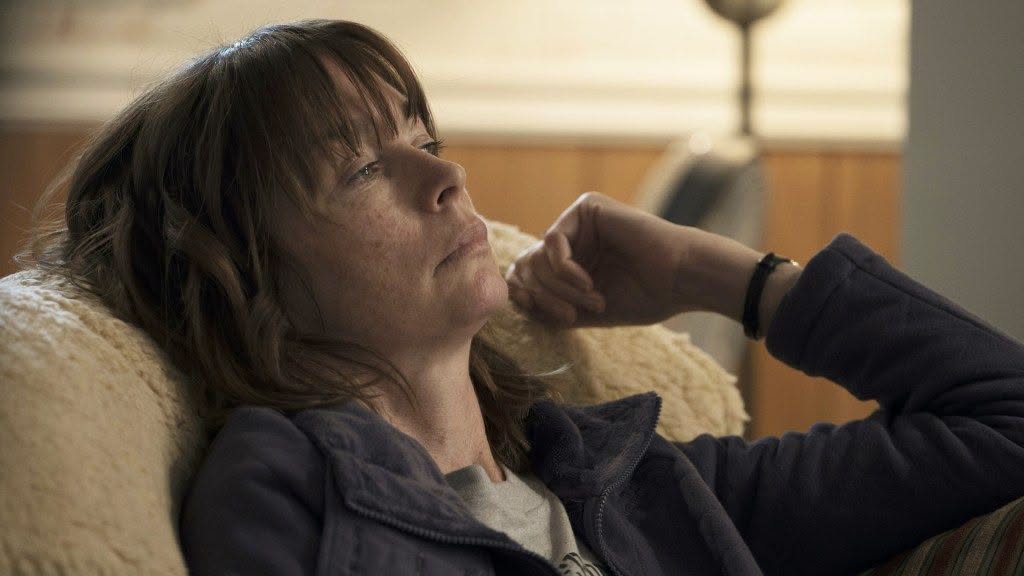
When the search for the killer leads straight to your own living room. Julianne Nicholson captures the devastating emotional breakdown of a woman torn between friendship and blood. The silent confession written across her face right after this frame proves that some truths cut deeper than any crime scene.
In the gray, rain-slicked streets of Easttown, Pennsylvania, HBO’s 2021 limited series Mare of Easttown does not merely investigate a murder. It dissects the quiet rot that festers beneath the surface of a working-class community where everyone knows everyone, and no one is ever truly a stranger. What begins as a detective story about the killing of a young teenage mother quickly becomes something far more intimate and cruel: a portrait of loyalty tested to its breaking point.
At the center of this moral earthquake stands Julianne Nicholson as Lori Ross. On paper, Lori is the supportive best friend—the steady presence in the chaotic life of Detective Mare Sheehan (Kate Winslet). She is the one who shows up with coffee, who listens without judgment, who holds the line when Mare’s world threatens to collapse under the weight of her own unresolved grief. For much of the series, Lori appears to be the character who has her life most under control. Her house is warmer. Her marriage, for all its quiet fractures, still holds. Her children are still at home. In a town defined by loss, Lori seems to have held on to something solid.
That solidity is an illusion.
As Mare digs deeper into the murder of Erin McMenamin, the investigation begins to circle closer and closer to the people Mare knows best. The deeper the detective goes, the more the line between professional duty and personal loyalty dissolves. Clues that once pointed outward begin pointing inward—toward family gatherings, shared secrets, and the kind of protective instincts that can turn ordinary people into co-conspirators. The question that haunts the final stretch of the series is no longer simply “Who killed Erin?” but something far more devastating: How far will you go to protect the people you love when the truth threatens to destroy them?
Nicholson’s performance is a masterclass in restrained devastation. She does not play Lori as a schemer or a villain. She plays her as a woman who has spent years holding everything together with quiet competence, only to discover that the foundation beneath her feet was never as secure as she believed. When the weight of the secrets finally becomes unbearable, the collapse is not loud or theatrical. It is quiet. It is physical. It is the kind of breakdown that happens when a person has exhausted every last resource of denial.
There is a moment—captured in a single, unforgettable frame—when the truth settles across Lori’s face. No grand speech is required. No monologue is necessary. The confession is written in the sudden emptiness behind her eyes, in the way her body seems to lose its ability to hold itself upright. Friendship and blood collide in that instant, and Nicholson makes the collision feel almost unbearable to watch. Viewers have described the sequence as one of the most emotionally precise pieces of acting in recent television: not because it is showy, but because it is so painfully recognizable. This is what it looks like when a person realizes that the life they thought they were protecting has already been lost.
The series refuses to offer easy answers or tidy moral victories. Mare’s pursuit of justice is not presented as pure heroism; it is messy, compromised, and deeply personal. Lori’s choices are not framed as pure betrayal; they are the desperate calculations of a mother and wife trying to keep her family from disintegrating. In Easttown, love and damage are rarely separate. The same bonds that sustain people also trap them. The same loyalty that makes someone a good friend can make them complicit in something unforgivable.
What makes Nicholson’s work so powerful is the way she charts the slow erosion of trust. Early episodes establish Lori as Mare’s emotional anchor. Later episodes show that anchor beginning to drag. The friendship that once felt like the one solid thing in Mare’s life becomes the very relationship under the greatest strain. When the investigation finally reaches Lori’s doorstep—when the search for the killer quite literally leads into the living room of the person Mare trusts most—the series stops being a procedural and becomes something closer to a tragedy of intimacy.
The performances around Nicholson elevate the material further. Winslet’s Mare is all sharp edges and buried pain, a woman who has survived by refusing to look too closely at her own wounds. Jean Smart, as Mare’s sharp-tongued mother, provides both comic relief and unexpected depth. The supporting cast fills Easttown with the kind of lived-in specificity that makes the town feel real enough to hurt. But it is Nicholson who carries the emotional center of the final act. Her scenes in the closing episode have been widely praised as the series’ most devastating, and for good reason. She does not simply react to the plot; she embodies the cost of it.
Mare of Easttown understands something essential about small-town crime stories: the most dangerous secrets are rarely the ones kept by strangers. They are the ones shared across kitchen tables, whispered in bedrooms, protected out of love until the protection itself becomes a form of violence. The series is less interested in the mechanics of the crime than in the human wreckage left behind when the truth finally surfaces. It asks what happens when the person you would do anything to protect is the same person whose actions force you to choose between silence and justice.
By the time the final revelations arrive, the question is no longer who pulled the trigger. The deeper question is how two women who have known each other for decades will survive the knowledge of what one of them was willing to do—and what the other was willing to uncover. The silent confession on Lori’s face is not merely the acknowledgment of a crime. It is the recognition that some bonds, once broken in a certain way, can never fully heal. Friendship and blood do not always reinforce each other. Sometimes they tear in opposite directions, and the person standing in the middle is left holding the pieces.
Five years after its release, Mare of Easttown still lingers in the cultural memory not because of its plot twists alone, but because of the precision with which it captures the cost of those twists on the people forced to live with them. Julianne Nicholson’s performance remains the series’ quiet triumph: a portrait of a woman who discovers too late that the search for justice has come home, and that the most devastating confession is the one that never needs to be spoken aloud. The look on her face says everything. In Easttown, that is more than enough.