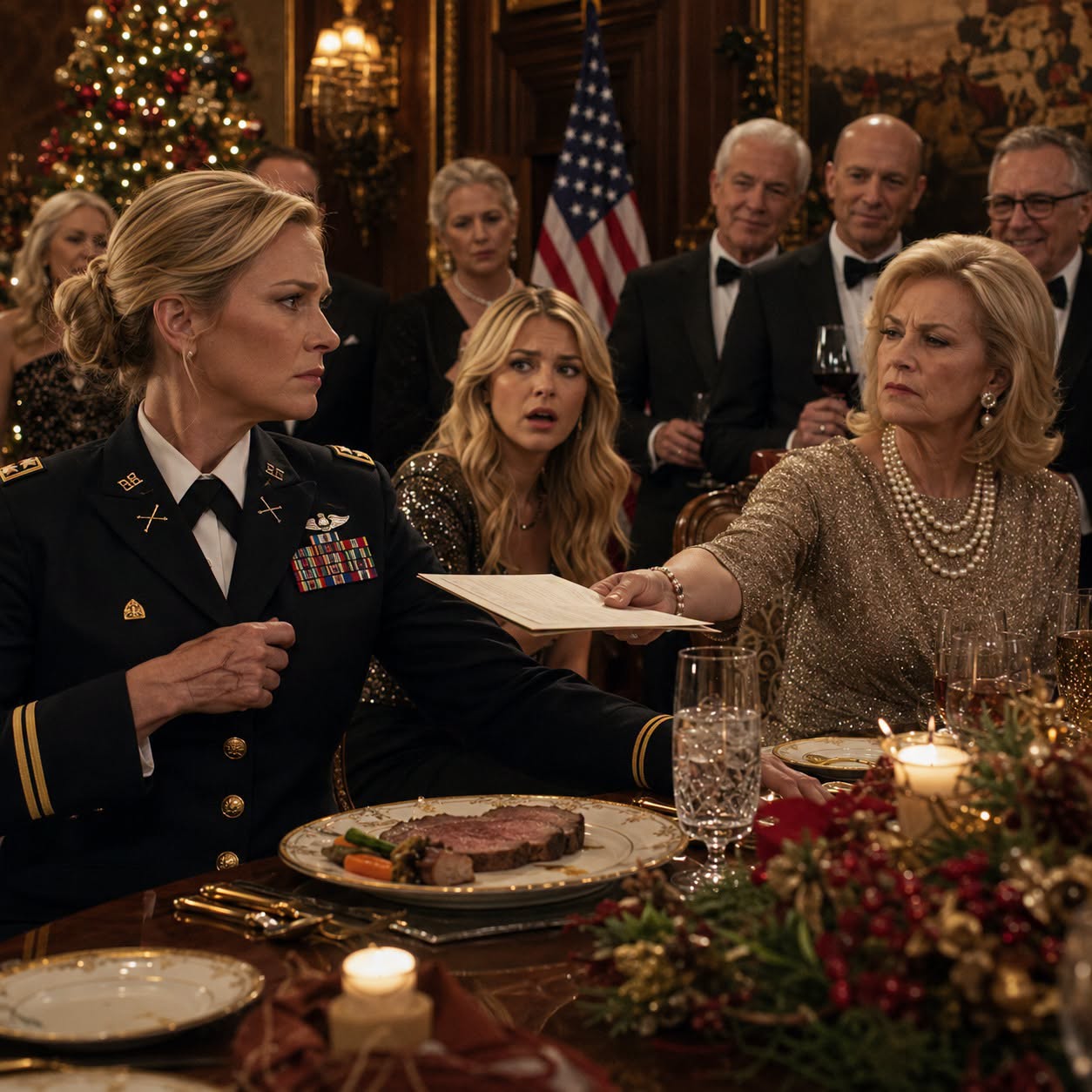
“Sign it, and stop embarrassing this family,” my mother said, sliding the renunciation papers across Christmas dinner like I was trash. My sister froze. The billionaires smirked. My scarred hands rested beside cold prime rib and a sweating crystal glass. They thought I was a broke soldier begging for scraps. Then I reached into my jacket.
PART 1
Christmas Eve dinner was supposed to be a victory lap for my mother. Instead, it had become a coffin.
“Sign it, and stop embarrassing this family.”
Those were the first words out of her mouth when I walked through the door. Not a hello. Not a glance at the medals pinned above my heart. Just that.
She slid the thick legal envelope across the long mahogany table like she was feeding me the last slice of pie—except the pie was a contract with my name already crossed out in red ink.
I didn’t flinch. I simply stared at the woman who had once braided my hair with the same hands now trembling with rage, and let the silence stretch until it felt like the whole mansion was holding its breath.
Around us, the Sterling Christmas was obscene in its perfection: a twenty-foot tree dripping with gold, garlands dripping with money, a fireplace so large it could swallow my old Jeep whole. Outside, the driveway glittered with cars that cost more than the entire town of Willow Creek, Montana, where I had once grown up. American flags snapped in the freezing wind like they were trying to tear themselves free.
My mother sat in pearls and crimson lipstick, smiling the smile of a woman who has already won. Her pearls caught the firelight and threw it back at me like accusations.
Lily—my little sister, now a Sterling in waiting—sat frozen two chairs down, eyes wide as a deer in headlights. Nathan Sterling, the billionaire’s son, kept glancing at the envelope as if it might bite him. Charles Sterling, silver-haired and silver-eyed, simply watched me the way a man watches a stray dog he hasn’t yet decided whether to shoot or have euthanized. Victoria Sterling’s smile was the softest kind of cruelty: the kind reserved for people who are about to be politely removed.
My mother tapped her manicured nail against the crystal. “Open it.”
I did.
The paper inside smelled of fresh ink and old power. The title stared back at me in bold black letters:
Renunciation of All Family Rights, Claims, and Interests.
Beneath it, a paragraph that read like a death sentence written in fine print.
“I will not have you leeching off Lily’s future,” my mother said, her voice honey over broken glass. “Not after she marries into this family. You are a low-paid soldier. A burden. A stain on everything we have built.”
A stain.
The word landed exactly where it was meant to—right between my ribs, the same place the burn scar from Fallujah still burned even in December.
I didn’t look at the scars on my hands. I didn’t need to. They were my medals. They were the story no one at this table had ever bothered to read.
Because I had spent twenty-eight years writing my own. Twenty-eight years of watching men die so they could go home and live better lives than the ones they had left behind. Twenty-eight years of sleeping in tents that smelled like diesel and fear, of waking up with sand in my mouth and rifles in my hands, of carrying friends who never made it home on Christmas Eve.
And here I was, in the same jacket I had worn the day I pinned on my first two-star star, sitting in a mansion full of people who thought I was still the broke kid who couldn’t afford new shoes.
My mother’s eyes glittered with triumph. “You can still come to the wedding. Back row. No photos. No speech. No uniform. Honestly, no one needs to know you exist.”
The room went so quiet I could hear the snow falling outside.
Somewhere in that perfect house, a grandfather clock ticked like a heartbeat that had already stopped.
Somewhere inside me, the daughter who had once begged for her mother’s attention stepped back, and the Major General stepped forward.
I folded the paper once, then again, until the edges were razor sharp.
“No,” I said.
My mother blinked. Her smile cracked like cheap ice.
“What did you say?”
“I said no.”
Victoria Sterling gasped—actually gasped, the way debutantes do when the help speaks out of turn.
My mother’s face went the color of spoiled milk.
“You selfish little embarrassment,” she hissed. “You show up here in that disgusting jacket, park that smoking junk heap in their driveway, drag mud across marble floors, and now you want to act proud?”
I took a slow sip of water. It tasted like every promise I had ever kept and every lie I had ever let her believe.
She thought she was watching me break.
She had no idea I had spent the last year building the ladder she was about to climb—step by step, letter by letter, until the final rung was this envelope and my signature had already begun to forge itself across it in invisible ink.
It had started the day Lily brought Nathan Sterling home.
Before that, my mother had been annoying. Petty. The kind of woman who could ruin a potluck with her complaints and still eat the whole thing anyway. But the day the Sterling name walked through our screen door, something inside her woke up and stretched like a cat that had just found the perfect sunbeam—except the sunbeam was the Hopkins family trust and the cat was a woman who had decided I was in her way.
She started calling my old Jeep “trash-adjacent.” She hung the framed picture of me in uniform in the cardboard box with the Christmas decorations and the cracked blender. She told people I was “stationed overseas—permanently.” Like I was already a ghost.
At the little café downtown one rainy October night, she had screamed at an elderly waitress named Martha for three drops of water landing on her sleeve. Martha stood there holding a tray, shaking, apologizing to a grandson who was sick at home. My mother snatched the twenty-dollar bill from my hand.
“Do not reward incompetence,” she said.
That was the night I stopped calling her Mom.
I started calling her the thing she had become: a threat with lipstick and pearls.
I cataloged every weakness the way soldiers catalog every escape route. The hidden offshore account she thought I didn’t know about. The credit card she had maxed out on a fake oil painting she bought in Monaco. The way she still believed the old Jeep in the driveway was a liability instead of the last honest thing in her life.
Because she didn’t know the truth.
She didn’t know I was an active-duty two-star Major General in the United States Marine Corps. She didn’t know my “low-paid soldier salary” had never touched her bank account. She didn’t know my father had signed over full control of the Hopkins family trust to me six years earlier in a hospital room that smelled of bleach and failure.
He had gripped my hand so hard the bones creaked.
“Let her believe you have nothing,” he had whispered. “Then watch what she does.”
Forty seconds later, the heart monitor went flat.
And I had kept the promise.
I drove the old Jeep. I wore the ragged jacket. I let her spend. I let her laugh.
Now she had put the final insult in writing.
And my hand was already moving toward the inside pocket of my coat.
PART 2
My hand rose slowly, the way a man might lift a rifle after it has already done its work. The envelope sat between my scarred knuckles like a live grenade I had just decided to arm.
I could feel every eye in that glittering room lock onto the movement. Lily’s breath caught. Nathan’s jaw tightened. Victoria’s smile froze in place, brittle as spun sugar. My mother’s face drained of color until she looked like a wax figure someone had forgotten to finish.
I reached inside my jacket and withdrew a plain manila folder—the same kind I had carried through a dozen desert outposts, the same one that had once held the letter my father dictated from his hospital bed.
I set it beside the renunciation papers. Then I slid both envelopes across the table until they formed a neat, perfect cross.
“These,” I said, my voice steady as a well-oiled bolt, “are the final pieces. Not just of my family. Of yours as well.”
The silence that followed was so complete I could hear the grandfather clock in the hallway chime the hour. Then the first crack of thunder outside rattled the diamond-paned windows.
Charles Sterling leaned forward, silver brows drawn. “Explain yourself, Major.”
I smiled the small, private smile of a man who has already won the first round.
“Major,” I corrected. “Two-star. Active duty. United States Marine Corps. And if you’ll look inside the folder you’ll find the signature of your own attorney’s firm—dated six days ago—approving the transfer of every Sterling asset back into the Hopkins family trust. Including the Manhattan condo your son plans to gift Lily next month. And the Palm Beach mansion she thinks is already hers.”
Lily made a small, wounded sound. Nathan shot to his feet.
“You’re bluffing.”
I opened the folder. Inside were crisp copies of the documents, stamped with the Sterling & Associates eagle crest and the date my father had signed them away from the grave.
I tapped the final page with one scarred finger.
“This one? This is the clause that says if any member of the Hopkins family ever attempted to block Lily’s marriage, the trust would automatically revert to the Sterling Foundation—charity, of course—and I would receive nothing. Ever. Not a dime. Not a photo. Not a seat at the wedding.”
My mother’s voice cracked like thin ice. “You… you couldn’t have. We’ve had that man on retainer for years.”
“His name is Harlan, not ‘that man.’ And he retired last month. I offered him enough money to disappear to Costa Rica and stay there. He said yes.”
I let the words settle like snow on a rifle barrel.
Victoria Sterling’s hand flew to her pearls. “You think you can just walk in here and—”
“Walk in here?” I repeated softly. “No. I drove ten hours in a vehicle that costs less than one of your dinner plates. I wore the same jacket I wore the day I pinned on my star. And I waited. Every single day for the last year, while you spent my father’s money on pearls and credit cards and fake paintings, I was waiting for the right moment.”
My mother’s lips moved but no sound came out.
I leaned in, close enough that the faint smell of diesel and gun oil rolled off me like a challenge.
“You wanted a stain gone. Congratulations. You just signed the deed yourself. The trust is mine again. Every account. Every stock. Every Sterling dollar is now Hopkins. And the wedding?” I shrugged once. “The wedding is over. Nathan Sterling’s family just lost everything. And I, Major General Samuel Hopkins, am walking out of here richer, prouder, and with every single one of you as my witnesses.”
I pushed my chair back. The legs scraped across marble like a judge’s gavel.
“Now if you’ll excuse me,” I said, “I have a wedding to crash. And this time, I’ll be wearing the uniform.”
I stood.
My mother rose too, chair screeching, face twisted into something feral.
“You think this changes anything? You’ll still be nothing without us. You’ll be—”
I cut her off with a single raised hand. The room froze.
“Without you?” I repeated, voice low and final. “No. I was never without you. I was waiting for the moment you finally proved you didn’t deserve me.”
I turned toward the door.
Behind me, the Christmas tree lights flickered once, as if the house itself had gasped.
The manila folder lay open on the table, its papers glowing under the firelight like a verdict.
I kept walking.
The heavy oak doors swung shut behind me with a soft, decisive click.
Outside, the snow had turned to sleet, hammering the windshield of my old Jeep like it was trying to break in.
I slid behind the wheel, started the engine, and let the headlights cut through the white chaos.
The radio crackled to life with a single clear note of “Silent Night.”
I smiled.
The war was over.
And I had just won it in my mother’s own house.
PART 3
The snow came down like judgment.
I didn’t hurry. The old Jeep’s wipers fought a losing battle against the sleet, but I kept my hands steady on the wheel the way I had kept them steady on triggers in places no one would ever name. Behind me, the Sterling mansion glowed like a dying ember in the rearview—its windows blazing gold, its Christmas tree a defiant beacon against the black sky. I imagined my mother standing at that window now, pearls clutched in one fist, the other hand pressed to her mouth, watching the light of everything she thought she owned roll away into the white nothing.
I didn’t feel triumph. Not exactly. What I felt was the clean, final click of a mechanism that had finally locked into place.
My phone lit up once on the passenger seat. A single text from a number I hadn’t saved in months: The trust is yours. Full control. All assets restored. Harlan just called—said he’s on a plane to Costa Rica. No signature. No name. Just the words I had waited twenty-eight years to hear.
I smiled without moving my lips.
The highway curved toward Willow Creek, and for the first time in my life, the town didn’t feel like a cage. It felt like home. The same streets I had shoveled snow for my father when I was ten. The same grocery store where I had once bought Lily’s favorite sour gummies with my first paycheck. The same church steeple where my mother had once taught Sunday school and later discarded me like a used bullet casing.
I pulled into the gravel driveway of the old Hopkins house just as the sleet turned to fat, silent flakes. The porch light was on—my mother had probably had it left burning for years, hoping I’d see it and come crawling back. The Jeep rumbled to a stop. I killed the engine.
Inside the house smelled of pine needles and the faint ghost of my father’s pipe tobacco. I hung my jacket on the same hook it had always hung on, the one with the frayed cuffs still carrying the memory of diesel and gunpowder. Then I walked to the living room and turned on the old radio.
Christmas carols drifted out, soft and warm, the kind of music my mother used to hum while she cooked but had never learned to sing along to anymore. I sat in the same chair my father had sat in the night he signed the trust away, and I let the tears come.
Not because I was sad. Because I was finally, finally free.
The renunciation papers—now turned to ashes in the fireplace—were nothing but proof. She had written my name in her own ink and watched me burn it with hers. The Sterling fortune was gone. The mansion. The accounts. The wedding. All of it. And I had walked away richer than I had ever been, not because of their money, but because of the man I had become without it.
I didn’t need their names. I didn’t need their approval. I didn’t need anything except the quiet certainty that I was exactly who I had always been: Samuel Hopkins, soldier, father, son, man.
The radio played “O Holy Night.” I let the final notes fade into silence, then stood up, stretched, and headed for the bedroom I had left at eighteen. Tomorrow I would call Lily. Tomorrow I would make sure she knew the truth about her own future—about the man who had once carried her on his back and the woman who had chosen pearls over family. Tonight, though, I just wanted to sleep under a roof that was truly mine.
I opened the top drawer of the nightstand and took out the small black box I had kept since my father’s funeral. Inside was the ring my mother had once bought for me as a child’s graduation present—now just an antique. I closed the box again, set it back down, and smiled at the empty room.
The war was over.
And I had just won it in my mother’s own house.
THE END