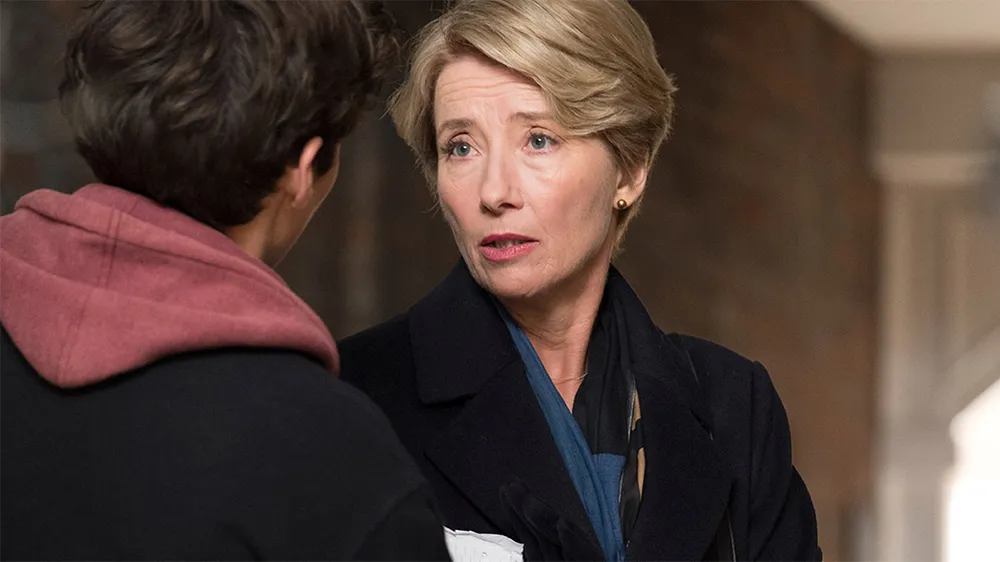
THE SHOCKING NETFLIX DRAMA MOMENT THAT LEFT EVERY VIEWER IN MORAL SHOCK
A judge’s forced order. A shattered belief system. And the haunting price of saving a boy against his own will.
On Netflix, Emma Thompson and Fionn Whitehead deliver a devastating clash between law and faith. One frame in particular has left audiences staring at the screen in silence: the moment a High Court judge looks into the eyes of the teenager she has legally forced onto a hospital bed. The Children Act captures the heartbreaking fragility of a young soul in distress. The final plea spoken right after this frame shows just how fragile the line is between protection and violation.
The film, adapted by Ian McEwan from his own novel and directed by Richard Eyre, opens on the carefully ordered world of Fiona Maye, a brilliant and emotionally restrained High Court judge in the Family Division. Emma Thompson plays her with the quiet intensity of a woman who has spent decades deciding other people’s most intimate crises while her own marriage quietly unravels. Stanley Tucci appears as her husband, a man who has grown tired of being the secondary character in his wife’s life of principle and procedure. Their private collapse runs parallel to the public case that will define her.
That case arrives like an emergency. A seventeen-year-old boy named Adam Henry is dying of leukaemia. Doctors insist that a blood transfusion is the only way to keep him alive long enough for treatment to work. Adam and his parents are Jehovah’s Witnesses. To them, accepting blood is a direct violation of scripture. Adam is three months short of his eighteenth birthday. Legally, he is still a child. The hospital asks the court to authorise the transfusion against the family’s wishes. Fiona must decide whether the state’s duty to protect a minor’s life outweighs the boy’s right to follow his faith, even if that faith will kill him.
What follows is not a dry legal argument. Fiona does something unusual. She leaves the courtroom and goes to the hospital.
The scene that has stunned viewers is quiet, almost intimate. Emma Thompson’s Fiona sits beside Fionn Whitehead’s Adam in a hospital room that feels both sterile and sacred. The boy is pale, intelligent, and frighteningly composed. He plays music. He recites poetry. He speaks about his beliefs without the feverish intensity of a fanatic and without the uncertainty of someone merely repeating his parents’ words. He understands that refusing the transfusion may not only end his life but leave him damaged if he survives. He says he would accept that cost. The camera holds on their faces as Fiona tries to determine whether this is genuine autonomy or carefully cultivated obedience. The conversation is civil. The emotional stakes are anything but.
When Fiona returns to court, she rules that the treatment must proceed. The law, she says, places the child’s welfare as the paramount consideration. Adam will receive the blood. He will live. At least for now.
That decision is the forced order at the centre of the film’s moral shock. Viewers have described feeling the weight of it in their bodies. Some side instinctively with the judge: a child cannot be allowed to die for a belief system he has not yet had the freedom to question. Others feel the opposite: what does it mean to “save” someone by destroying the core of who they believe themselves to be? The film refuses to offer an easy answer. It simply lets the consequences unfold.
Adam survives the initial crisis. The transfusion works. He leaves hospital. And then the real complication begins. The boy who was once prepared to die for his faith has been forced to live with a decision made for him by a stranger in a black robe. Something shifts inside him. He begins to reach toward the woman who ordered his survival. Letters. Visits. An attachment that is part gratitude, part confusion, part something more unsettling. Fiona, already struggling with the collapse of her marriage, finds herself drawn into a relationship that has no clear legal or emotional boundaries. The judge who believed she was acting in a child’s best interests now confronts the possibility that she has altered the course of a young life in ways she cannot control or fully understand.
Thompson’s performance is surgical. She never raises her voice. She never begs for sympathy. She simply carries the accumulating weight of every decision until the cracks begin to show. Whitehead, in one of his earliest major roles after Dunkirk, matches her with a quiet intensity that makes Adam’s vulnerability almost unbearable to watch. Their scenes together are the emotional core of the film. Two people on opposite sides of an impossible question, both changed by the encounter.
The film does not stop at the hospital bed or the courtroom ruling. It follows the longer, quieter aftermath. What happens when a young man who was ready to die for God is forced to keep living? What happens when a judge who has always believed in the clean authority of the law is forced to live with the messy human results of her judgment? The final sequences bring these questions to a point of almost unbearable clarity. The “final plea” referenced in the caption is not theatrical. It is quiet, personal, and devastating. It arrives after the legal battle is supposedly over, when the real cost of survival becomes visible.
The Children Act is not a courtroom thriller in the conventional sense. There are no shouted objections or last-minute revelations. Its power comes from the accumulation of small, carefully observed moments: a judge singing along to a folk song in a hospital room, a husband asking for something his wife can no longer give, a teenager discovering that the world is larger and more complicated than the faith that once defined him. The moral shock is not that the system intervenes. It is that intervention, even when motivated by the purest desire to protect, can leave permanent marks on everyone involved.
Streaming on Netflix, the film has found a new audience years after its original release. Many viewers come for Emma Thompson’s performance and stay for the ethical discomfort that lingers long after the credits. In an age when public debate often reduces complex questions to slogans, The Children Act insists on the difficulty of the terrain. It asks what we mean by “best interests.” It asks whether a child’s right to life can ever be cleanly separated from the beliefs that give that life meaning. And it refuses to let either side walk away feeling entirely righteous.
The image that stays with people is the one described in the caption: a judge looking into the eyes of the boy she has ordered to live. In that moment, the law has spoken. The body will be treated. The blood will flow. But something essential between them has already begun to shift, and neither of them will leave that room unchanged.
The final plea that follows is not a legal argument. It is a human one. And it is the reason so many viewers have sat in silence after the film ends, still turning the question over in their minds: when we force someone to survive, what exactly have we saved?