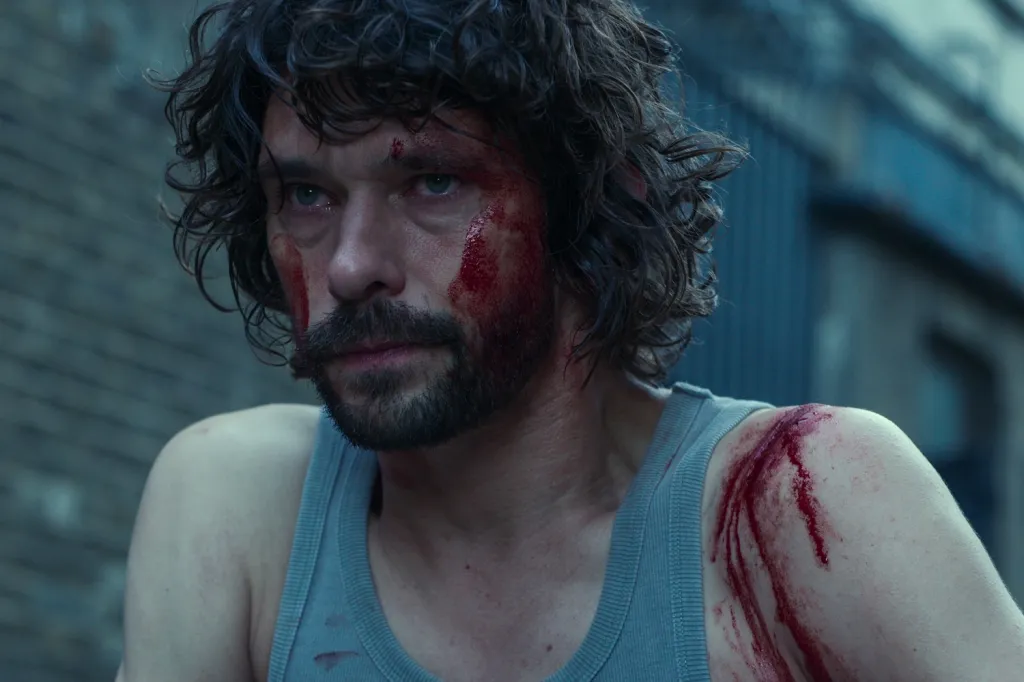
NOW STREAMING ON NETFLIX: BEN WHISHAW IN A DARK, UNFORGIVING REVENGE DRAMA!
Covered in blood, battered to the brink, yet far more lethal than his attackers realized. On Netflix, Ben Whishaw’s chilling portrayal of Sam turns a brutal fight for survival into a masterclass in psychological warfare. Look past his severe injuries—the terrifying secret hidden behind his icy stare was…
In the blood-slicked underbelly of a London Christmas, where fairy lights glitter against the rain-streaked windows of government townhouses and shadowy alleys, one man emerges from the carnage looking like he should be dead. Instead, he is the deadliest thing in the room.
Ben Whishaw has always possessed a rare gift for quiet intensity. As Q in the Bond films he was the soft-spoken genius behind the gadgets. As the voice of Paddington he radiated gentle warmth. In Black Doves, the six-part spy thriller now streaming in full on Netflix, he discards both personas and steps into something far colder, far more dangerous. His Sam Young is a hired assassin who drinks champagne like water, calls almost everyone “love,” and carries a private grief that never quite leaves his eyes. When the series forces him into a corner, bloodied and cornered, Whishaw turns that familiar vulnerability into something terrifying.
The premise is deceptively simple. Helen Webb (Keira Knightley), the polished wife of the Defence Secretary and mother of twins, has spent a decade living a double life. By day she hosts Christmas parties and smiles for the cameras. By night she feeds secrets to a private intelligence organisation known as the Black Doves—mercenaries who sell industrial, political and diplomatic intelligence to the highest bidder. When her lover is gunned down in a London park, the carefully constructed walls of her existence begin to crack. Her handler, the steely Reed (Sarah Lancashire), does what any good spymaster would do: she calls in the one person capable of keeping Helen alive.
That person is Sam.
Sam arrives from exile in Rome with the weary air of a man who has already buried too many versions of himself. He is not the swaggering action hero of traditional spy fare. He is slight, soft-spoken, openly gay, and still half-haunted by the relationship he fled years earlier. Yet when the violence comes—and it comes with sudden, shocking force—Sam transforms. One sequence in particular has already lodged itself in the minds of early viewers: Sam, face and clothes soaked in blood, body absorbing blows that would floor a larger man, staring down his attackers with an expression that is almost calm. The icy stare Whishaw gives the camera in those moments is not the look of a man fighting for survival. It is the look of someone who has already calculated every possible outcome and decided which one he prefers.
That is the terrifying secret the caption hints at. Sam is not merely skilled with a gun. He understands the architecture of fear. He knows how to make an opponent hesitate for half a second too long. He knows when to speak softly and when silence itself becomes a weapon. In Black Doves, the physical violence is only the surface. Beneath it runs a current of psychological warfare that Whishaw plays with surgical precision. Every glance, every carefully measured breath, every quiet “love” delivered like a blade becomes part of the arsenal.
Created by Joe Barton (Giri/Haji, The Lazarus Project), the series refuses to stay in any single lane. It is a Christmas story soaked in blood. It is a workplace drama about the ethics of selling secrets. It is a love story—though not the romantic kind most audiences expect. The deepest relationship on screen is the long, complicated friendship between Helen and Sam, two people who have known each other since the days when both were still learning how to kill without flinching. Knightley and Whishaw share a chemistry that feels lived-in and slightly dangerous. They argue, protect each other, and occasionally look at one another as if measuring how much of the truth the other can still bear.
The supporting cast is equally sharp. Sarah Lancashire’s Reed is a study in controlled menace, all expensive coats and unblinking judgment. Kathryn Hunter, as the crime boss Lenny, brings a gravel-voiced, almost maternal ruthlessness that makes every scene she enters feel unstable. Around them swirl politicians, Chinese diplomats, young assassins with too much enthusiasm, and the ordinary Londoners who have no idea how close the violence is sitting to their festive tables.
What elevates Black Doves above standard spy entertainment is its refusal to let the audience look away from the cost. Sam’s past is not glamorous. Flashbacks reveal a young man forced into an impossible first kill, a moral line he would not cross years later, and the personal price that decision exacted. When present-day Sam is dragged back into the world he tried to leave, the blood on his face is not just makeup. It is history repeating itself with interest.
Whishaw has spoken about the appeal of playing a queer hitman who is neither a stereotype nor a tragic figure. Sam is competent, funny in a dry, almost flippant way, and capable of sudden, decisive violence. He is also a man who still checks his phone for messages from the life he abandoned. That tension—between the professional killer and the private human being—gives the performance its particular chill. When Sam is covered in blood and still standing, the audience is not meant to cheer the body count. They are meant to wonder what it costs a person to remain that controlled while the world around him turns red.
Netflix released all six episodes of the first season on 5 December 2024, perfectly timed for the Christmas binge. The series has already been renewed, with production on season two underway and new names joining the cast. Yet the first season stands complete on its own: a self-contained story of loyalty, betrayal, and the peculiar intimacy that forms between people who have seen each other at their most lethal.
There is a particular shot, late in the run, that crystallises everything Whishaw brings to the role. Sam sits in a quiet room, face still marked by the earlier violence, eyes fixed on something the camera does not show. The blood has dried. The fight is over. And yet the expression on his face suggests the real battle never ends. It simply changes shape.
That is the power of the performance at the centre of Black Doves. Ben Whishaw does not play a superhero assassin. He plays a man who has learned that survival sometimes requires becoming the most dangerous person in the room—and that the price of that knowledge is a permanent coldness behind the eyes.
The series is available now on Netflix. Viewers who start watching for the star power of Knightley and Whishaw may find themselves staying for the quieter, more unsettling question the show keeps asking: once you have learned to look at the world the way Sam does, is there any way back to the person you were before the blood?
In the end, the most chilling secret behind that icy stare may not be what Sam is capable of doing to others. It may be what he has already done to himself in order to keep doing it.