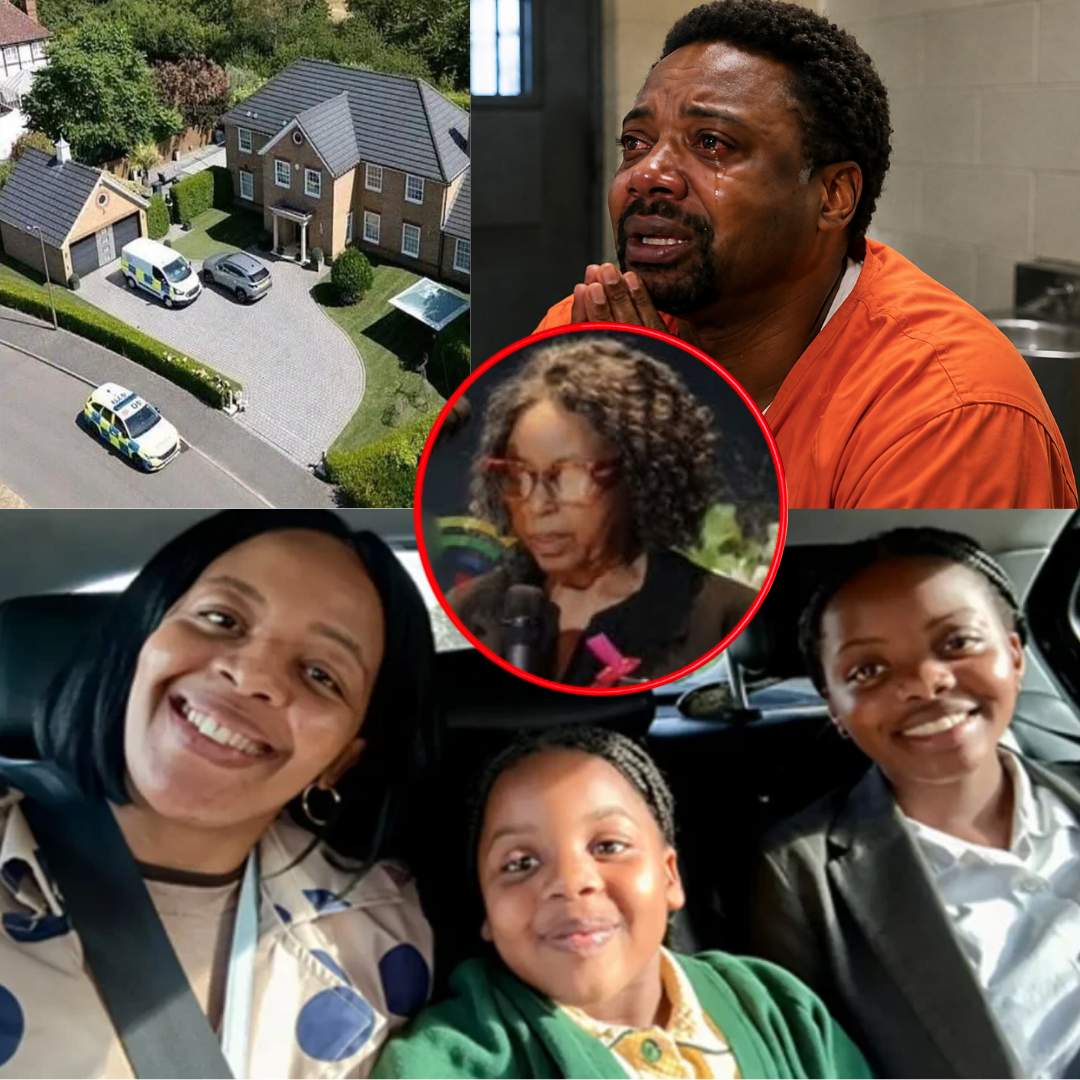
TSHUMA’S GRANDMOTHER FINALLY BREAKS SILENCE: “HE WAS DEFINITELY FORCED!”
In a development that has sent fresh shockwaves through one of the most harrowing familicide cases of recent years, the grandmother of Ndodana Mkhanyisi Tshuma has broken her long silence with an emotional and explosive claim that completely reframes the narrative surrounding the brutal deaths of his wife and two young daughters.
Speaking with a trembling voice that cracked under the weight of grief and conviction, the elderly woman insisted that her grandson was not acting of his own free will when the unthinkable occurred inside the family’s £1.3 million home in Great Denham, Bedfordshire. “He was definitely forced,” she declared. “My boy was under severe coercion and threat. This was not the man I raised. Something dark was done to him in the days before.”
The statement, delivered in a private setting before being shared with selected contacts, marks the first time a senior member of the Tshuma family has publicly addressed the events that left Nothabo Zandile Tshuma, 42, and her daughters Natalie, 15, and Nala, five, dead from blunt force trauma. Their bodies were discovered on 6 July 2026 after concerned relatives and neighbours raised the alarm when the family had not been seen for several days. Police forced entry and launched a murder investigation that quickly identified the girls’ father and Zandile’s husband as the prime suspect.
Ndodana, also known as Mark, had already fled the United Kingdom. CCTV captured him at Heathrow Airport on 4 July boarding a flight that ultimately took him to South Africa via Dubai. An international manhunt involving Bedfordshire Police, the National Crime Agency, Interpol and authorities in Zimbabwe and South Africa ended with his arrest in the Kensington suburb of Johannesburg on 10 July. British prosecutors swiftly authorised three counts of murder. He also faces a separate South African charge of unlawful possession of a firearm, which investigators believe he acquired shortly after arrival, possibly intending to take his own life.
Until now, the Tshuma side of the family has largely remained tight-lipped. Patricia Tshuma, the suspect’s mother, previously declined detailed comment when approached by journalists, stating only that she would speak to the relevant authorities. The silence stood in stark contrast to the open anguish expressed by the Khumalo family, Zandile’s relatives, who have spoken of their “unimaginable loss” and publicly criticised the Tshumas for failing to offer a traditional apology or formal condolences in the cultural manner expected.
The grandmother’s intervention changes the emotional temperature of the case. In her account, she painted a picture of a man under extreme pressure in the final days before the killings. She claimed that an unknown individual had approached Ndodana with threats so severe that they altered his behaviour overnight. According to her, he became withdrawn, anxious and uncharacteristically secretive. Phone calls grew shorter. Visits stopped. When she last spoke to him, she sensed fear rather than anger. “He told me things were not right,” she said. “He said someone was watching. Someone was forcing his hand. I begged him to come home to us, to leave whatever was happening. He promised he would sort it. Then everything went quiet.”
She refused to name the alleged individual or provide specifics that might compromise any ongoing investigation, but the suggestion of external coercion has already ignited intense speculation among those following the case. Was there a debt? A business dispute? Blackmail linked to the couple’s reported marital difficulties? Friends had previously described the household as strained, with talk of an impending separation and an atmosphere of control. The grandmother’s claim adds a darker layer: the possibility that the violence was not solely the product of domestic breakdown but of something imposed from outside.
The timing of her statement is significant. The three victims were laid to rest in early August at Old Luveve Cemetery in Bulawayo after their remains were repatriated from the United Kingdom. The funeral was marked by profound sorrow and underlying tension. Representatives of the Khumalo family used the occasion to express hurt that the Tshuma relatives had not come forward in the traditional way to kneel and express collective sorrow for what their son was accused of doing. “They took it lightly,” one relative said. The grandmother’s decision to speak now, weeks after the burial, suggests a family wrestling with its own narrative of events and seeking to humanise the man at the centre of the storm.
Ndodana remains in custody in South Africa. Extradition proceedings continue alongside the local firearms case. South African authorities have indicated that any sentence on the gun charge may need to be served before he can be returned to Britain to face the murder allegations. Throughout the legal process he has appeared subdued. Those who saw him in the early court appearances noted red eyes and a withdrawn demeanour. His grandmother’s words offer one possible explanation for that appearance: a man who, in her view, had already been broken by forces beyond his control before the final, irreversible acts.
Whether her claims will withstand scrutiny remains to be seen. Detectives on both sides of the investigation have so far given no public indication that they are pursuing a coercion angle. Post-mortem findings confirmed the cause of death as blunt force trauma. The sequence of events—the family vanishing from view, the father’s rapid departure from the country, the discovery of the bodies—has been pieced together through CCTV, flight records and witness accounts. Motive has remained deliberately unstated by police, who continue to urge against speculation while evidence is gathered.
Yet in the court of public opinion, especially across Zimbabwean and diaspora communities, the grandmother’s emotional intervention has landed with force. Social media has filled with competing interpretations. Some see a mother’s (or grandmother’s) desperate attempt to salvage the reputation of a loved one. Others hear the ring of a possible deeper truth that investigators have not yet revealed. The claim that an unknown individual approached Ndodana “just days before the event” has become the new focal point of discussion, the missing piece that some believe could explain an otherwise incomprehensible act of family annihilation.
Zandile Tshuma had built a successful life in Britain after leaving Zimbabwe. She worked in senior roles involving financial analysis and forensic risk. Natalie was a promising student with interests in computer science and sport. Little Nala was remembered by relatives as a bubbly child full of laughter. Their deaths extinguished two generations in a single night of violence inside what should have been the safest place on earth. The grandmother’s insistence that her grandson was forced into that night does not erase the loss. It does, however, introduce a new and unsettling possibility: that the tragedy may have had more architects than the man now sitting in a South African cell.
As the legal machinery grinds forward and extradition talks continue, the grandmother’s words hang in the air. “He was definitely forced,” she repeated. “I know my child. This was not him alone.” Whether those words will ever be tested in a courtroom, or whether they remain the anguished testimony of a family trying to make sense of the senseless, is a question that only the coming months of investigation and legal process can answer. For now, they have shifted the emotional landscape of a case already heavy with grief, cultural tension and unanswered questions.
The three white coffins have been lowered into the soil of Bulawayo. The living are left to wrestle with what remains: a devastated extended family, a suspect in foreign custody, and a grandmother’s unwavering conviction that the full truth has not yet been told.