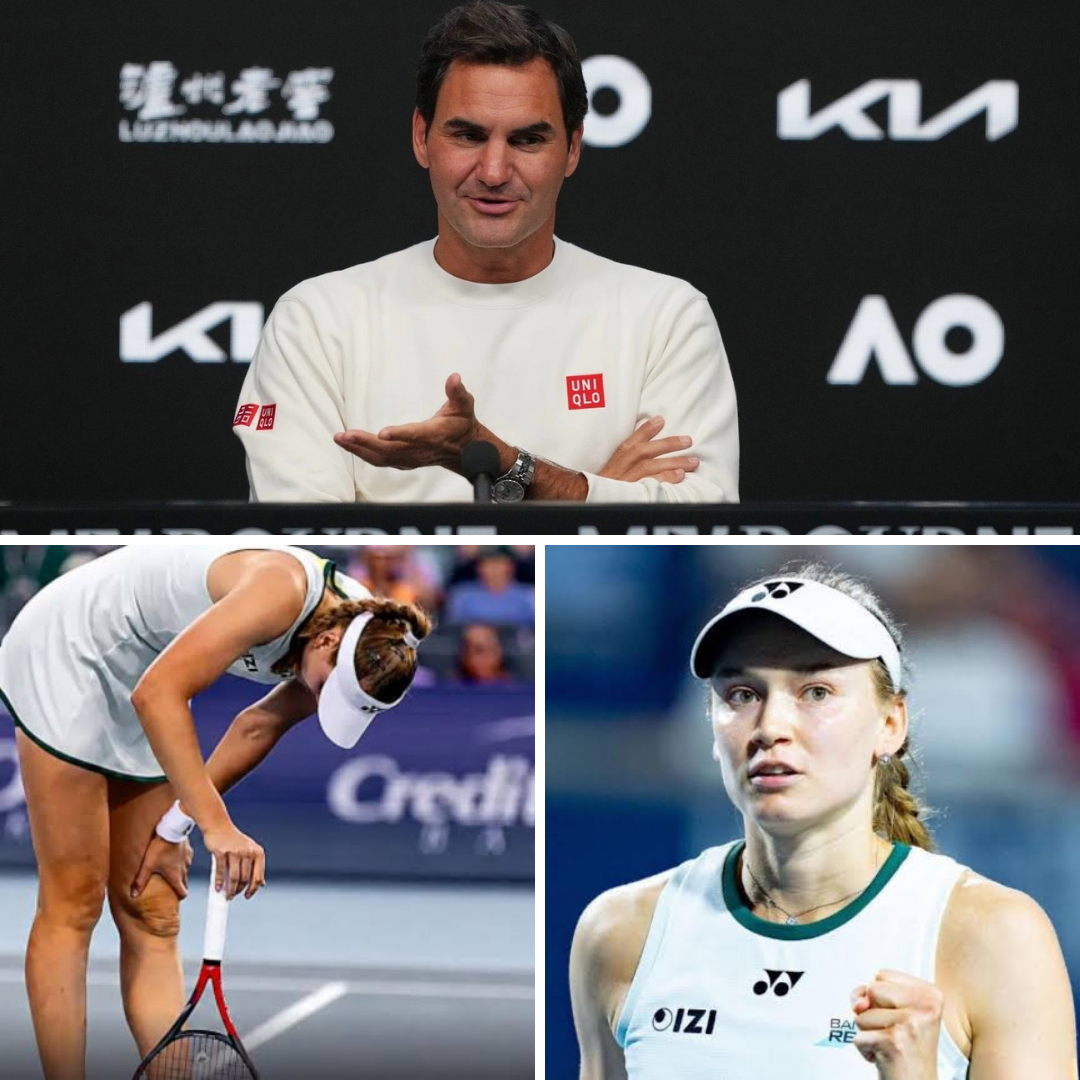
THE TRUTH BEHIND ROGER FEDERER’S “SECRET” LETTER TO ELENA RYBAKINA: WHEN CINCINNATI REALITY IS MANIPULATED BY SENSATIONALIST MEDIA
Behind the manufactured rumors about the Swiss legend lies the harsh reality of the former Wimbledon champion’s injury, physical attrition on the WTA Tour, and the explosion of fake news in modern sports.
Over the past few days, social media platforms and unverified sports sites suddenly exploded with a wave of sensational headlines claiming that tennis legend Roger Federer “broke his silence” to send an emotional letter to Elena Rybakina. Expressing deep sympathy following the 2022 Wimbledon champion’s withdrawal from the Cincinnati Masters, these reports went as far as fabricating a “secret leaked postscript” in which Federer allegedly offered a shocking piece of advice that left fans stunned.
However, behind these clickbait titles and thousands of shares across digital platforms lies a completely different reality. There was no secret letter, no leaked postscript, and certainly no dramatic reaction from Roger Federer. This entire narrative is a sophisticated concoction of sensationalist media (clickbait), utilizing automated content generation techniques to exploit the emotions of fans for profit.
1. The Reality at Cincinnati: Elena Rybakina’s Heartbreaking Withdrawal
To understand why this rumor spread like wildfire, one must look at the actual events that transpired at the Cincinnati Masters.
Elena Rybakina, representing Kazakhstan with an aggressive playing style, powerful serves, and world-class caliber, has endured a remarkably difficult stretch regarding her physical health. During her quarterfinal match at the Cincinnati Masters against her long-time rival Iga Swiatek, Rybakina was forced to retire in the very first set (while trailing 1–4) due to a severe heel injury.
REAL-WORLD EVENTS AT THE CINCINNATI OPEN

- Context: Women's Singles Quarterfinal match between Elena Rybakina and Iga Swiatek.
- Physical Condition: Rybakina experienced severe heel pain and physical fatigue.
- Score at stoppage: Swiatek led 4–1 in Set 1.
- Decision: Rybakina retired to prevent worsening the injury prior to the US Open.
- Media Reality: Zero interference, letters, or public statements from Roger Federer.
This was far from the first time Rybakina had to make such an agonizing decision. Throughout recent seasons, the 1999-born player has continuously struggled with persistent health issues, ranging from severe allergies and respiratory viruses to muscle and joint injuries. Having to step away right on the doorstep of the final Grand Slam of the year—the US Open—left tennis enthusiasts deeply concerned for her future and form.
The exact moment Rybakina walked off the court in utter disappointment became prime fodder for nameless clickbait outlets. Capitalizing on the public’s regret and sympathy, they began weaving a sensational script, turning a routine sports medical incident into a melodramatic soap opera.
2. Roger Federer and Elena Rybakina: The True Relationship Behind the Rumors
One reason this rumor so easily deceived the public is that it was anchored in a genuine emotional truth: Elena Rybakina’s profound admiration for Roger Federer.
In numerous interviews throughout her career, Rybakina has never hidden the fact that the “Swiss Maestro” was her ultimate childhood idol and the primary inspiration that drew her to professional tennis. Federer’s calm demeanor, effortless grace, and unyielding sportsmanship have always served as the gold standard to which the Kazakh player aspires.
On Roger Federer’s side, since his official retirement at the 2022 Laver Cup, he has maintained an extraordinarily dignified and measured presence before the media. Federer frequently follows top-tier tennis and offers praise to younger generations such as Carlos Alcaraz, Jannik Sinner, Iga Swiatek, and Aryna Sabalenka through official channels. However, he has never intruded into personal player decisions or injuries via private, provocative, or “leaked” letters as these baseless rumors suggested.
Disinformation purveyors deliberately juxtaposed Federer’s name—an emblem of ultimate prestige and sportsmanship—alongside Rybakina’s story to create a veneer of authenticity. When readers saw two giant stars paired together in such an emotional context, their critical guard immediately dropped.
3. Deconstructing the Clickbait Playbook: The Formula for Emotional Manipulation
The emergence of the viral story regarding Federer and Rybakina was no accident; it was the product of a systematic, low-quality content production pipeline operating online.
A close analysis of the sensational caption reveals a textbook blueprint for psychological manipulation:
-
Extreme Emotional Triggers: The heavy use of capitalized, high-octane phrasing like “EMOTIONALLY BREAKS SILENCE,” “SHOCK WITHDRAWAL,” and “SWEAT, BLOOD, AND TEARS.” These terms hit the reader’s emotional processing centers directly, driving instant curiosity.
-
Manufacturing Surreal Scenarios: Depicting Rybakina as “breaking down in tears” upon receiving the letter creates a dramatic narrative arc reminiscent of serialized television dramas.
-
The “Secret Leak” Cliffhanger: Fake news narratives almost universally end on an unresolved note: “A newly leaked private postscript contained an unscripted shock, revealing he secretly urged her to…” This unfinished thought, paired with “READ FULL HERE” prompts or down-pointing hand emojis, serves as the lure driving users to click through to ad-laden sites, malicious links, or view-bait YouTube channels.
ANATOMY OF CLICKBAIT FAKE NEWS (CLICKBAIT TACTICS)

[Attach 2 Major Stars] ──> [Fabricate Dramatic Incident] ──> [Create Leaked Secret] ──> [Drive Malicious Links/Ads]
         │                                │                            │                             │
         ▼                                ▼                            ▼                             ▼
Federer & Rybakina              Tearful Letter Narrative          "Leaked Postscript..."           Drive Clicks & Revenue
Equipped with artificial intelligence (AI) text generators and automated voiceovers, modern “content farms” can churn out hundreds of fabricated videos and articles daily. They care nothing for factual accuracy or athlete reputations; their sole objective is capturing clicks to convert into ad revenue.
4. Punishing Physical and Mental Demands in Modern Tennis
Setting aside the fabricated internet stories, the genuine crisis facing Elena Rybakina—and scores of elite players—is the brutal physical attrition exacted by the modern professional tennis schedule.
The current calendar on the WTA and ATP Tours is widely regarded as one of the most grueling in all of professional sports:
-
Relentless Duration: The season opens in January in Australia and stretches all the way into November with the WTA Finals/ATP Finals, leaving players with a mere 3 to 4 weeks of true off-season rest per year.
-
Travel Intensity and Surface Shifts: Athletes constantly cross multiple time zones, adapt to fluctuating weather conditions, and transition rapidly between playing surfaces (hard courts to clay, to grass, and back to hard courts). Swapping surfaces on short notice exerts immense strain on knees, ankles, and ligaments.
-
Ranking Maintenance Pressure: To protect top 5 or top 10 world rankings, players are virtually obligated to compete across mandatory tournaments (Grand Slams, WTA 1000s). Withdrawing not only sacrifices precious ranking points but can also trigger financial penalties or impact major endorsement deals.
Elena Rybakina’s situation exemplifies how the human body possesses hard physical limits. Her power-heavy style, reliant on thunderous serves and intense court coverage, requires near-flawless physical conditioning. When stamina is eroded by an unrelenting calendar and recurring illnesses, heel issues or muscle strain become virtually inevitable.
Her decision to step aside in Cincinnati was not an act of “surrender” as trash tabloids claimed, but a professional, clear-headed move aimed at safeguarding her long-term career.
5. Information Literacy and Sports Media Consumption in the Algorithm Era
The manufactured tale surrounding Roger Federer and Elena Rybakina serves as a stark wake-up call regarding how the public consumes sports media in the digital age.
In an ecosystem where social media algorithms prioritize engagement over accuracy, sensationalized rumor content spreads across user newsfeeds far faster than official communications from governing sports bodies.
To avoid falling victim to sports misinformation, fans must equip themselves with crucial analytical filters:
-
Verify Official Sources: Major statements, letters, or announcements from icons like Roger Federer or Elena Rybakina will always originate directly on their verified blue-check social media channels, or through reputable global sports networks like the WTA Tour, ATP Tour, BBC Sport, Sky Sports, or Tennis Channel.
-
Beware of Cliffhanger Headlines: Any article employing templates like “Legend X reveals shocking secret about Y,” “Leaked recording,” or “Click here for full details” without primary source attributions is 100% fabricated content.
-
Respect Athlete Privacy and Health: Rather than getting swept up in internet-spun melodrama, sports fans should offer empathetic, civilized support to athletes navigating injuries and competitive burnout.
Conclusion
Elena Rybakina withdrew from the Cincinnati Masters due to a very real heel injury—a painful but necessary pause to recover for greater challenges ahead. Meanwhile, Roger Federer continues to enjoy his retirement peacefully, holding utter respect for the younger generation without needing “secret” letters or sensationalized scripts.
The true tragedy in this story is not Rybakina’s injured heel, but the willingness of predatory media outlets to trample on the truth, reducing the genuine pain and dedication of elite athletes into cheap clickbait currency. It is time for tennis fans to clear the air: honor the sweat, blood, and tears of players through the lens of reality—not the deception of social media hoaxes.