IRON WIDOW: THE GHOST WHO WALKED THROUGH A MINEFIELD AND MADE THE ENTIRE WORLD GO SILENT
PART 1: The Silence That Followed Her Name
“Tell the generals your call sign, little girl.”
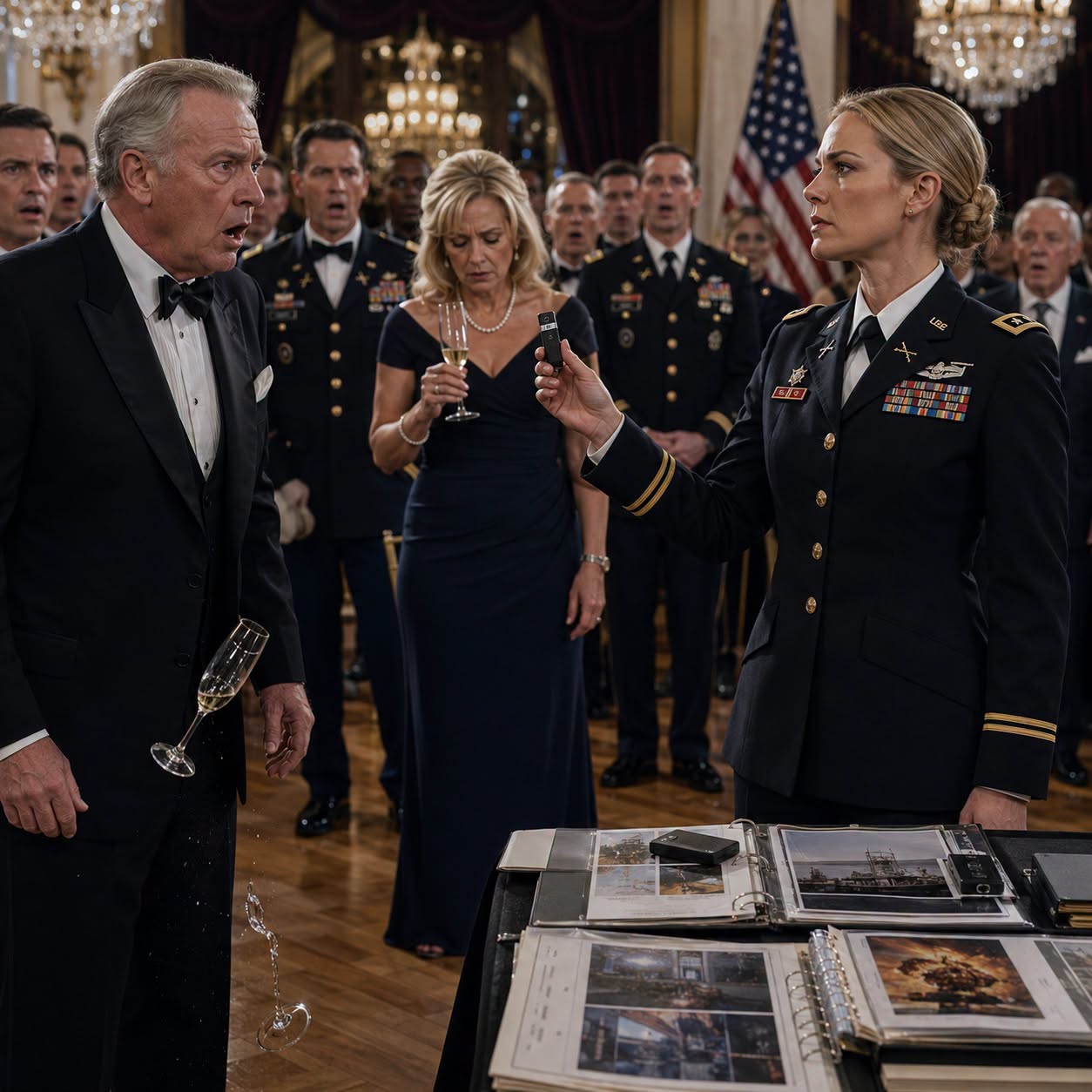
Arthur Sterling’s voice sliced through the ballroom like a blade wrapped in silk, rich, oily, and impossible to ignore. Crystal chandeliers dripped light across six hundred of the most powerful men in defense. Generals in tailored uniforms, executives in Tom Ford, and the sleek, polished faces of Delta candidates who thought they owned the world.
A few laughed.
A few more followed.
My mother did not.
She sat frozen at the white table, her diamond bracelet trembling against the stem of her untouched champagne flute. That single sound—tiny, vicious, unmistakable—cut through the laughter louder than any insult.
Arthur leaned in, breath warm against my ear, the scent of his cologne thick as betrayal.
“Or has the Army finally decided not to give call signs to failures who live off their parents’ money?”
I met his eyes for one heartbeat. Then I turned to the sea of generals and spoke with the calm of someone who had already died once.
“My call sign is Iron Widow.”
The glass in Arthur’s hand exploded.
It did not shatter in pieces. It became shrapnel. The crash was sudden, final, like a coffin lid slamming shut. No one laughed after that. The laughter died the way smoke dies when you snuff a candle.
Fifteen days earlier, the Nevada sun had been merciless.
Camp Bravo lay in a dust bowl two hours from Las Vegas, baked rock and pine shadows stretching under a sky that refused to forgive. Twenty candidates stood at attention in a line that seemed endless. Arthur Sterling had arrived in a white linen shirt rolled to the elbows, as if the heat itself was a personal insult he had come to enjoy.
He stopped in front of me.
His cologne fought its way through the honest smells of gun oil, canvas, and sweat.
“Your mother cried all night,” he murmured, so low only I could hear. “Drop out before you embarrass her again.”
I kept my eyes forward, on the horizon, on the future I had fought for since I was twelve and my father’s name was taken from me.
“I belong to the United States Army, Mr. Sterling.”
His jaw worked. When he called me “Dad” instead of my real father’s name, the word tasted like poison on his tongue.
Captain Jason Cross, broad as a doorway and twice as loud, snorted from the second rank.
“Rich girl playing soldier.”
Arthur smiled the way a shark smiles at a drowning swimmer.
That smile told me everything.
The ruck began at dawn—fifteen miles through heat that made the air shimmer. My new armor locked around my chest with a mechanical sigh. A motor whined near my shoulder. Eleven extra pounds slammed onto my back like an accusation. The straps bit into my neck. My left arm went numb before the first mile.
I felt Marcus’s presence before I saw him.
He was in the contractor control room, administrator access wide open, sipping iced coffee behind one-way glass. He had not changed the suit. He had simply turned the weight-limiting chip into a live grenade.
They expected me to complain.
I walked.
Boots hammered stone. Sweat ran into my eyes and stung like tears I refused to shed. At mile six, Cross glanced back, hoping for the fall I would not give him. I met his stare with the small, cold smile of someone who had already won.
Then I stepped behind a pine trunk beyond the surveillance cameras. With two fingers I cracked the chip. The frame released in a soft hiss. I rejoined the formation before anyone noticed.
I finished third.
Arthur’s smile vanished forever.
That night, the Army ran a live-fire test on Sterling’s security grid around a mock enemy compound. Arthur’s voice crackled over every headset.
“Thermal indexing. Seismic sensors. Laser matrices. Try not to break anything while you fail.”
Cross led Team Alpha like a man who had already won the script.
His point man stepped over a buried cable.
Sirens screamed. Red lights flooded the walls. The entire team was declared dead in thirty seconds.
Cross punched concrete until his glove split.
Then it was my turn.
I removed my earpiece. Lieutenant Ryan Miller stared at me across the rally point. I gave him three silent hand signals no one in Ranger school had ever been taught. His face changed. He knew exactly what they meant.
We crossed the open ground heel to toe—slow enough that the sensors never recorded a clean vibration. At the control box I attached a small device built from scrap and a broken radio. Three seconds later the laser grid flickered and died. Cameras went blind.
I walked inside, took the target folder, and returned before Sterling’s technicians understood their million-dollar system had stopped breathing.
Cross watched me drop the folder on the table. Water ran from his open mouth onto his shirt.
Arthur watched from the bunker.
I could almost hear him breaking things.
The next day Cross blocked the mess-hall door. Fryer grease hung in the air. A tray of cold cheeseburgers waited near the soda machine. Somewhere on the highway beyond the fence, a police siren wailed like it knew we were in trouble.
“You cheated,” he said.
“No.”
“You used a family back door.”
“I don’t have a family back door.”
He shoved one finger into my plate carrier. “Prove it. Land navigation tomorrow. Standard Army GPS. No Sterling tricks.”
I brushed the spot as though removing lint.
“The battlefield doesn’t care about your ego, Captain.”
He grinned. He thought I had accepted the bait.
I had.
At 0400, Team Bravo entered the badlands with GPS units and paper maps sealed in our packs.
By midmorning my screen began drifting east. The digital arrow told us to cross a dry ridge. The dirt told me not to.
No tire marks.
No boot prints.
No range flags.
Only cracked clay and one rusted strand of wire.
I raised my fist. The team froze.
Miller checked his GPS. “It says we’re on the safe route.”
I knelt. The knife scraped soil. Metal gleamed beneath the dust.
An old M15 anti-tank mine.
Live.
Waiting.
My pulse slowed to the rhythm of the desert itself.
Above us, a Sterling surveillance drone hovered against the sun, camera locked on my face.
Marcus had not sent us off course by accident.
Arthur had not come to watch a training exercise.
They had guided twelve soldiers into an uncleared minefield because killing me had become cheaper than controlling me.
And somewhere behind that drone lens, my stepbrother was waiting for me to take one more step.
TO BE CONTINUE IN PART 2: The Mine That Spoke