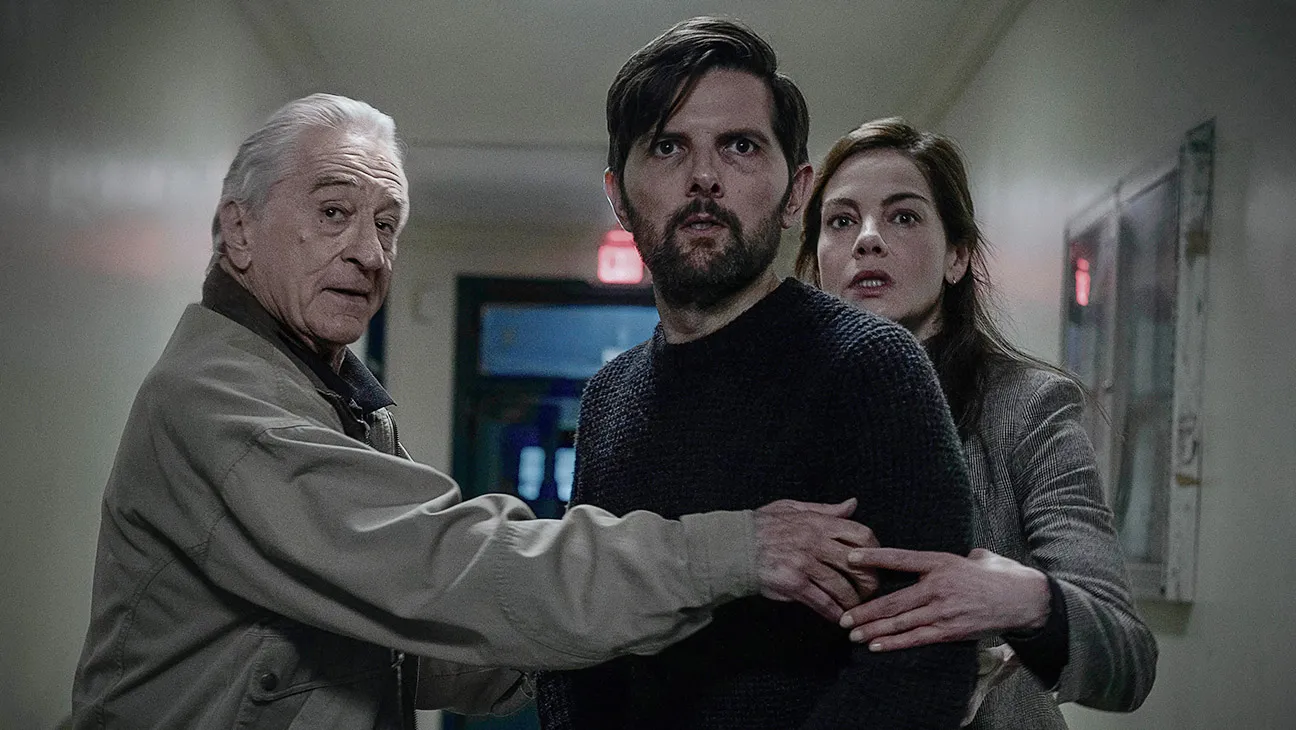
LATE-CAREER NOIR: DECONSTRUCTING ROBERT DE NIRO’S CHILLING ROLE IN ‘THE WHISPER MAN’
Deconstructing the Sensational Teaser
A high-potency promotional teaser has circulated across social media feeds, declaring that “at 82, Robert De Niro is stepping into one of his darkest roles yet.” Laden with dramatic emojis and suspenseful framing, the viral post outlines the story of a retired detective haunted by his past who is pulled back into a nightmare when a child mysteriously disappears. The caption promises a tale of cold-case connections, internal manipulation, and a shocking revelation discovered on the final page of an old diary, before urging users to click below for the full story.
While social media marketing often relies on heightened clickbait tropes—such as mysterious diaries and manufactured cliffhangers—to drive traffic, this specific teaser directs attention to a major cinematic release: Netflix’s feature film adaptation of Alex North’s bestselling 2019 psychological thriller, The Whisper Man. Directed by James Ashcroft (Coming Home in the Dark) and produced by the Russo brothers’ AGBO production company, the film pairs two-time Academy Award winner Robert De Niro with Adam Scott, Michelle Monaghan, and Michael Keaton in a haunting exploration of generational trauma, guilt, and cold-case horror.
The Nightmare of Featherbank: A Cold Case Reawakens
The narrative engine of The Whisper Man centers on the quiet town of Featherbank, a community shadowed by a terrifying history. Twenty years prior to the events of the film, the town was victimized by a serial killer known as “The Whisper Man.” The killer earned his sinister moniker from his distinct method of operation: standing outside young children’s bedroom windows at night, whispering creepy nursery rhymes into the dark to lure them into the night. Five young boys vanished during his reign of terror before the killer, Frank Carter, was arrested and incarcerated.
Decades later, widowed crime novelist Tom Kennedy (Adam Scott) relocates to Featherbank with his young son, Jake, hoping for a fresh start following the sudden death of his wife. However, the fragile peace is destroyed when another young boy in town vanishes under circumstances identical to the original cold case. When Jake begins hearing whispering outside his own window and subsequently disappears, Tom is forced to seek help from the one person he has spent years keeping at a distance: his estranged father, Peter Willis (Robert De Niro).
De Niro at 82: The Weight of the Aging Detective Archetype
What elevates The Whisper Man beyond standard abduction thrillers is the emotional gravitas that Robert De Niro brings to the role of Peter Willis. At 82 years old, De Niro is enjoying a late-career renaissance characterized by grounded, morally complex performances across major streaming projects, including Martin Scorsese’s The Irishman and Netflix’s political thriller Zero Day.
In The Whisper Man, De Niro portrays a man physically worn down by time and mentally scarred by his past. Peter Willis was the lead detective who successfully caught Frank Carter decades earlier, but the victory came at a devastating cost. His obsession with the case destroyed his marriage, alienated his son, and left him a lonely, regretful retiree living in the shadow of his former life.
De Niro’s performance taps into the rich cinematic legacy of the “aging detective” archetype. Unlike the invincible action heroes of traditional cinema, De Niro’s character carries the tangible physical frailty and emotional exhaustion of an octogenarian who realizes his life’s work may have been incomplete. His interactions with Adam Scott’s character carry authentic domestic friction: two men bound by blood and shared grief, forced to confront decades of unspoken resentment while frantically searching for a missing boy.
Case Files, Diaries, and the Mechanics of Psychological Suspense
The viral teaser’s reference to an “old diary” and a “case manipulated from within” highlights a fundamental element of psychological mystery fiction: the reliance on physical artifacts to unlock buried secrets.
In The Whisper Man, the investigation is not merely a modern police search; it is an excavation of the past. As Peter Willis revisits his old case notes, personal journals, and interrogation transcripts from his interactions with Frank Carter, he begins to realize that the original investigation contained subtle inconsistencies. The discovery of hidden entries and unexamined clues forces Peter to confront a disturbing possibility: that the original killer did not act entirely alone, or that someone within the original investigation inadvertently enabled the nightmare to continue decades later.
The psychological tension relies on the contrast between two distinct eras:
-
The Analog Cold Case: Paper files, handwritten journals, cassette tape recordings, and decades-old crime scene photographs that require painstaking manual review.
-
The Modern Investigation: Digital forensics, immediate media coverage, and procedural urgency led by Detective Amanda Beck (Michelle Monaghan).
By bridging these two timelines, the film creates a multi-layered narrative where the past literally haunts the present, forcing an old detective to re-examine his own memories and professional legacy.
Beyond the Clickbait: Why Late-Career Thrillers Resonate
The persistent popularity of crime thrillers starring legendary actors like Robert De Niro demonstrates an enduring audience appetite for character-driven mystery. While modern digital media often packages these stories with sensationalized headlines and click-prompting clichés, the true appeal lies in the narrative’s emotional resonance.
The Whisper Man succeeds because it uses the terrifying container of a serial-killer mystery to explore universal human themes: the desire of a father to protect his child, the lingering pain of family estrangement, and the realization that the past is never truly buried. For viewers seeking an atmospheric, masterfully acted psychological thriller, Robert De Niro’s turn in The Whisper Man offers a dark and compelling journey into the shadows of memory and truth.