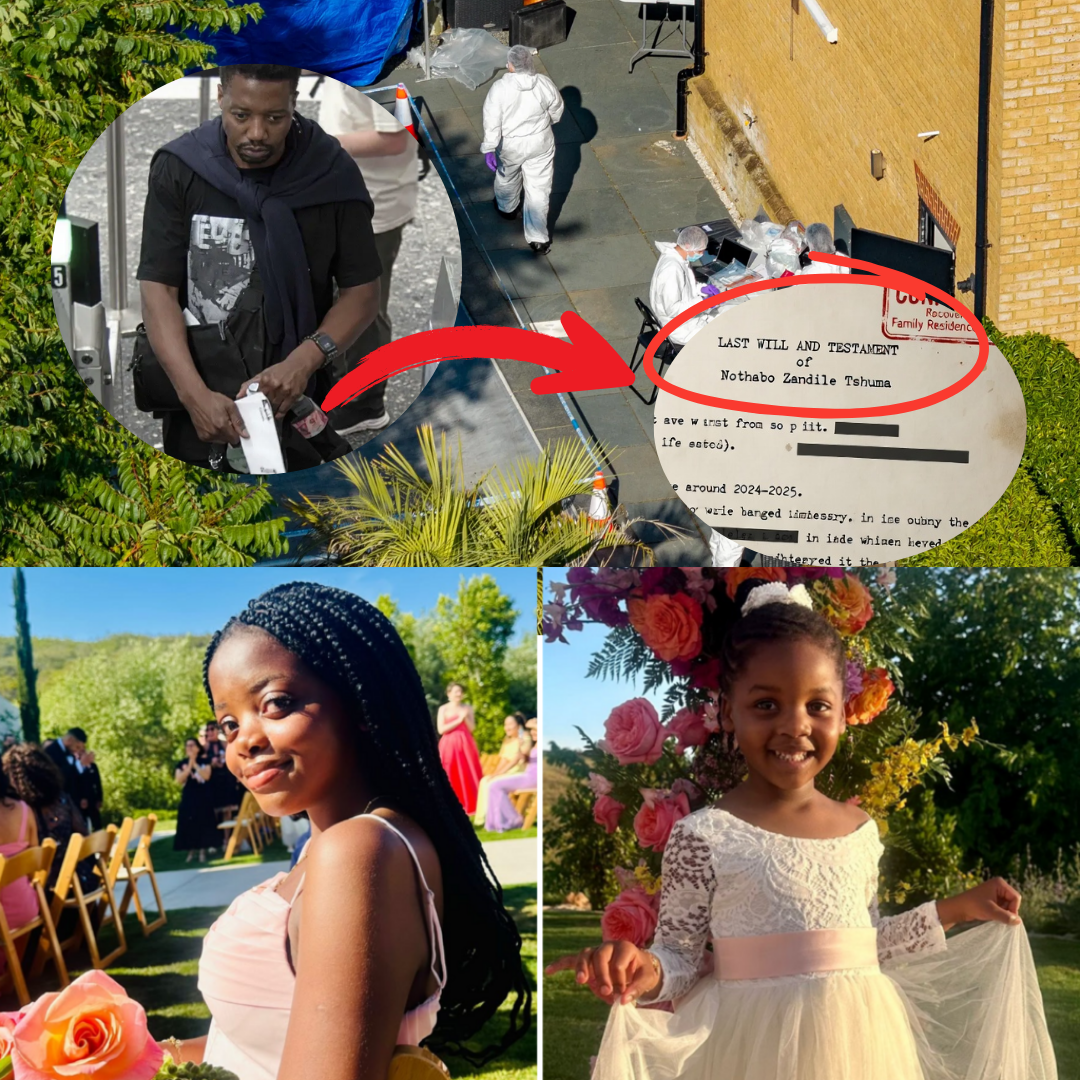
ESTATE BOMBSHELL: THE CONCEALED SECOND WILL THAT REWROTE TSHUMA’S MOTIVE
Initial theories regarding money conflict were shattered today after legal archivists unsealed a secret secondary will. The authenticated terms confirm Ndodana Tshuma was completely excluded from the family estate long before the event. Analysts examining the beneficiary list stopped in disbelief upon discovering the full sum was directed away from him — into a tightly drawn trust for his daughters, with residual control reserved for his wife’s blood relatives.
For weeks the working assumption had been grimly simple. A collapsing marriage. A £1.3 million house in Great Denham, Bedfordshire, already valued for sale. A property company, Nexus Trove Holdings, sitting on more than a million pounds in assets. Three bodies found on 7 July after neighbours raised the alarm. A husband who had already slipped through Heathrow on 4 July, routed through Dubai, and vanished into Johannesburg. Money, people said. It always comes back to money.
The second instrument, dated months earlier and lodged outside the ordinary family solicitor’s file, cuts that story at the root.
According to sources familiar with the unsealed papers, Ndodana Mkhanyisi Tshuma — the 45-year-old dual British-Zimbabwean national also known as Mark — does not appear as a beneficiary, executor, or even a contingent heir. The principal estate, including the Carnoustie Drive mansion bought in May 2024, associated holdings, and designated personal effects, was structured so that Natalie, 15, and Nala, five, would take under a protective trust. Residual authority sat with members of Nothabo Zandile Tshuma’s family — the Khumalo side — not his.
Investigators who had been mapping a conventional “if I can’t have you, nobody will” financial motive now face a colder possibility: that the accused man already knew he had been written out.
Friends of Zandile, 42, an associate director specialising in financial crime, fraud investigations and anti-money laundering, had already described a marriage in freefall. Divorce proceedings had begun. The house had been valued. She had, they said, decided to start again with the girls. There were allegations of infidelity spanning the United Kingdom, South Africa and Zimbabwe, and of controlling behaviour she had previously forgiven and then refused to forgive any longer. One associate recalled a warning attributed to Tshuma: if he could not have her, nobody would. Those claims have never been tested in a British courtroom. He has not yet been extradited to face the three murder charges authorised by the Crown Prosecution Service.
What the second will does is rearrange the sequence.
If the document is what archivists now say it is, Tshuma was not fighting to keep a fortune he still expected to share. He was confronting a legal reality in which the life he had built in Bedford — private schools, swimming pool, four bedrooms, the appearance of a successful IT consultant and property operator — would pass entirely out of his hands. Natalie at Bedford Girls’ School. Nala at Pilgrims Pre-Prep. A wife whose professional world was the detection of financial crime. And a paper trail that, if enforced, left him with nothing from the family estate.
That is the detail that stopped the analysts.
Family annihilation cases are often read as possessive rage dressed as despair, or as insurance and inheritance calculations dressed as domestic collapse. The first reading never required a payout. The second reading now looks thinner. A man already excised from the will does not need the deaths to collect. He needs them, if the darkest reading is taken, to punish the excision itself — to erase the people in whose names the money had been placed.
South African police have offered a different fragment. After landing at OR Tambo on 5 July, Tshuma is alleged to have bought an unlicensed 9mm pistol with two rounds in Alexandra. Officers said they believed he intended to use it on himself. He was arrested on 10 July in Kensington, Johannesburg, in a joint operation involving Interpol, the SAPS and the National Crime Agency. He faces a South African firearms charge that could, if he is convicted, delay extradition until any local sentence is served. Both the firearms matter and the extradition papers were postponed in late August to 8 and 10 September so his defence could consult further. The National Prosecuting Authority has said the United Kingdom has now supplied the required documentation.
None of that answers the will.
The Khumalo and Tshuma families were already at war over the funerals. A Tshuma delegation that travelled to Gwabalanda, Bulawayo, was turned away. The Khumalo side insisted on taking charge of arrangements for Nothabo — also known as Zandile Khumalo — and the two girls. The bodies were eventually repatriated and buried in Zimbabwe after a public fundraising effort. Relatives spoke of a relationship between the two families that had been strained long before July. The second will, if its terms hold, explains why that strain had a legal spine.
There is a further, quieter implication. Zandile’s career was built on following money that other people tried to hide. The existence of a second, concealed instrument — authenticated, according to those who have seen the unsealing, and executed well before the weekend of 3–4 July — suggests she, or someone acting with her, treated the estate as something that had to be protected from the man still living in the house. The public will, the one that first circulated in rumour, had left room for the old story: a bitter husband still inside the circle of beneficiaries, a fortune still theoretically his if the others were gone. The private will closed that circle.
Prosecutors in England have not commented on the document. Criminal proceedings are active. The CPS has already warned against material that could prejudice a future trial. Tshuma remains in custody in Johannesburg. He has not entered a plea to the British charges because he has not yet been returned to stand them.
What can be said without waiting for a dock is narrower and colder. The timeline no longer fits a man improvising after a row. He was seen with the family at a school sports day on the Friday. By Saturday he was on a flight. The bodies were not found until Monday. The second will, by the archivists’ account, was already years or at least many months old. Exclusion was not a surprise sprung in the last forty-eight hours. It was a settled fact.
That is why the beneficiary list produced the silence in the room. The full sum was not sitting there for him. It had already been moved — into the names of a fifteen-year-old, a five-year-old, and the family of the woman who had decided she was leaving. If the Crown’s case is eventually put to a jury, the question will not only be who used blunt force in a four-bedroom house in Great Denham. It will be whether a man who had already been written out of everything decided that if the estate would not be his, it would not be anyone’s.
The house is still there. The company filings are still on the register. The extradition clock is running toward the September dates. And the second will, once sealed among the ordinary papers of a prosperous diaspora family, is no longer a rumour. It is the document that turned a familiar motive inside out.