The Power of Cinema and Human Connection: Olivia Colman and Colin Firth Shine in Sam Mendes’s ‘Empire of Light’
In his deeply nostalgic and emotionally resonant period drama Empire of Light, Oscar-winning director Sam Mendes (1917, American Beauty) crafts a poignant love letter to human connection, community resilience, and the healing power of cinema. Featuring extraordinary lead performances by Olivia Colman and Colin Firth alongside a standout turn by Micheal Ward, the film delves into the quiet fractures of post-war societal trauma, mental health, and racial tension against the backdrop of an elegant, fading seaside movie palace in early 1980s Britain.
Now streaming on major digital platforms including Netflix, Empire of Light offers a delicate, atmospheric exploration of two isolated souls navigating personal hardship in a rapidly changing world. Rather than relying on bombastic melodrama, Mendes’s narrative moves with quiet restraint, allowing subtle glances, unspoken regrets, and cinematic light to carry the heavy emotional weight of its characters’ lives.
A Fading Palace of Dreams in 1980s Britain
Set in a coastal Kent town during the turbulent political climate of Thatcherite Britain in 1981, the film centers on the Empire Cinema—a grand, art-deco movie theater featuring a magnificent art-deco lobby, two remaining operational screens, and a long-abandoned top-floor ballroom overlooking the sea. The venue serves as both a literal workplace and a sanctuary for a quirky, close-knit group of employees who form an ad-hoc family amidst the economic stagnation and social unrest of the era.
Olivia Colman delivers a haunting, tender performance as Hilary Small, the theater’s duty manager. Hilary is a quiet, middle-aged woman living a lonely life conditioned by routine and managed by lithium prescriptions as she recovers from a severe psychiatric breakdown. Her fragile stability is further exploited by Mr. Ellis, played with subtle, bureaucratic coldness by Colin Firth—the theater’s married general manager who uses his position of authority to subject Hilary to coerced, transactional encounters inside his private office.
The daily cadence of the Empire shifts dramatically with the arrival of Stephen (Micheal Ward), a vibrant, warm-hearted young Black man hired as a new front-of-house usher. Aspiring to study architecture but repeatedly blocked by the systemic social barriers of the era, Stephen brings a fresh, gentle energy into the theater that instantly captivates Hilary.
A Delicate Connection Born of Mutual Isolation
Despite their differences in age and background, Hilary and Stephen form an immediate, profound bond rooted in a shared sense of alienation. Both characters understand what it means to be marginalized by a society that often prefers them to remain invisible. Stephen faces the overt, terrifying threat of anti-immigrant hostility and skinhead violence on the streets, while Hilary struggles silently against the social stigma of mental illness and workplace exploitation.
Their relationship blossoms quietly within the cavernous, forgotten spaces of the Empire Cinema. In one of the film’s most enchanting sequences, Stephen introduces Hilary to the upper ballroom—a dusty, derelict monument to forgotten grandeur inhabited only by a injured pigeon that Stephen gently nurses back to health. Through this shared sanctuary, the couple discovers a rare, unvarnished intimacy where they can set down their emotional armor.
The romance between Hilary and Stephen is portrayed not as a loud, dramatic affair, but as a series of quiet revelations. Every shared glance across a dimly lit auditorium and every conversation held against the backdrop of rolling coastal waves carries the weight of their respective griefs, offering both characters a fleeting taste of genuine affection and emotional liberation.
The Shadow of the Past and the Onset of Crisis
However, the fragile future Hilary and Stephen build together is continuously threatened by internal and external pressures. As the UK experiences rising racial tensions, national unemployment, and social polarization, the hatred brewing outside the theater inevitably breaches its doors. Stephen is subjected to degrading microaggressions from patrons and physical intimidation from far-right youth groups, testing his resilience and forcing Hilary to witness the brutal realities faced by the man she loves.
Simultaneously, the delicate chemical balance maintaining Hilary’s mental health begins to crumble. Triggered by buried regrets, professional frustration, and the oppressive presence of Mr. Ellis, Hilary gradually stops taking her medication, leading to a heart-wrenching manic episode during the high-profile regional premiere of Chariots of Fire.
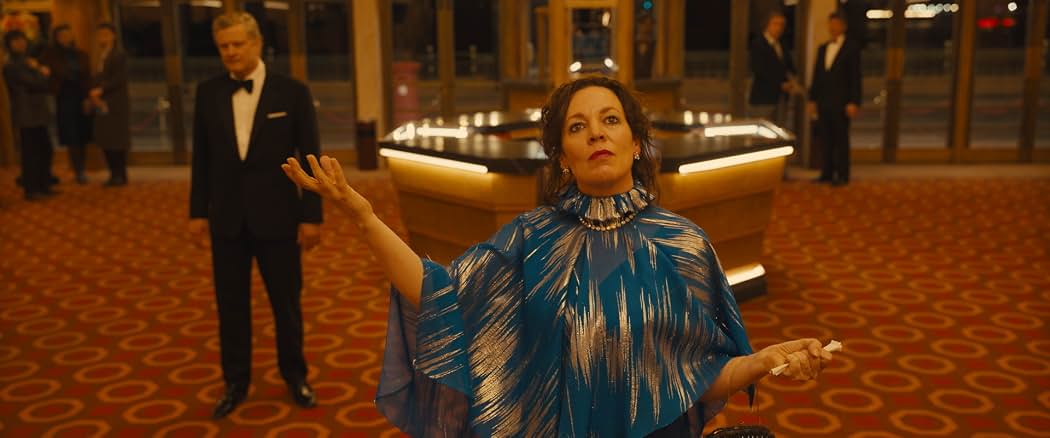
During the star-studded event, Hilary bravely confronts Mr. Ellis in front of his wife and local dignitaries, exposing his predatory behavior and shattering the quiet facade of the theater. Colman’s performance during this sequence is nothing short of breathtaking—masterfully balancing fierce defiance with raw, terrifying vulnerability as Hilary’s grasp on reality slips away once more.
Roger Deakins and the Magic of the Projection Booth
Visualizing this delicate narrative is legendary cinematographer Roger Deakins, whose stunning camera work elevates Empire of Light into a visual masterpiece. Deakins captures the contrast between the cold, grey realities of the British winter outside and the warm, golden glow emanating from the cinema’s projector.
Central to the film’s thematic core is the character of Norman, the theater’s eccentric, solitary projectionist played with sublime grace by Toby Jones. Sitting high above the auditorium surrounded by vintage film reels and carbon-arc lamps, Norman serves as the keeper of the flame. He delivers a beautiful monologue explaining the mechanics of cinema—how rapid static images flickering at twenty-four frames per second create an illusion of motion through darkness, mirroring the delicate balance between sadness and joy in human life.
In a pivotal moment toward the film’s conclusion, Norman invites Hilary—who, despite working at the theater for years, has never actually watched a movie—into the empty auditorium. As the lights dim and the projector turns on, Hilary watches Hal Ashby’s Being There, allowing the moving images to wash over her in a moment of pure, transcendent catharsis.
A Timeless Reflection on Healing and Hope
Empire of Light is a quiet, profoundly humane film that celebrates the resilience of the human spirit. Through the combined brilliance of Sam Mendes’s direction, Roger Deakins’s cinematography, and unforgettable performances from Olivia Colman, Micheal Ward, and Colin Firth, the movie reminds us that even in our darkest moments, connection and art can light the way forward.
Rather than offering easy resolutions to complex societal and personal problems, the story leaves viewers with a sense of quiet hope. It demonstrates that while the past cannot be erased and pain cannot be entirely avoided, finding someone who truly sees us can give us the strength to face the daylight once again.