THE HIGH-STAKES MYSTERY COMEDY ON NETFLIX THAT WILL LEAVE YOU ABSOLUTELY SPEECHLESS!
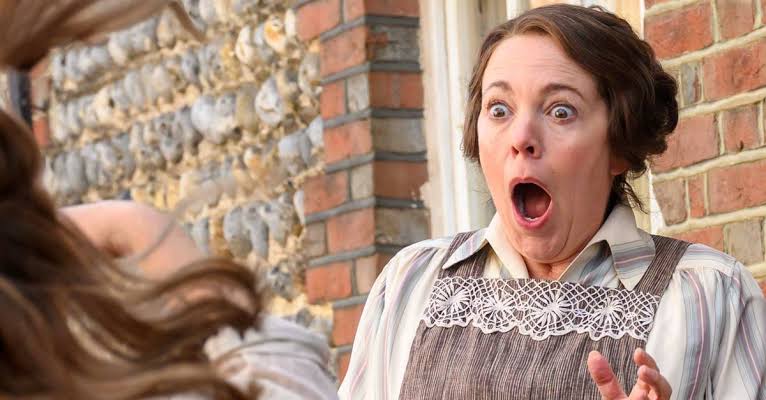
A quiet seaside town, a stream of shockingly profane anonymous letters, and a devout woman pushed to the absolute brink. On NETFLIX, Olivia Colman delivers a hilarious, edge-of-your-seat performance in a story of scandalous secrets and deadly gossip. Staring in utter horror as a fresh wave of outrageous insults comes to light, the terrifying realization Edith comes to in this exact moment proves that nothing in Littlehampton was ever as respectable as it pretended to be.
Wicked Little Letters looks, at first glance, like the kind of charming British period piece you put on while folding laundry. Then the first letter arrives. Then the second. Then the nineteenth. And suddenly the teacups start rattling.
Set in 1920s Littlehampton, a sleepy West Sussex coastal town still recovering from the Great War, the film drops viewers into a world of twitching lace curtains, Sunday hymns, and neighbors who know far too much about one another’s dustbins. Edith Swan, played with unnerving precision by Olivia Colman, is the picture of pious respectability. She lives with her domineering father Edward (Timothy Spall) and gentle mother Victoria (Gemma Jones) at 47 Western Road. She recites scripture. She keeps house. She judges quietly. She is, by every outward measure, the last person anyone would expect to be at the center of a national scandal.
Next door lives Rose Gooding, brought to roaring, defiant life by Jessie Buckley. Rose is Irish, loud, unmarried when she first arrives with a child, fond of a drink, and even fonder of language that would make a sailor blush. The two women were once friends. Then they were not. A communal garden, a reported concern to child welfare, a birthday party that exploded into shouting — the usual small-town kindling. Shortly afterward, Edith begins receiving unsigned letters so filthy they feel almost physically dirty to hold.
The language is not merely rude. It is operatically, inventively, almost childishly obscene. Cakes compared to livestock anatomy. Neighbors called names that had never been printed in a respectable newspaper. Accusations of theft, adultery, and worse, flung at anyone connected to the Swan household. The town is scandalized. Edith’s father is apoplectic. The police, almost entirely male and deeply uninterested in a woman’s complaint about “naughty words,” are only too happy to believe the obvious suspect: the foul-mouthed Irish neighbor who already swears in public.
Rose is arrested. Rose is tried. Rose goes to prison. And the letters keep coming.
That is the engine of Wicked Little Letters, and it is far more dangerous than it first appears. What begins as a comedy of manners becomes a pressure cooker about class, gender, immigration, and the quiet violence of respectability. Directed by Thea Sharrock from a screenplay by Jonny Sweet, the film is based on a true story so strange that contemporary newspapers called it the Littlehampton Letters, or simply the Seaside Mystery. Real Edith Swan really did accuse real Rose Gooding. Real Rose really did serve time. Real letters really did continue arriving after the “guilty” woman was locked away. Scotland Yard eventually became involved. Parliament discussed it. Four court cases and three prison sentences later, the truth that emerged was stranger than most fiction.
The film understands something essential about that truth: the comedy is the horror, and the horror is the comedy. Colman’s Edith does not play the victim as a simple martyr. Her face, in close-up after close-up, is a masterpiece of competing impulses — piety, fury, loneliness, and a flicker of something that looks uncomfortably like satisfaction when the town rallies around her. Buckley’s Rose is the opposite current: raw, funny, exhausted, and increasingly terrified that the entire machinery of English respectability has decided she is disposable. Between them stands WPC Gladys Moss, played by Anjana Vasan with deadpan steel. Gladys is one of the few women on the force. She is not supposed to have opinions. She has them anyway. When the official investigation stalls, it is Gladys and a circle of townswomen — the nosy, the overlooked, the underestimated — who start asking the question nobody else wants asked.
Who would actually write these letters?
The caption is right about the moment that leaves you speechless. There is a scene — you will know it when it arrives — in which Edith stares at a fresh wave of insults as if seeing them for the first time. The camera holds on Colman’s face long enough for the joke to curdle. What she realizes in that instant is not just a plot twist. It is a diagnosis of an entire way of life: the way a woman can be so thoroughly boxed in by duty, church, and a father’s will that the only language left to her is the language she claims to despise. The film does not lecture. It lets the realization land like a slap.
That is why Wicked Little Letters works as both mystery and comedy. The swearing is funny because it is so badly, eagerly constructed, as if someone had learned profanity from a dictionary and a grudge. The mystery is tense because the stakes are not abstract. A woman’s child can be taken. A woman’s reputation can be destroyed in an afternoon. A woman’s body can be locked in a cell on the strength of a neighbor’s testimony and a town’s prejudice. The film never forgets that the Littlehampton case was not a quirky anecdote. It was a miscarriage of justice that took years to unwind, and it happened because people preferred a convenient villain to an inconvenient truth.
Performances carry the weight. Colman has built a career on women who smile while something breaks behind the eyes; here that gift is sharpened to a point. Buckley matches her with a physical, vocal performance that refuses to make Rose merely “the colorful one.” Spall’s Edward is a portrait of domestic tyranny so ordinary it is almost invisible until it is not. Vasan’s Gladys may be the film’s secret weapon — the person who notices what the men in charge have already decided not to see.
Is every historical detail exact? No. The film condenses years of letters, trials, and reversals into a tighter dramatic arc. Some relationships are streamlined. Some confrontations are heightened. What remains faithful is the emotional geometry: two women who once liked each other, a town that needed someone to blame, and a set of letters that exposed how thin the veneer of niceness really was. Historians have written books about the case. The National Archives still holds the files. The film’s opening title card is not kidding when it says this is more true than you would think.
On Netflix, Wicked Little Letters has the rare quality of being both a Saturday-night crowd-pleaser and a story that keeps working on you after the credits. You laugh at the letters. Then you notice who is laughing with you and who is not. You watch Edith’s horror and realize the horror is not only at the words on the page. It is at the life that produced them. In an age of anonymous messages, pile-ons, and reputations destroyed at the speed of a post, a 1920s poison-pen scandal should not feel this current. It does.
A quiet seaside town. A devout woman. A neighbor who swears too much. A stack of letters no respectable person would ever admit to writing. By the time Edith stares at the latest outrage and the truth finally, terribly clarifies, the film has already done its real work. It has shown how easily a community can decide who is allowed to speak, and how violently it will punish anyone who speaks in the wrong voice.
Wicked Little Letters will leave you laughing. It will leave you uneasy. And if you are paying attention in that exact moment the caption describes, it will leave you, for a few seconds at least, absolutely speechless.
Now streaming on Netflix.