STREAMING NOW ON NETFLIX: 11 YEARS IN A HIDDEN HELL – THE TRUE CRIME MOVIE BASE ON THE TRUE STORY THAT SHOOK AMERICA!
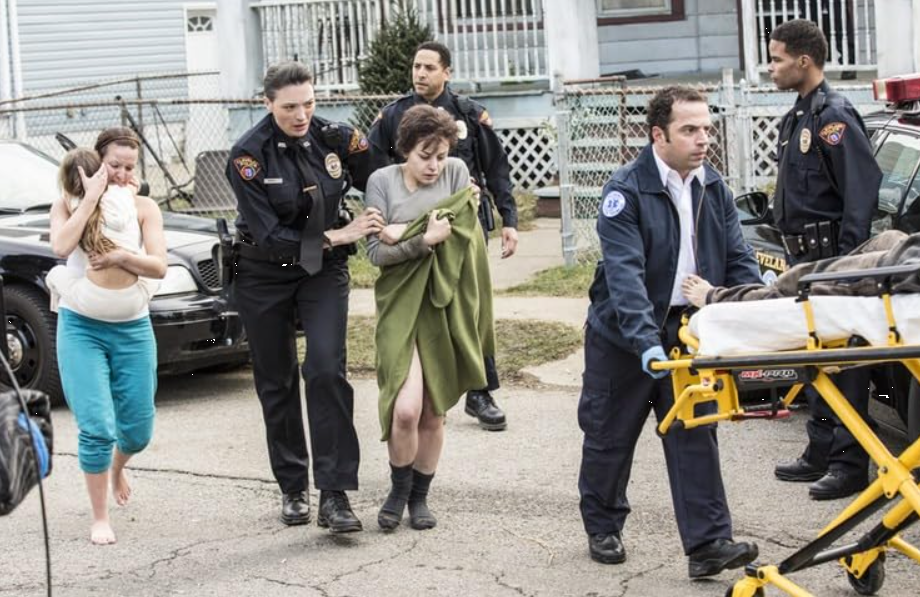
A single mother vanishes without a trace on an ordinary afternoon, stepping directly into an eleven-year nightmare hidden inside a quiet suburban neighborhood. Trapped inside an ordinary house on Seymour Avenue, starved, chained, and subjected to unspeakable cruelty for more than a decade. In Cleveland Abduction, Taryn Manning delivers a haunting, deeply emotional performance as Michelle Knight — the forgotten first victim who refused to let her spirit die. As paramedics wrap her frail body in a blanket and rush her out into the sunlight, the detail officers discovered in that house — chains running through the walls, a support pole that rose from the basement into an upstairs bedroom, windows sealed with wood so no daylight could enter — proves that hell had been living next door the entire time.
It began on August 23, 2002, in Cleveland, Ohio. Michelle Knight was 21, a young mother who had lost custody of her toddler son, Joey. She was trying to reach a court appointment that might bring him back. She accepted a ride from Ariel Castro, a school-bus driver she knew only as the father of a neighborhood girl. He mentioned puppies. She went inside. The door closed. For 11 years, almost no one looked for her with the urgency given to the two girls who would later vanish from the same streets.
That is the wound at the center of Cleveland Abduction, the 2015 Lifetime film now finding a new audience on streaming. Directed by Alex Kalymnios and adapted from Knight’s memoir Finding Me: A Decade of Darkness, a Life Reclaimed, the movie does not treat her as a footnote to a larger case. It begins with her. It stays with her. Manning, known to many viewers from Orange Is the New Black, plays a woman the system had already written off — poor, struggling, presumed to have run away — and then shows what it costs to keep a soul intact when the world has stopped searching.
Raymond Cruz, as Castro, is quietly terrifying. He is not a cinematic monster with a monologue. He is a neighbor. He plays bass in a band. He has children. He boards windows, installs alarms, threads metal through plaster, and returns to ordinary life while three women live in the dark. The film’s most chilling achievement is how ordinary the house looks from the street.
In April 2003 Castro abducted Amanda Berry, then 16. In April 2004 he took Gina DeJesus, then 14. Samantha Droke and Katie Sarife play them with a raw, protective tenderness. The three women become sisters in captivity. They cut each other’s hair. They share food when there is any. When Amanda becomes pregnant, Michelle — who had already suffered forced miscarriages after Castro beat her — delivers the baby and performs CPR under the threat that the infant would be killed if she failed. The child, Jocelyn, grows up inside the boarded rooms believing this is the world.
Cleveland Abduction does not linger on graphic violence for its own sake. It lingers on time. Birthdays that pass unmarked. Holidays Castro used as extra torment. A puppy given and then destroyed when Michelle tried to escape. A motorcycle helmet forced over a screaming face so the neighbors would hear only music. Days measured in chains and plastic buckets. Years in which Michelle told herself she would see her son again.
On May 6, 2013, Amanda Berry kicked through a door panel, screamed for help, and a neighbor finally heard. Police entered 2207 Seymour Avenue. What they found was not a secret room behind a bookcase. It was a family house rearranged into a prison: padlocks on the outside of bedroom doors, doorknobs removed, holes cut for air because the windows were sealed, more than 45 kilograms of chain, a pole in the basement that continued through the floor above, dog leashes attached to the ceiling. Officers later testified that chains ran through the walls themselves. That is the image the caption withholds, and it is the image that still stops viewers mid-scroll: the architecture of the house had been turned into a cage.
Paramedics wrapped Michelle Knight’s body — starved, injured, almost unrecognizable after 3,891 days — and carried her into daylight she had not felt in more than a decade. The film holds that moment. Manning’s face, when the blanket goes around her shoulders, is not triumph. It is disbelief that the air is real.
Castro pleaded guilty to 937 counts, including kidnapping, rape, and aggravated murder for the pregnancies he ended by violence. He received life plus 1,000 years. A month into the sentence he died by suicide in his cell. The house was demolished. Michelle stood and watched it fall.
What Cleveland Abduction understands, and why it keeps returning to streaming charts years after its Lifetime premiere, is that the horror was never only the basement. It was the silence around it. Neighbors. A missing-persons system that treated a 21-year-old single mother as someone who had chosen to disappear. A city that drove past the same porch for eleven years. The movie’s emotional engine is not the captor. It is the woman who decided, in the dark, that he would not get her soul.
Manning has said the real Michelle Knight was reluctant at first to meet Cruz because he looked too much like Castro; they later became friends. That detail belongs in any honest account of the film. So does this one: after freedom, Knight changed her name to Lily Rose Lee, wrote her book, and spoke of faith and of the son she had lost years before the abduction. The movie ends not with a courtroom speech — though the real Michelle told Castro, “You will die a little every day” — but with the harder work of walking back into a world that had moved on without her.
Cleveland Abduction is 88 minutes. It cannot contain every cruelty recorded in police files or every kindness the three women gave one another. It can, and does, refuse to let Michelle Knight remain the forgotten one. Katie Sarife’s Gina and Samantha Droke’s Amanda are essential to that refusal; the film is strongest when the three of them are simply trying to stay human in a room designed to erase them.
If you press play now, you will see a suburban street, a ride offered on an ordinary afternoon, and a door that should never have closed. You will see a woman who was told no one was looking. You will see the moment the blanket goes around her shoulders and the sun hits her face. And you will understand why officers who walked those basement stairs later said the walls themselves had been made into restraints.
Eleven years. One house. Three lives that refused to end in the dark. That is the true story Cleveland Abduction puts on screen — and the reason it still feels like a warning, not a closed case.