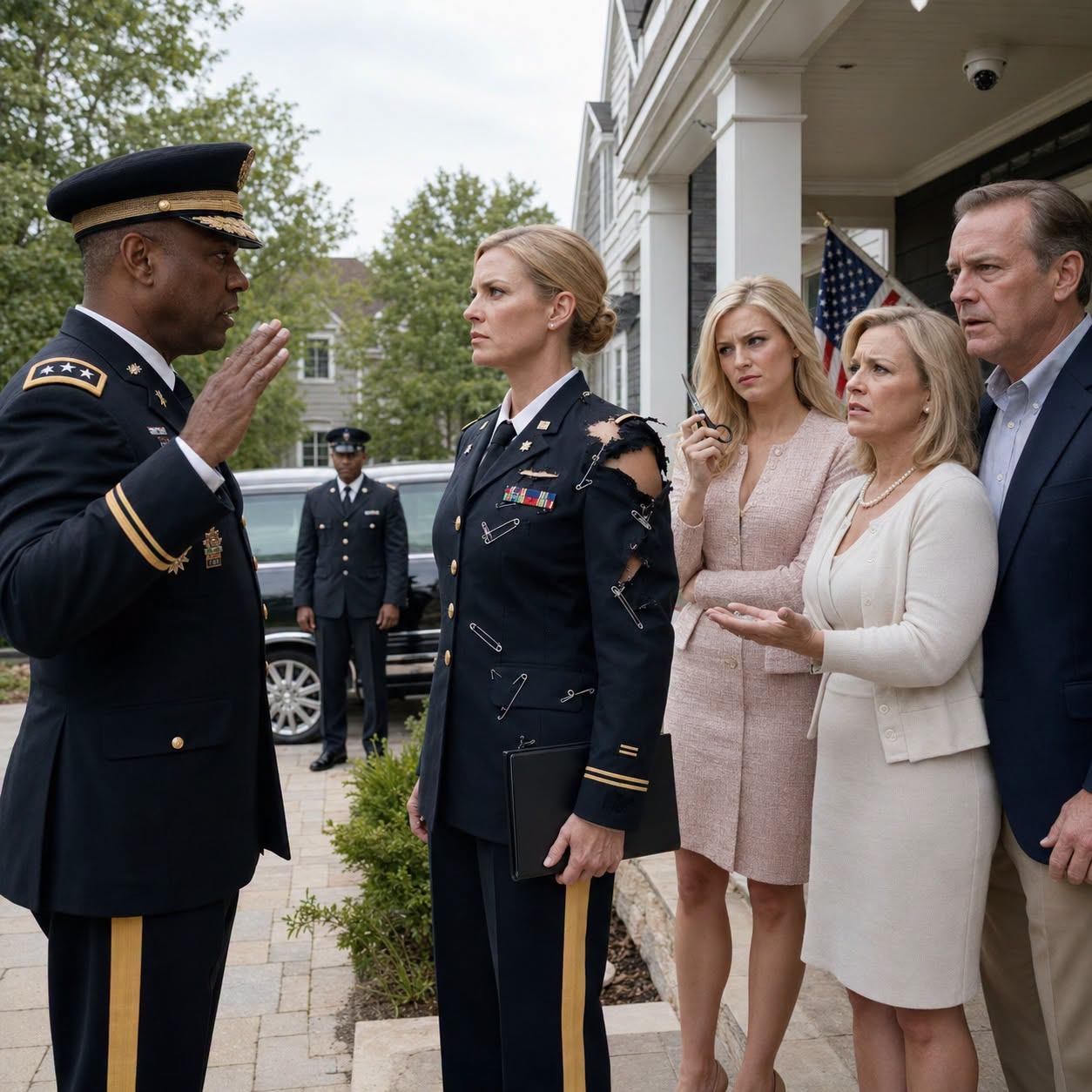
PART 3 – “It’s Just a Uniform—Stop Acting Like Somebody Died.” My Mother Said It While I Held My Dress Blues in Two Pieces. My Sister Smiled Into Her Coffee. The Hallway Camera Did Not Smile.
They were not allowed through.
That was the first mercy of a building built for worse weather than a Virginia engagement. Security held Mason Bennett in a lobby that had never cared who sponsored Little League. Callie was with him. Pink had been replaced by a coat thrown over panic. My mother’s name sat in my phone like a third person who had not yet decided to arrive.
The two-star did not stand.
“Captain. This board is not adjourned for a fiancé.”
“No, sir.”
“You will finish. Then you may walk downstairs and choose what kind of officer you are in a hallway.”
We finished.
I briefed the last scenario with a pinned sleeve and a voice that belonged to the work, not to the kitchen. When they closed their folders, no one offered me a speech about sisterhood. The colonel only said, “Legal is expecting you.” The civilian added, “The assignment is not decided in a lobby.” It was the kindest thing anyone had said to me since Grandpa’s camera learned to blink.
Legal watched the card on a screen that made 1:13 a.m. look like noon.
Callie in the hallway. Mother’s silver scissors. The zipper. The minutes—minutes, not a slash of temper—spent opening the jacket as if it were a rival dress. The ribbons arranged on the floor and cut through their hearts. She smiled once, toward the guest room, a small private enjoyment. Then she looked up, almost at the lens, and the smile flickered. Forgotten furniture. Remembered too late.
The JAG officer stopped the tape.
“That is criminal mischief and destruction of government property if the uniform is treated as such in your component’s guidance. At minimum it is conduct we document. You are not required to file a civilian report. You are required not to lie about it.”
“I won’t.”
“Will your family?”
“They already tried.”
Downstairs Mason looked like a man who had been handed a fire and told it was a candle. Callie reached for my arm and found air.
“You dragged us to the Pentagon over a jacket.”
“You followed me to the Pentagon over a jacket,” I said. “There is a difference.”
Mason’s voice was low.
“She said you had a meltdown. That you cut it yourself for attention.”
I looked at him. He had the unhappy face of someone discovering the brand partnership had a receipt.
“There is a camera,” I said. “There is a time stamp. There is my sister with scissors and enough time to be thorough. If you want the story where I am dramatic, you will have to watch it with the sound of the zipper.”
Callie laughed, high and brief.
“You would burn my wedding for this.”
“You burned eleven years before breakfast and asked me to call it an accident so Mason’s parents could enjoy coffee.”
Her eyes shone, not yet with remorse. With the shock of a system failing.
“Mom and Dad—”
“Chose you. I know the hymn.” I took out my phone, blocked the familiar reflex of paying, fixing, swallowing. “The venue deposit comes off my card by Monday. You can explain the complication to the Bennetts with the same mouth you used on my ribbons.”
Mason flinched.
“Elena.”
“I am not your referee,” I told him. “If you marry her, learn what she does with sharp objects when she feels second. If you don’t, that is also not my medal to pin.”
Callie stepped closer, dropping to the old weapon.
“You always had to be the serious one. The patriot. The better daughter. It was a uniform, Elena. Fabric.”
“To you.” I felt the pins at my shoulder like a small spine. “To the people who sent me into this building, it is a record you took scissors to because you could not stand a morning that was not about you.”
Security shifted. The lobby wanted us gone the way all clean lobbies want mess to remember it is temporary.
I did not show her the tape there. I sent it to the address legal had given me, and to myself, and—after a pause I refused to call cruelty—to Mason.
His phone buzzed.
He did not play it in front of her. He only looked at the thumbnail of a hallway at 1:13 and aged a year in the jaw.
Callie saw that look and understood, at last, that the camera had been the one relative who would not fold foil and stay silent.
I left them under the fluorescent lights.
By Friday the board had not made me a myth. It had made me a name on a short list, pending the ordinary weeks that follow extraordinary mornings. Legal kept the file. My father called and used the word family until it wore through. My mother cried, late, into the same voice that had said nobody died. I did not collect their shame like back pay. I also did not drive home to sew the morning back together.
Callie learned the cost in the only currency she had always counted: other people’s eyes. The Bennetts asked questions. The venue wanted money from a different card. The county that loved a dealership did not love a video of scissors and dress blues. I was not there for the scenes. I had stopped being the audience that made them possible.
On Sunday I bought a new jacket with my own name in the collar.
The cut ribbons I kept in the envelope.
Not as a shrine.
As a reminder that endurance without a spine is just a way of teaching people where to cut next.
THE END