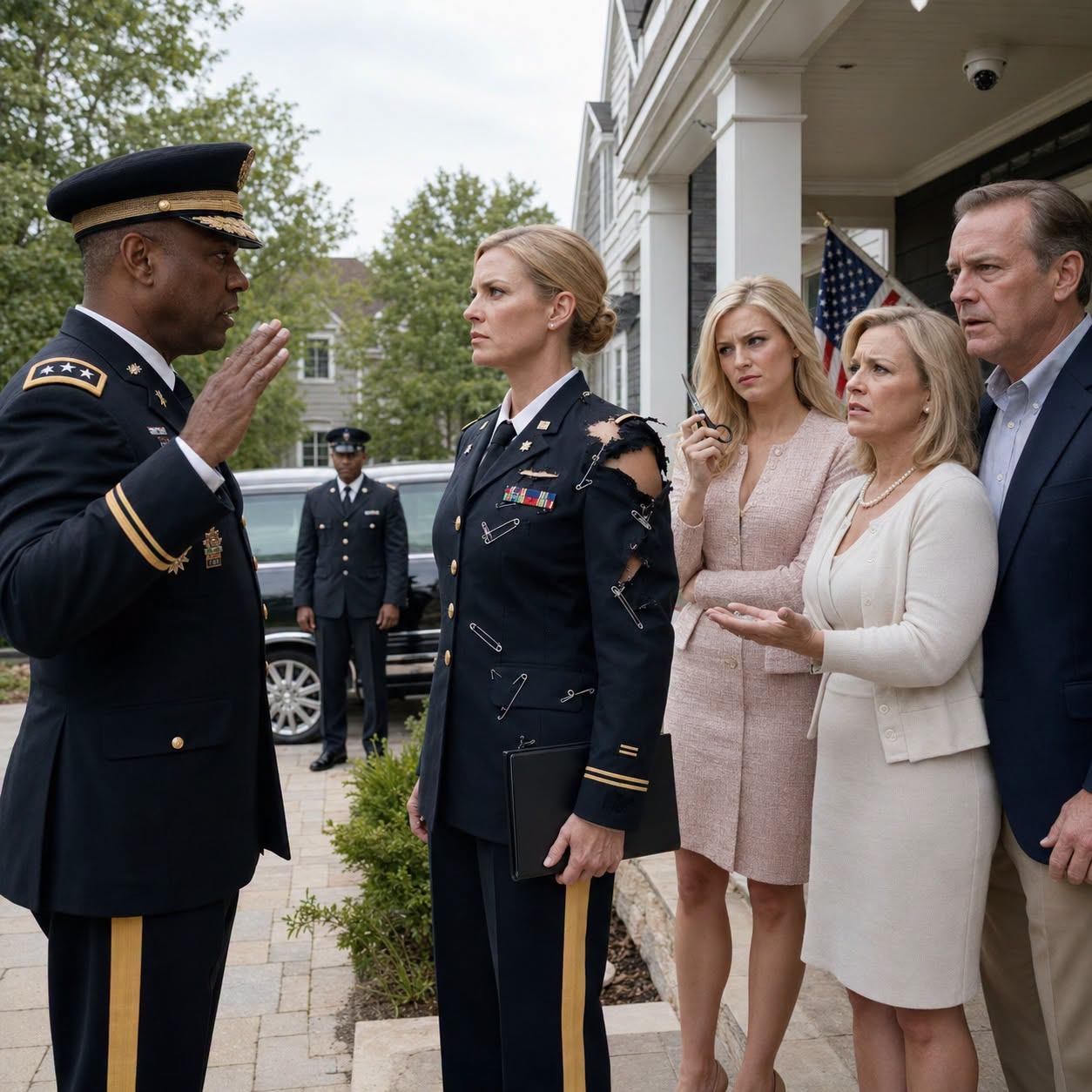
PART 2 – “It’s Just a Uniform—Stop Acting Like Somebody Died.” My Mother Said It While I Held My Dress Blues in Two Pieces. My Sister Smiled Into Her Coffee. The Hallway Camera Did Not Smile.
The Pentagon does not care about a sister’s mug.
It cares about whether you arrive on time, whether your story holds, and whether the person in the chair can keep a room steady when the room is designed to tilt. I drove with the jacket pinned at the shoulder like a secret I had refused to leave in Virginia. The cut ribbons rode in the envelope between the seat and my bag. The memory card sat behind my ID, a thin, ugly truth warming against plastic.
In the parking lot I checked the pins in the visor mirror. From ten feet the damage would look like haste. From two feet it would look like what it was. I did not have ten-foot luck. I had a 1000 interview and a family that had called eleven years fabric.
The corridor to the conference room smelled of coffee and carpet glue and the particular quiet of people who have already read your file. A captain at the desk glanced at my sleeve, then away, the professional mercy of not asking yet.
They were three.
A two-star whose name I had only said in briefings. A civilian in a dark suit who took notes without performing interest. A colonel who had the eyes of someone who had seen uniforms ruined by better reasons than scissors.
We began as these things begin. Scope of work. Judgment under incomplete information. The difference between what can be briefed and what should be. I answered. My voice did not shake. Training is useful that way. It will carry you through a kitchen and a classified panel with the same borrowed calm.
Then the two-star sat back.
“Captain. Your jacket.”
Not unkind. Not vague.
“Yes, sir.”
“That is not travel wear.”
“No, sir.”
The civilian’s pen stopped.
I could have given them a weather report. Accident. Luggage. I’ll replace it. My father had already written that script and tried to hand it to me with the dishwater.
I set the envelope on the table.
“My dress blues were cut apart this morning in my parents’ house. The ribbons were sliced so they could not be remounted. I repaired the shoulder enough to sit in this chair. I did not repair the rest because I will not describe sabotage as clumsiness to this panel.”
Silence, of the useful kind.
The colonel said, “Do you know who.”
“I have a hallway camera. I have not watched it in this building. I will not make your interview a family court.”
The two-star’s mouth tightened, not at me.
“Destroying a service uniform is not a household prank, Captain. Neither is interfering with an officer on the morning of a selection board.”
“I understand, sir.”
“Do your people understand it?”
“They understand that my sister is getting married, and that my work is a cubicle story they tell when the meatloaf needs a laugh.”
I had not meant to put that last piece on the table. It sat there anyway.
The civilian looked at the envelope and did not touch it.
“You still want this assignment.”
“Yes.”
“Why, this morning.”
Because a cut sleeve is a tactic, I did not say. Because if I turned the car around I would spend the rest of my life proving Callie right in the only language my parents spoke.
“Because the work does not become less real when my family refuses to see it,” I said. “And because I will not let a pair of sewing scissors decide who sits in this chair.”
The two-star nodded once, a small motion that was not yet a yes.
“We’ll continue. Afterward you will speak to legal about the uniform and the recording. That is not optional.”
“Yes, sir.”
We went back into the work. For twenty minutes I was only the officer in the file. Then my phone, silenced in my bag, lit the chair beside me with a name I had not wanted in that room.
MOM.
I let it die.
It lit again.
CALLIE.
Then a text preview I should not have been able to read from the angle I had, and read anyway:
Mason’s parents are here. Do NOT make this a thing.
The colonel saw my eyes change. He was trained for that too.
“Captain.”
“Family, sir. The morning they asked me not to ruin.”
The two-star closed the folder in front of him, not finished, but marking a line.
“You will finish this board. Then you will deal with Virginia. If that camera shows what I think it shows, this stops being a sister problem. Do you understand the difference?”
I did.
I had understood it in the kitchen, when my father chose the engagement over the cut cloth, and I had walked out anyway.
What I did not yet understand—what arrived only when the civilian’s assistant opened the door without knocking—was that Virginia had not stayed in Virginia.
“Excuse me,” the assistant said, pale in the way people get when a private mess has found a public building. “There is a man at security asking for Captain Marsh. He says he’s her sister’s fiancé. He says it’s urgent. And he’s not alone.”
The two-star looked at me.
On the table, the envelope of sliced ribbon suddenly seemed very small.
And in the hallway beyond the secure door, I heard Mason Bennett say my name as if he had just discovered that a costume could still bleed.
TO BE CONTINUE…