“Women Don’t Belong on a Firing Line—Hold the Cooler.” He Said It Into a Microphone While Dad Smiled. Then One Round Hit Dead Center, and the Range Officer Laid a Forged Policy on the Counter.
The microphone made my brother larger than he was.
“Women don’t belong on a firing line, Callahan. Hold the cooler and try not to embarrass Dad.”
Twelve men laughed because laughter was cheap and Derek signed things that mattered to them. Our father smiled behind him, the particular smile of a man who has decided a daughter’s spine is a mood. It was Saturday at Miller’s, six miles past the Baptist steeple and Ruthie’s biscuits. Dry grass. Oil. A flag working hard above the clubhouse. Derek’s new truck sweated a paper bag of sausage on the hood. He wore a vest that had never met weather and boots that still remembered the box.
I wore the clothes I use when I do not intend to perform.
That difference delighted him. Costumes were his native language.
“Don’t get sensitive,” Dad said from the tailgate. “He’s joking.”
Derek offered me a rifle the way men offer a dare they have already scored in their heads. The optic sat a fraction dishonest. The sling had been twisted by someone who liked how the thing looked on a shoulder.
“You sighted this?”
He turned to his audience.
“She knows words now.”
Trent, Colby, Benz—insurance-office soldiers expecting extraction after lunch—laughed on cue.
“One shot. Dead center. You miss, you carry the cooler, you police the brass, and you say on camera that the big military career was a desk.” The phone was already recording. A red dot, hungry and small.
Linda, in a folding chair, lipstick on foam coffee: “Humor him. It’s his promotion weekend.”
“And if I hit it?”
The smile stumbled.
“Lunch.”
“No. You apologize on the same video.”
Fine, he said, too loud. He shoved the rifle as if ownership were a shove.
I did what you do with a tool a careless man has handed you in public. Chamber. Magazine. Selector. The crooked eye of the glass. I straightened the sling and did not narrate it. Benz whispered that I looked like I knew. Derek said YouTube.
The paper at a hundred yards shivered in a thin wind. Behind me he announced the rare unemployed sister attempting masculinity. I let the sentence pass through the air it was made for.
The optic pulled left. I paid the correction. I have stood in rooms that did not come with coolers and commentary.
The shot was one sound.
Paper jumped far away. For a held breath the line forgot its jokes.
Then the range speaker: cease fire, verify.
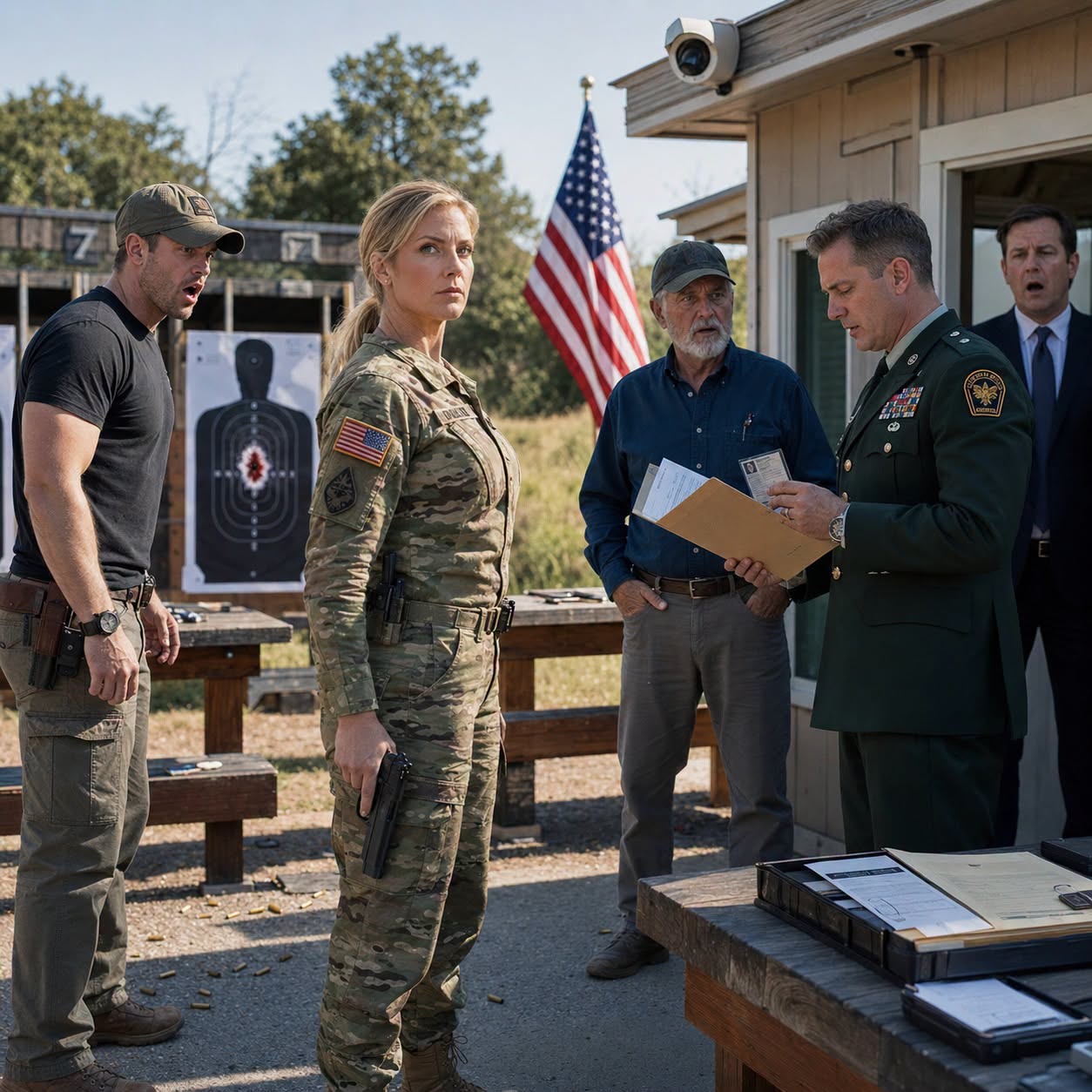
Master Sergeant Owen Hargrove—barrel chest, twenty-six years, the kind of calm that does not need a vest—walked toward the monitor. The camera over the target fed the clubhouse screen. Center, almost impolitely clean.
“Lucky,” Derek said. “That optic is zeroed.”
“Not with that mount,” Hargrove said.
He looked at me.
“Shooter. Identification at the desk.”
Derek followed, still filming, certain humiliation had only been rescheduled. Burnt coffee. Dust. Four security angles keeping their own minutes: lot, line, counter, cage.
My license. Then the military ID I had not brought for theater.
Hargrove’s eyes stopped in a way that was not surprise. We had spoken two weeks earlier, after my name turned up in a file that should not have contained it.
“Staff Sergeant Callahan Reyes.”
Derek snorted. “Tech support with better posture.”
Hargrove did not look at him yet.
“Call sign Wren.”
The room changed temperature. No speech required. Six men discovered stillness.
A locked drawer opened. A summary I had authorized, because a range officer who finds your name on a policy deserves more than a rumor. Deployments. Designated marksman. The badge. Instructor paper that did not come from a weekend catalog.
Dad arrived with coffee and the question men ask when a joke has grown a spine.
Hargrove answered him without raising his voice.
“Your daughter has more verified long-range qualification than every civilian instructor on this property stacked together.”
Derek’s phone drifted downward, a flag losing wind.
“You never told us.”
“You never let a sentence finish.”
Anger arrived to save him, as it always had.
“You staged this. An old Army buddy to spoil a promotion.”
“I work here,” Hargrove said.
Derek pointed at me, the last reliable gesture.
“She couldn’t stand one weekend that wasn’t about her service.”
If a fact made him small, the fact was the bully. I looked at the lens he still held.
“Keep recording. You wanted a video.”
Hargrove set a second document on the wood.
Harland Mutual. My full legal name. A signature I had not written. A title I had not claimed: Director of Firearms Safety. A corporate event discounted on credentials that were mine. A commission routed somewhere that was not.
If a stranger had been hurt on that line, the paper would have come looking for me.
Hargrove touched the forged line as if it might stain.
“Her record is not your largest problem, Mr. Reyes.”
Gravel spoke in the lot. A county patrol car, unhurried, the way official trouble prefers to arrive.
Derek looked at the window. At the policy. At me.
Nobody offered him a laugh to stand on.
The car door opened.
And the microphone, for the first time that morning, had nothing to say.
TO BE CONTINUE…