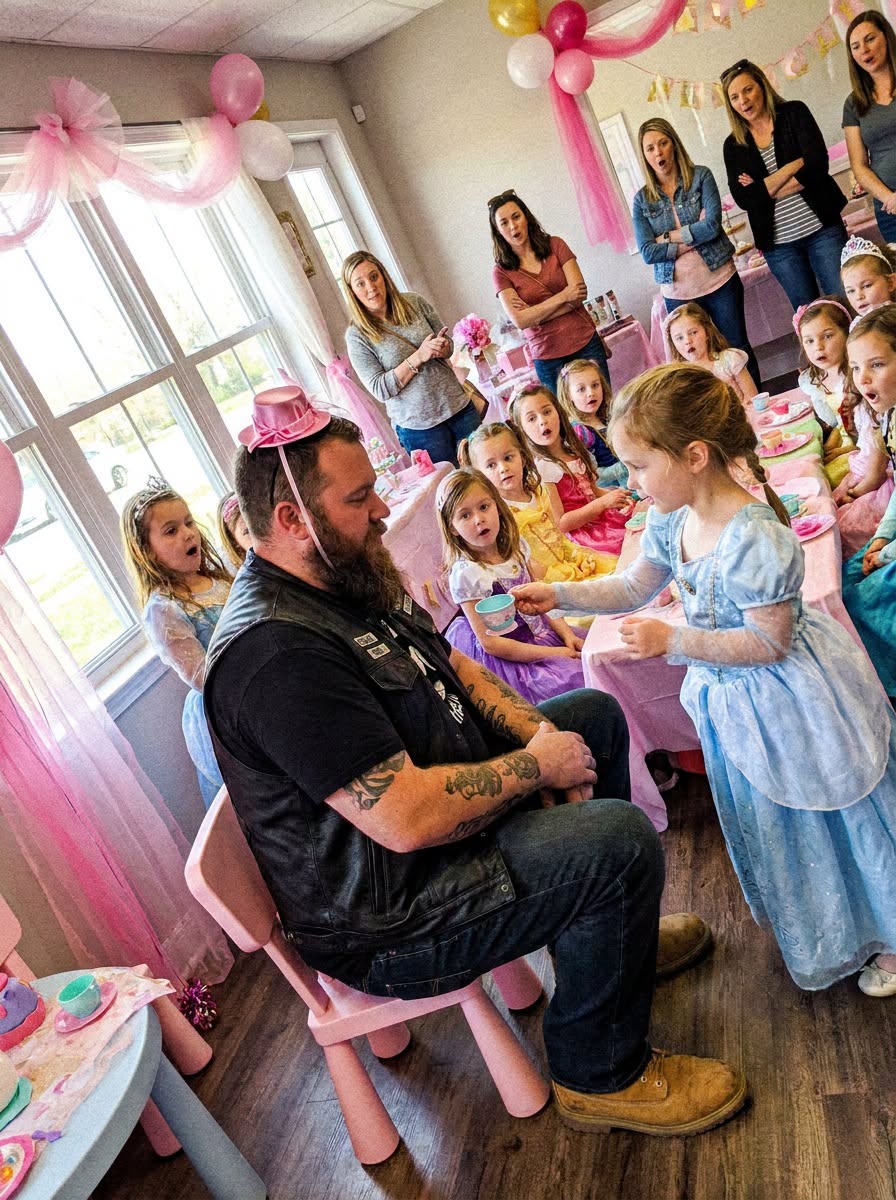
The Pink Hat That Defied Fear. A father’s leather vest and a six-year-old girl’s pink source of the single question that redefined courage.
PART 1 – The Pink Hat That Defied Fear
In the sunlit chaos of the community hall, where pastel balloons bobbed like fragile promises and the air smelled of strawberry jam and expensive perfume, one man stepped through the doorway and the entire room seemed to shrink. He wore a leather vest the color of midnight and a pink satin hat that sat low on his massive head, the ribbon tucked beneath a thick, snow-dusted beard. One embroidered rose drooped forward with every measured step he took, as if even the fabric had decided to bow in respect.
Cole Mercer was six-foot-five and two hundred ninety pounds of quiet power. His black boots left faint tracks on the glitter-strewn floor. Twelve six-year-olds stared. Their mothers stared harder. No one spoke.
Then Lily raised one small hand.
“Sit, Daddy.”
The pink plastic chair protested beneath him like an old horse accepting its rider. She lifted her own pinky finger, demanding the same.
Cole lifted his scarred one in return.
The laughter that followed was light, easy, the sound of children testing the ground beneath their feet. Only Lily stayed silent, her eyes moving over him with the solemn focus of a general inspecting a battlefield. She watched him drink three cups of imaginary tea—each one a deliberate, tiny motion—before she finally exhaled.
Something was wrong.
Natalie’s fingers kept brushing the folded hospital paper tucked inside her purse. Every time the paper shifted, a logo appeared like a hidden signature. Cole carried his own secret in the breast pocket of his vest: a plastic wristband still warm from his wrist, the kind given to patients who must be watched very carefully.
I had watched him at school pickups for two years and never once heard him raise his voice. Yet when his Harley roared into the parking lot, every adult stepped aside. Whispers trailed him like smoke—prison, rival clubs, nights he had spent behind bars. None of those stories touched the afternoons he spent fixing teachers’ cars for free, the winters he hauled bags of salt to every elderly neighbor’s doorstep, or the way he once taught a frightened first-grader how to ride a bicycle without ever touching the seat.
That afternoon, the pink hat laid everything bare.
To the rest of us, Cole looked like a man built for road wars, not princess parties. To Lily, he looked like a wall of safety. After the diagnosis fourteen days earlier, after the chemotherapy that had already begun to steal her curls, she had asked the question no child should ever ask: “Will medicine make me look different?”
Natalie had lied softly. Cole had answered more carefully, his voice low and steady.
“You may look different. You won’t be different.”
That answer had cracked something open in her small chest. So she had built her own test.
She had chosen the smallest, brightest hat in her costume box and told him to wear it. If he could walk through a room of strangers without hiding, perhaps she could walk through the hospital without hiding from the needles, the cold, the staring faces.
Cole understood. He always understood.
The mothers did not.
We smiled, we clapped, we recorded every moment with trembling thumbs. We did not see the way Cole’s scarred fingers moved when he adjusted the ribbon beneath his beard. We did not see the careful precision with which he answered Lily’s questions—not with grand promises of never being afraid, but with the small, solid truths he could control: where he would sit, what he would wear, whether she would face the unknown alone.
For a child whose days were about to be ruled by adults, that precision was more precious than any wish.
When the moment came, Lily rose on her chair, pink fingers gripping the brim of his hat, and asked the question that changed everything.
“Does it feel bad when they look?”
Cole considered it for a long moment, the weight of every staring eye in the room settling between them.
“A little.”
“Do you want to take it off?”
“No.”
“Why?”
He leaned closer, voice dropping to a rumble that somehow felt like shelter. “Because you asked me to keep it on.”
Lily turned to the twelve girls around her table, her small face radiant and brave.
“My hair is going away,” she announced, voice clear as a bell. “Daddy’s going to wear my hats until it comes back. So I’m not the only one who looks funny.”
The laughter died.
Cole lifted the hat slowly, turning it so the entire room could see the message embroidered inside the pink brim:
FOR WHEN BRAVE FEELS SCARED.
Then he placed it back on his head and let Lily tighten the ribbon beneath his beard with her own trembling hands.
What none of us could see was the folded drawing tucked beneath her plate. Seventeen hats in every color, each one named in careful, childish letters. The names were already changing—new friends, new faces, faces she would meet soon enough in places far more terrifying than a tea party.
Lily was not merely testing whether her father would stand beside her.
She was testing whether he would stand beside everyone she was about to lose.
And in that quiet moment, with glitter still sparkling on the floor and the weight of worlds waiting just beyond the door, she finally believed he would.
TO BE CONTINUE…