The Measured Heart
The rain outside Norfolk wasn’t the refreshing kind; it was a heavy, grey curtain that smelled of salt, diesel, and old asphalt. For Corporal Emily Harris, it matched her mood perfectly. It had been a grueling forty-eight hours of logistics drills and motor pool maintenance that had left her bones aching and her mind frayed. As she drove her aging sedan away from the base, the neon sign of “The Rusty Anchor” flickered through the downpour like a dying star. It was a rundown diner, the kind of place where the coffee was burnt and the secrets were kept in the cracked vinyl of the booths. No one came here for the food; they came here to be invisible.
Emily parked, pulled her hoodie over her head, and ran through the puddles. Inside, the air was thick with the scent of fried onions and floor wax. She chose a stool at the far end of the counter, far from the two truckers arguing over a sports game on a static-filled TV. She just wanted twenty minutes of silence before heading to her cramped apartment.
She had just ordered a black coffee when the atmosphere in the room shifted. It wasn’t a loud noise, but rather a sudden, uncomfortable silence that started at the register.
An older man sat three stools down from her. He wore a faded flannel shirt and a baseball cap with the word VETERAN stitched in gold thread that had long ago lost its luster. His hands were weathered, the skin like parchment, resting beside a half-eaten plate of eggs.
The waitress, a woman named Martha who had worked there since the Nixon administration, leaned over the counter. Her voice was uncharacteristically soft, tinged with a pity that felt sharper than an insult.
“Sir… I’m sorry. Your card didn’t go through. I tried it twice.”
The man didn’t flinch. He didn’t huff or puff or go through the performative dance of checking his pockets for a missing twenty. He simply opened his wallet with a slow, methodical grace. He stared into the empty leather folds for a long moment, his shoulders squared, refusing to let them slump.
The truckers stopped talking. The cook looked through the hatch. In a place like this, being unable to pay for a six-dollar breakfast was the ultimate vulnerability. The man’s silence wasn’t one of defeat; it was the silence of a person who had seen much worse than a declined credit card but still felt the sting of a public failing.
Before the silence could settle into something permanent, Emily moved. She didn’t think about her own dwindling bank account or the fact that she was three days away from payday. She saw the cap. She saw the dignity.
She slid her own card across the Formica counter.
“Put it on mine,” Emily said. Her voice was steady, the same tone she used when directing a convoy. Simple. Direct. No hesitation.
Martha looked at her, then at the man, then back at Emily. She swiped the card.
The man turned his head slowly. His eyes were a piercing, crystalline blue—the eyes of a man who spent his life looking at horizons. He wasn’t embarrassed, which surprised her. He looked at her with an intense, quiet focus, as if he were reading a map written in the lines of her face.
“You don’t have to do that, young lady,” he said. His voice was a deep, gravelly baritone that commanded the air around it.
“It’s fine,” Emily replied, offering a small, tired smile. “Veterans look out for each other. It’s the rule.”
The man’s expression flickered. It was subtle—a slight tightening of the jaw, a sharpening of the gaze. He looked at the digital readout on the register, then back at her. He didn’t offer a profuse thank you. Instead, he asked a question that felt more like a command.
“What is your name, soldier?”
Emily straightened her posture instinctively. “Corporal Emily Harris. 3rd Sustainment Brigade.”
He nodded once. Just once. “Corporal Harris. I’ll remember that.”
He stood up, tucked his empty wallet into his pocket, and walked out into the rain. He didn’t look back. Emily finished her coffee, paid her bill, and forgot about the encounter by the time she reached her front door. In her world, you did the right thing because it was the right thing, not because you expected the universe to send a receipt.
Two weeks later, the world changed.
It started with a frantic call from her First Sergeant. “Harris, get your Class A uniform on. Now. You’re needed at Building 1.”
Building 1 was the heart of the base, a place of high-level briefings and polished brass. Emily’s mind raced as she dressed. Had she messed up the inventory? Was there a discrepancy in the fuel logs? She mentally retraced every step of the last month, but nothing stood out.
When she arrived at the commander’s wing, the atmosphere was electric. Usually, the hallways were a bustle of lieutenants and captains, but today, they were lined with MPs in white gloves. The silence was deafening.
She was ushered into a large, wood-panneled office. Her Commanding Officer, Colonel Miller, was standing near the window, looking uncharacteristically nervous. He gave her a look that was hard to decipher—part confusion, part awe.
“Corporal Harris reporting as ordered, sir,” she said, her salute crisp.
“At ease, Harris,” Miller said, gesturing toward the heavy leather chairs in front of the desk.
Seated in the primary chair was a man whose presence seemed to pull all the oxygen out of the room. He wasn’t wearing flannel anymore. His uniform was dark, sharp, and decorated with a galaxy of ribbons that told the story of half a century of conflict. On each shoulder sat four silver stars.
General Silas Vance. The Deputy Chief of Staff. A man whose name was spoken in hushed tones in every mess hall in the country.
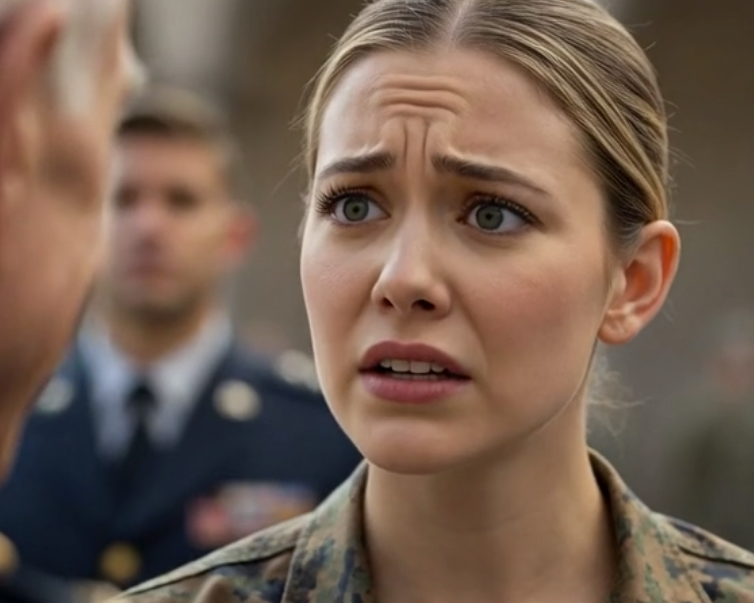
Emily felt the blood drain from her face. She stayed at a rigid attention, her eyes locked on a point on the wall behind the General’s head.
“Corporal Harris,” the General said. It was the same gravelly baritone from the diner. “Do you remember me?”
“Yes, sir,” she managed to say, her heart hammering against her ribs like a trapped bird.
The General stood up. He moved with a precision that belied his age. He walked around the desk, stopping just inches from her. Up close, he was even more intimidating. He carried the weight of thousands of lives on his shoulders, yet he was looking at her as if she were the most important person in the building.
“Two weeks ago, I was in a diner,” Vance said, his voice echoing in the still room. “I had lost my civilian wallet the day before and was using an old emergency card that, as it turns out, had been deactivated years ago. I was testing a theory I have about the modern soldier. I wanted to see if the ‘quiet act’ still existed. Or perhaps, I just wanted to see if I had become invisible in my old age.”
He stepped closer. “You saw a man in trouble. You didn’t see a rank. You didn’t see a person who could do anything for you. You saw a brother-in-arms who was hungry and ashamed, and you stepped into the gap.”
He looked over at Colonel Miller. “The Colonel tells me your reviews are exemplary, Harris. He also tells me you’ve been passed over for the last two promotion boards because of ‘limited slots’ in your MOS.”
Emily swallowed hard. “I just do my job, sir.”
“The Army doesn’t just need people who do their jobs,” Vance countered. “It needs people who remember why we wear the cloth. It needs leaders who understand that the smallest act of service is often the most significant.”
The General reached into his pocket. He didn’t pull out a wallet this time. He pulled out a small, velvet-lined box.
“I’m heading back to the Pentagon tomorrow,” Vance said. “I’m looking for a new junior aide. Someone who isn’t impressed by stars. Someone who understands that we are all, at the end of the day, just looking out for each other.”
He opened the box. Inside was the rank of Sergeant, but it wasn’t the standard issue. It was a set of historic brass pins, polished to a mirror finish.
“I’m promoting you today, Sergeant Harris. Not because you paid for my meal, but because of the character you displayed when you thought no one was watching. And then, you’re coming with me to D.C.”
He extended his hand.
Emily looked at the hand—the hand that had signed off on wars and shaped the future of nations. She reached out and took it. His grip was like iron, warm and steady.
“Thank you, sir,” she whispered.
“Don’t thank me,” the General said, a rare, genuine smile breaking through his stern mask. “I believe I still owe you six dollars and forty-two cents. Plus interest.”
As they walked out of the office, the hallway of officers snapped to attention. Emily walked a little taller, not because of the new stripes or the prestigious new post, but because she realized that in the vast, cold machinery of the military, the heart still had a place.
The rain outside hadn’t stopped, but as Emily looked out the window of Building 1, the world didn’t look grey anymore. It looked like a field of possibilities, all because she had decided that a stranger was worth the price of a cup of coffee.