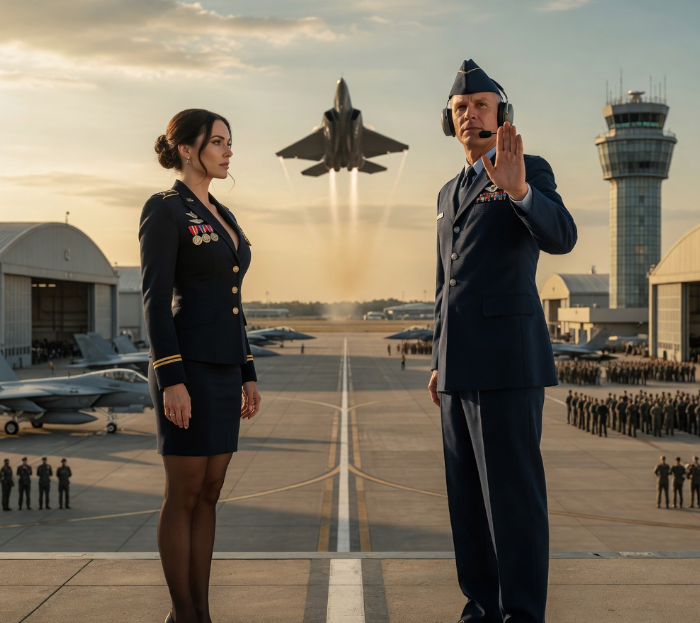
The Valkyrie’s Descent
The air at the Oak Ridge Airshow tasted of burnt kerosene and nostalgia. It was a thick, heavy scent that most people associated with excitement, but for Sarah Mitchell, it tasted like a life she had buried twelve years ago.
She stood at the far edge of the airfield, where the manicured grass gave way to the scrubby weeds of the perimeter fence. Behind her, the roar of the crowd was a muffled hum, punctuated by the high-pitched screams of children and the rhythmic thumping of a nearby popcorn machine. Sarah didn’t look like an elite pilot. She wore a charcoal hoodie pulled low, faded jeans that had seen too many hardware store shifts, and scuffed work boots. To the thousands of spectators turned skyward, she was just another face in the blur—invisible, unremarkable, a ghost in the machinery of a Saturday afternoon.
But while the crowd watched the spectacle, Sarah watched the physics.
Above, a sleek, twin-engine experimental jet—the XJ-7 Phoenix—was performing a series of high-alpha maneuvers. The crowd gasped as it pulled into a vertical climb, the afterburners carving twin scars of orange fire into the pale blue sky. They saw the power. Sarah saw the slight tremor in the horizontal stabilizers. They saw the grace of the roll. Sarah saw a recovery that was three-tenths of a second late, a subtle sign of a pilot fighting the fly-by-wire system rather than dancing with it.
Her eyes didn’t follow the plane; they anticipated it. She knew where the jet would be before the pilot moved the stick. It was a primal geometry, a language she had spoken fluently before the silence took over.
“Too steep,” she whispered to herself, her voice lost in the wind. “Check your trim, kid. You’re bleeding energy.”
For twelve years, Sarah had worked as a freelance diesel mechanic in a town three counties over. She went by ‘Sarah M.’, never stayed for the after-work drinks at the hangar bars, and never, ever mentioned the sky. Her hands were permanently stained with grease, a deliberate choice to mask the precision of fingers that had once toggled the most sensitive weapon systems on the planet.
The Phoenix went into its signature move: the ‘Falling Leaf.’ It was a controlled stall, a terrifying-looking tumble that required perfect engine synchronization to pull out of.
The crowd held its breath.
Sarah’s hand stilled in her pocket. Her fingers brushed against a small, cold object she always carried—a habit she couldn’t break.
The jet began its recovery. One engine roared, the other coughed. It was a sound no one else noticed over the booming soundtrack playing through the PA system, but to Sarah, it was a death rattle. The Phoenix didn’t settle. It drifted five degrees off the centerline, the nose hunting for a horizon it couldn’t find.
Then, the music stopped.
The silence that followed was more deafening than the jet engines. A sharp, feedback-heavy click echoed across the field as the airshow announcer’s microphone remained live. A voice, tight and straining against the G-forces of a desperate correction, broke through the speakers.
“Priority call. This is Phoenix Lead. I’m having trouble holding her level. Control, I have an uncommanded pitch-up. Hydraulics are… they’re spiking.”
The murmur of the crowd shifted from wonder to a low, vibrating anxiety. They didn’t understand the mechanics, but they understood the fear in a professional’s voice.
Sarah stepped forward.
She didn’t run. She didn’t scream. She moved with a deliberate, predatory calmness that sliced through the frantic energy of the people around her. She bypassed a family of four, stepped over a discarded soda cup, and headed straight for the restricted gate leading to the mobile command unit.
The staff near the fence were already scrambling. A young man in a ‘Flight Crew’ vest was shouting into a radio, his face pale under his headset.
“Is there anyone here with advanced jet emergency experience?” the announcer’s voice boomed again, this time with a note of pure desperation. “We have a civilian contractor in the air, and we’re losing the link to the flight computer.”
The staffer by the gate looked around wildly. He was met with blank stares from hobbyists and tourists.
Sarah reached the gate. “I’m Mitchell,” she said.
The staffer looked her up and down—the hoodie, the grease under the fingernails. “Lady, move back. This is a restricted zone.”
“You’re losing the Phoenix because the AOA sensors are icing in the high-altitude humidity, causing a logic loop in the fly-by-wire,” Sarah said, her voice a flat, icy horizontal line. “He’s fighting the computer. If he doesn’t go to manual override in the next twenty seconds, the jet will tear itself apart in a high-speed stall.”
The staffer froze. “How do you—”
Sarah reached into her pocket and pulled out a small, worn leather case. She flipped it open. Inside, pinned to the velvet, was a silver wing insignia with a centered diamond—the mark of a Master Instructor. Below it was a weathered brass badge with a serial number that hadn’t been active in over a decade.
The staffer’s eyes went wide. He didn’t just see a pilot. He saw a legend. “You’re… the Mitchell? From the Nevada trials?”
“Tell your pilot to steady his breathing and hold level,” she said, ignoring the question. “Open the gate. I’ll take the next thirty seconds.”
A man in a flight suit, likely the safety officer, sprinted toward them from the command trailer. He caught the end of the conversation. He looked at Sarah, then at the badge, then back at the jet wobbling precariously at four thousand feet.
“One word,” the safety officer whispered, his voice cracking. “Valkyrie.”
The name was a ghost story in the Air Force. The woman who had mastered the impossible, who had rewritten the manual on emergency egress, and who had vanished after a classified incident that no one was allowed to speak of.
“Gate’s open!” the officer yelled.
The crowd parted like the Red Sea. Sarah Mitchell didn’t look back. She walked through the threshold, every step shedding the skin of the mechanic and reassuming the mantle of the commander.
She entered the mobile command trailer. It was a hive of controlled chaos. Screens were flashing red. The telemetry data was a mess of jagged lines. In the center of the room, the Air Boss was sweating, his headset lopsided.
“He won’t listen! He’s panicking!” the Air Boss shouted.
Sarah walked up and took the headset right off his head. She didn’t ask permission. She didn’t wait for a briefing. She sat in the comms chair and adjusted the mic.
She closed her hand around the metal object in her pocket—a small, die-cast model of the first jet she’d ever soloed. It was her totem, her anchor to the earth.
“Phoenix Lead, this is Valkyrie,” she said.
Her voice wasn’t loud, but it possessed a frequency that cut through the static of the radio and the chaos of the cockpit. It was the voice of a mother, a general, and a god all at once.
There was a gasp on the other end of the line. “V-Valkyrie? That’s not possible. She’s dead.”
“I’m very much alive, and you’re about to be too if you listen to me,” Sarah said, her eyes locked on the telemetry. “Stop pulling the stick. You’re feeding the oscillation. Take your hands off the controls.”
“I’ll crash!” the pilot yelled.
“Trust the air, Captain. Hands off. Now.”
In the sky, the wobbling jet suddenly went still. It drifted, nose-heavy, for a terrifying three seconds.
“Good,” Sarah said, her voice a soothing balm. “The computer just reset because it stopped receiving conflicting inputs. Now, look at your left console. There’s a yellow guarded switch labeled ‘Flight Control Bus B.’ Flip it.”
“That’s for ground testing only!”
“Do it, or the next thing you feel will be the ejector seat firing into a debris field. Flip the switch.”
A click echoed over the radio.
“Now, pull back gently. You have direct manual linkage. No computer. No safety nets. Just you and the wings. Stay with me, Phoenix. We’re going to fly this thing down together.”
The next ten minutes were a masterclass in aeronautics. Sarah guided the pilot through a series of wide, sweeping turns, compensating for the loss of the automated trim systems. She spoke to him about the feel of the wind, the pressure in his seat, the way the air should sound against the canopy. She wasn’t reading a manual; she was describing the soul of the machine.
The crowd outside stood in a silence so profound you could hear the grass rustle. They watched the XJ-7 Phoenix, no longer performing stunts, but fighting for every inch of altitude. It looked like a wounded bird being led home by an invisible string.
As the jet lined up for the final approach, the Air Boss stood behind Sarah, his hand trembling on the back of her chair. “You really are her,” he whispered. “Why did you leave?”
Sarah didn’t look away from the screen. “Because when you fly as close to the sun as I did, the shadows on the ground start to look like home.”
The jet touched down. The tires smoked as they hit the tarmac. The drag chute deployed—a beautiful, blooming flower of white nylon that caught the wind and brought the multi-million dollar machine to a shuddering halt.
The pilot’s sobbing breath came through the headset. “Thank you. Oh god, thank you.”
Sarah took off the headset and placed it neatly on the console. She stood up, her face a mask of iron. The command center was silent. Every technician, officer, and observer was staring at her with a mix of awe and terror.
She walked out of the trailer.
The safety officer was waiting at the door. “Mitchell… Sarah. You can’t just walk away again. The Pentagon… the investigators… they’re going to want to know where you’ve been. They’re going to want you back.”
Sarah stopped. She looked out at the airfield. The pilot was climbing out of the cockpit, being swarmed by emergency crews. The crowd was starting to cheer—a roar of relief that shook the windows of the command unit.
She reached into her pocket, pulled out the silver wings, and handed them to the officer.
“I was never here,” she said.
“Sarah, look at what you just did! You saved him. You’re the only one who could.”
“I saved a man,” she said quietly. “But I killed the ghost. That’s enough for one day.”
She pulled her hoodie up over her head. The sun was beginning to set, casting long, golden shadows across the runway. She walked back toward the perimeter fence, merging with the exiting crowd.
A little boy ran past her, clutching a toy airplane and making engine noises. He looked up at her for a brief second, his eyes bright with the dream of the sky. Sarah gave him a small, sad smile and kept walking.
She reached her old, rusted pickup truck in the gravel lot. She climbed in, the engine groaning as it turned over. It was a simple machine. No flight computers. No hydraulics. Just steel and sparks.
As she drove away, she looked in the rearview mirror. High above, the vapor trails of the airshow were starting to dissipate, fading into the darkening blue.
For twelve years, Sarah Mitchell had hidden her past. For thirty seconds, she had reclaimed it. And as she turned onto the main highway, heading back to her quiet life of grease and silence, she knew she would never have to look at the sky with longing again.
Because she finally knew that the Valkyrie didn’t belong in the clouds. She belonged wherever people needed a steady voice in the dark.
The wings remained in the officer’s hand, but the sky—the vast, infinite sky—would always remember her name.
Twelve Years Earlier: The Incident at Black Rock
The file was labeled “Case 404-Valkyrie.” It sat in a vault that didn’t officially exist.
Inside were photos of a crash site in the Nevada desert. There was no debris from a second plane, yet the telemetry showed Sarah Mitchell’s jet had engaged in a dogfight with something that moved faster than physics allowed.
The official report said “Pilot Error/Hallucination.”
But the black box recording told a different story. It recorded a voice—not Sarah’s—whispering through the comms just before she went dark.
“You’re not ready for the stars yet, Mitchell. Go back to the earth.”
Sarah had woken up in a hospital three days later with no memory of the impact, only a profound sense of grief. She realized then that the higher you fly, the more you realize how small the world is—and how much you stand to lose.
She had walked out of the hospital, hitched a ride to a small town in the Midwest, and bought a set of wrenches.
She thought she had escaped the “something” that had spoken to her in the desert. But today, standing in that command trailer, she realized the voice hadn’t been an enemy. It had been a warning.
She had spent twelve years being ‘ready’ for the earth.
As she drove through the night, Sarah felt a strange peace. The secret wasn’t the flight; the secret was the choice to stay down.
The Phoenix had landed. The Valkyrie had descended. And for the first time in over a decade, Sarah Mitchell wasn’t running. She was just going home.
The road ahead was long and dark, illuminated only by the steady glow of her headlights. But she didn’t need a radar to find her way anymore. She had the stars, and for the first time, they were just lights in the sky, not a destination.
She reached her small cottage on the edge of the woods. The air was cool, smelling of pine and damp earth. She stepped out of the truck, her joints aching with a familiar, grounded fatigue.
Inside, she made a pot of coffee. She sat by the window, watching the moon rise.
There was a knock at the door.
She didn’t startle. She had been expecting it. You don’t perform a miracle in front of five thousand people and expect to keep your privacy.
She opened the door. It wasn’t the military. It wasn’t the press.
It was the pilot. The young man from the Phoenix. He looked shaken, his flight suit wrinkled, his eyes rimmed with red.
“How did you find me?” she asked.
“The safety officer… he told me where you went. He said I owed you a ‘thank you’ in person.”
Sarah stepped aside, letting him in. “You don’t owe me anything, Captain.”
“I do,” he said, sitting at her small wooden table. “They’re calling it a mechanical failure. But I know what happened up there. The computer… it didn’t just glitch. It felt like something was trying to take the plane. Something… not from here.”
Sarah paused, her hand on the coffee pot. “The sky is a strange place, kid. We aren’t the only ones who use it.”
“You knew,” he whispered. “That’s why you left. You saw it twelve years ago.”
Sarah poured him a mug. “I saw a boundary. And I decided not to cross it. You got lucky today. You got to come back.”
“What do I do now?” he asked. “I can’t go back up there. Not knowing what’s waiting.”
Sarah sat across from him. She reached into her pocket—the Die-cast jet was gone, replaced by the simple weight of her own hand.
“You do what I did,” she said. “You find something on the ground that’s worth more than the view from fifty thousand feet. You find a reason to stay.”
They sat in silence for a long time, two pilots bound by a shared terror and a singular rescue.
When the sun rose the next morning, the pilot left. He didn’t go back to the Air Force. He went home to his wife in Virginia.
Sarah Mitchell went back to her garage. She opened the hood of a 1968 Mustang and began to work. The engine was a mess of carbon and age, but she knew exactly how to fix it.
She wasn’t a ghost anymore. She was a woman with a wrench, a story, and a horizon that finally stayed still.
And every now and then, when a jet flew over her shop, she would look up, not with fear, but with a quiet, knowing nod.
The patterns in the sky were still there. But Sarah Mitchell was finally part of the pattern on the ground.
She had hidden her past for twelve years. But in saving the future, she had finally found her present.
The Valkyrie was gone. Sarah was home.
And that was the greatest flight of all.