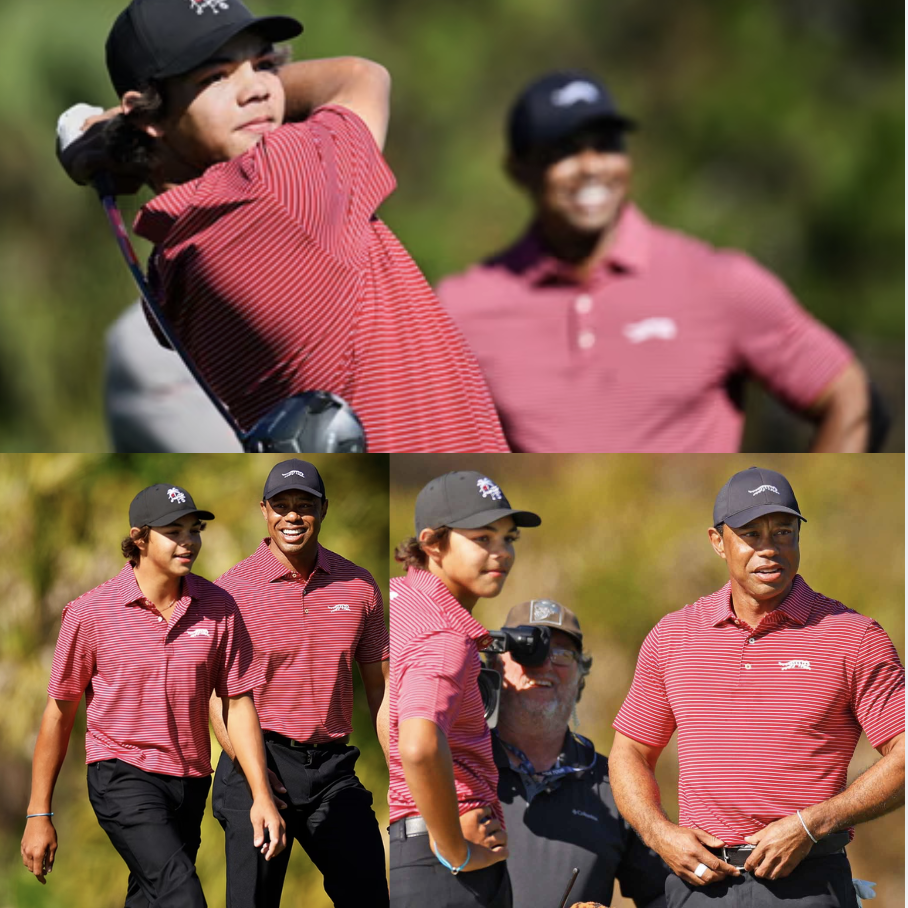
Ranked 606th. Won Anyway. Now Everyone’s Watching.
In a sport that measures progress in decimals and reputations over years, it is rare for a single week to rearrange expectations. Yet that is precisely what happened when Charlie Woods arrived at a junior event ranked 606th in the American Junior Golf Association standings—and left as its most talked-about champion.
On paper, there was little to suggest what would follow. A ranking outside the top 600 typically places a player well beyond the immediate spotlight, often still searching for consistency against elite junior competition. In a field stacked with rising prospects, Charlie’s position was not just modest—it was among the lowest. By the numbers alone, he was an outsider.
Standing on the other end of the spectrum was Miles Russell, the top-ranked junior golfer in the United States and widely regarded as one of the brightest young talents in the game. Russell’s résumé already included milestones few achieve at any age, including becoming the youngest player to make a cut on the Korn Ferry Tour. He entered the tournament in dominant form, having won three consecutive events and holding the title of AJGA Player of the Year.
The contrast could not have been sharper: a proven No. 1 versus a player ranked 606th. Experience, momentum, and expectation all pointed in one direction.
The result did not.
Over the course of the tournament, Charlie Woods delivered a performance that defied both rankings and narrative. Composed, deliberate, and increasingly confident, he separated himself from the field—ultimately finishing seven shots ahead of Russell. In junior golf, where margins are often narrow and volatility is high, such a gap against the nation’s top player is not easily dismissed as a fluke. It demands attention.
Observers noted not just the outcome, but the manner in which it was achieved. Charlie’s play reflected a level of control and patience that belied his ranking. Rather than chasing moments, he built rounds. Rather than reacting to pressure, he appeared to absorb it. For a player long viewed through the lens of potential, this was a week defined by execution.
Inevitably, comparisons followed. The surname Woods carries weight that no ranking can fully offset. As the son of Tiger Woods, Charlie has been a public figure in golf circles long before his competitive résumé could match the attention. Appearances alongside his father in exhibition events introduced him to a global audience early, often placing him in a space where expectation arrives before opportunity.
That dynamic has shaped much of the conversation around his development. Progress, for Charlie, has rarely been judged in isolation. Every round, every swing, has existed in relation to a legacy that remains one of the most dominant in the sport’s history.
What made this victory different was not just its scale, but its independence. This was not a moment shared or framed by association. It was a result earned in direct competition against the strongest peers in his age group. For perhaps the first time, the discussion shifted—if only slightly—from who he is connected to, to what he is capable of producing on his own.
In the days following the win, another development added to that sense of separation. Charlie Woods signed his first representation deal with a sports agency, choosing a path distinct from the one that has long represented his father. The decision was not accompanied by grand statements or public explanation, but its implications were clear enough.
In professional sports, representation is more than logistics. It is a signal of direction, of how an athlete intends to navigate opportunity, branding, and career progression. By aligning with a different agency, Charlie appears to be taking an early step toward defining his own framework—one that acknowledges his background without being confined by it.
The move may seem procedural on the surface, yet within the context of his recent performance, it carries a certain weight. Together, the victory and the representation choice suggest a shift from development to intention.
Attention, however, brings its own complexities. Junior golf has increasingly become a proving ground not only for skill, but for visibility. Strong performances are quickly amplified, often accelerating expectations beyond what a young player’s timeline might naturally support. In Charlie’s case, that amplification is magnified further by name recognition.
The challenge moving forward will not be a lack of opportunity, but the management of it. Consistency remains the currency of progression in golf, and a single standout week—no matter how impressive—does not redefine the long arc of development. What it can do is change the conversation, opening doors while also raising the bar.
Charlie Woods will return to competition soon, set to defend his title beginning May 21 at Pelican Golf Club. The setting will be familiar. The expectations will not.
Where he once entered as a lower-ranked participant, he now arrives as a player under close observation. Competitors will prepare differently. Spectators will watch more intently. The margin for anonymity, already narrow, has effectively disappeared.
This is the natural progression of breakthrough moments in sport. Performance creates attention; attention reshapes context. The question is not whether the spotlight will remain, but how it will influence what comes next.
For now, what can be said with certainty is simple. A player ranked 606th entered a tournament with limited expectation and left having altered how he is perceived within his field. He outplayed the top-ranked junior in the country by a decisive margin. He made choices that suggest a desire for independence. And he returns to the same course carrying a different kind of weight.
In golf, reputations are built over time, through repetition and resilience. One week does not complete that process. But occasionally, it begins it.
Charlie Woods may still be early in that journey. After this result, however, he is no longer moving unnoticed within it.