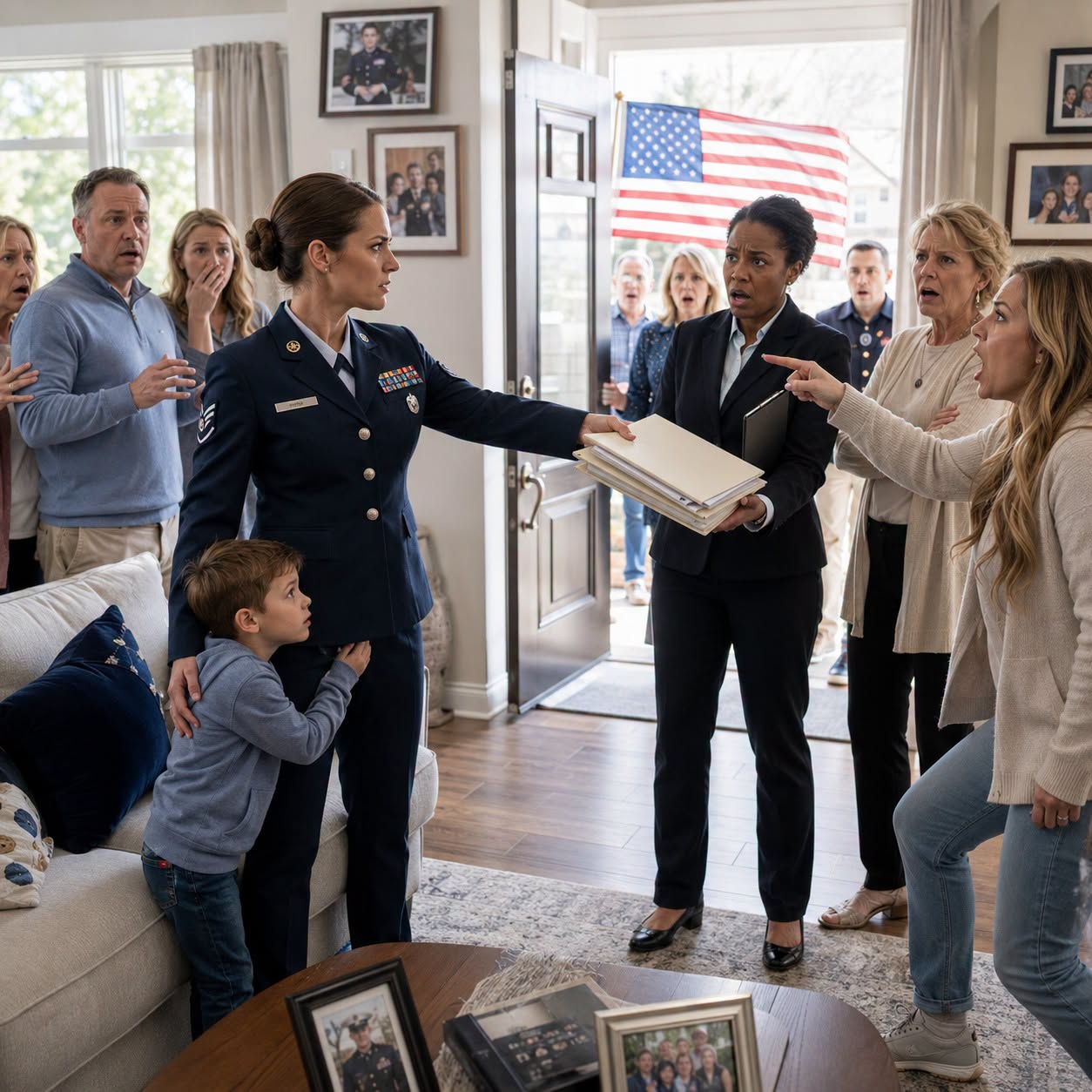
The knock came like a verdict. Four forty-seven on a Tuesday in July, the kind of afternoon that should have smelled of cut grass and sunscreen and the particular freedom of a child who still believed the world was mostly kind
I was on one knee in the entryway, wrestling the left Velcro strap of Noah’s sneaker into place while his red soccer ball waited by the door like a patient dog. Sunlight lay in clean rectangles across the hardwood. Somewhere outside, a lawn mower droned the ordinary music of suburbia.
Then the brass frame rattled under two hard, deliberate knocks.
A woman’s voice followed, steady and official through the wood.
“Ma’am, I’m with Child Protective Services. I need to speak with you about your son.”
Noah’s small fingers froze on the strap. He looked up at me with those clear blue eyes that still belonged more to his father than to me, the ones that had never learned how to doubt the people who loved him.
“Are we still going to the park?”
The question landed soft and lethal. I felt it open something under my ribs.
I stood. Smoothed the front of my navy slacks the way I used to smooth my uniform before walking into a courtroom that wanted blood. Eleven years as a Navy judge advocate had taught me the particular stillness required when the floor is about to drop. You do not flinch. You do not explain. You simply open the door and let the truth walk in on its own legs.
Marisol Trent stood on my porch in a gray blazer that had no business existing in Virginia heat. Damp curls clung to her temples. A thick manila folder pressed against her chest like a shield. She held up an identification card with the agency seal and her photograph.
“We received a report,” she said, “alleging neglect, physical mistreatment, and unsafe supervision of a minor child at this address.”
The words arrived cold and precise. I watched them settle into the warm air between us.
Behind me, Noah had moved closer. One hand found the hem of my blouse. The other still clutched the plastic dinosaur he carried everywhere, the one with the missing front tooth he insisted was a battle scar.
I did not need her to name the reporter.
Two days earlier my older sister Vanessa had stood in my kitchen while chicken soup simmered and the dishwasher hummed its ordinary song. She had spoken in that low, almost gentle voice she used when she wanted the knife to feel like kindness.
“A woman who spends her life pretending to be one of the boys has no business raising a little boy alone.”
She had looked at Noah’s backpack hanging from a chair, then at the framed photograph of me in dress whites that sat on the mantel.
“He needs a real home, Claire. Not a barracks with cartoons on the walls.”
I had asked her to leave. She had smiled the small, satisfied smile of someone who believed she had already won.
Now the government stood on my porch.
I stepped aside.
“You may come in.”
Marisol hesitated for half a second, the way people do when they expect tears or rage and receive neither. I crouched to Noah’s level instead.
“This lady needs to ask us some questions,” I told him. “We’re going to answer honestly. Then we’ll go to the park another day.”
His voice went small. “Did I do something bad?”
“No.” I held his gaze the way I once held the gaze of junior officers who needed to believe the world still had rules. “You did absolutely nothing wrong.”
I rose and led them both into the living room. The house smelled of the lemon oil I used on the floors every Sunday and the faint trace of the cinnamon oatmeal Noah had eaten that morning. Everything was in its place. The books on the low shelf were arranged by color because that was how he liked them. His drawing of a blue dinosaur with rocket boosters was taped carefully to the refrigerator. The emergency contact list was laminated and posted inside the pantry door.
Marisol sat on the edge of the couch and opened her folder. I remained standing.
She began with the expected questions. How long had I been a single parent. What was my work schedule. Who watched Noah when I was away. Had there ever been incidents of physical discipline. Did I keep firearms in the home. Had I ever left him unsupervised for extended periods.
I answered each one without embroidery. Yes, I was a single mother. My schedule was fixed and predictable; I left the office by five every day unless court demanded otherwise, and even then a trusted neighbor and a carefully vetted babysitter rotated according to a written plan I kept updated monthly. No, I did not use physical discipline. No firearms. Noah was never left alone.
She wrote everything down in neat, tight script.
When she asked about my military service, something shifted in her tone, the faintest edge of the narrative someone else had already sold her.
“I understand you spent a number of years in the Navy. Deployments. Long hours. A certain… culture.”
I met her eyes.
“I served as a judge advocate. I prosecuted and defended sailors. I did not spend my career ‘pretending to be one of the boys.’ I spent it making sure the boys—and the women—followed the law.”
She nodded once, noncommittal, and turned a page.
That was when I decided the conversation had gone far enough on her terms.
I crossed to the narrow desk against the far wall, the one that still held a brass nameplate from my last command. From the bottom drawer I took three folders. Not manila. Not the thin ones people use for grocery receipts. Heavy, labeled, color-coded the way I had been trained to prepare evidence that would survive cross-examination.
I set them on the coffee table between us with a quiet finality that made Marisol look up.
“These,” I said, “are for you.”
The first folder was labeled Medical & Developmental Records – Noah James Harrington. Inside were pediatric growth charts, vaccination records, developmental assessments, notes from his preschool teacher describing a child who was “securely attached, verbally advanced, and notably kind to younger children.” There were photographs of every well-child visit, dated and signed.
The second folder was thicker. Custody, Support & Parental Fitness Documentation. Court-ordered parenting evaluations from the divorce. Psychological assessments of both parents. Letters from Noah’s pediatrician, his teacher, the neighbor who had known him since birth. Bank statements showing consistent child support received and every dollar of it accounted for in a separate account used only for his needs. A detailed daily schedule for the past eighteen months, color-coded, with timestamps from the smart lock on the front door that recorded every entry and exit.
The third folder was the one that carried the real weight.
Prior Unfounded Allegations & Reporting Party History.
Inside were the two previous reports Vanessa had made—one when Noah was two, one when he was three—both investigated and closed as unfounded. The investigative summaries. The notes from the previous caseworkers who had found a clean home, a well-cared-for child, and a mother whose only “crime” appeared to be serving her country. And, clipped neatly at the back, a short affidavit from Vanessa’s own former husband describing a pattern of using child-protection systems as a weapon in family conflicts.
I did not speak while Marisol opened the first folder. I simply watched her face.
The living room was very quiet. Outside, a bird called once and fell silent. Noah sat on the rug with his dinosaur, making soft explosion sounds under his breath, the way children do when the adults are speaking a language they do not yet understand is dangerous.
Marisol turned a page. Then another. The professional mask she had worn on the porch began to crack at the edges. Not dramatically. Just enough that I could see the moment the story she had been handed started to come apart in her hands.
She looked up at me.
I kept my voice even.
“I never argued with my sister,” I said. “I simply prepared for the day she would try this again.”
The silence that followed was no longer ordinary.
It was the silence that comes just before the ground shifts.
Marisol Trent turned another page.
The living room held its breath with her. Afternoon light had shifted; the bright rectangles on the floor had lengthened into softer gold, and somewhere down the street a dog barked once and fell quiet. Noah remained on the rug, pushing his dinosaur in slow circles, making the soft vroom sounds that children make when the adult world has become too large and too still.
I did not sit.
I stood with my hands loosely at my sides, the same posture I had used in courtrooms when the opposing counsel believed they had already won. The three folders lay open between us like exhibits marked and ready.
Marisol’s pen had stopped moving. She read the pediatric notes first—growth percentiles, the careful handwriting of a doctor who had known Noah since he was six weeks old. Then the developmental assessments. Then the teacher’s letter describing a boy who offered his last crayon without being asked and who still checked the door every afternoon at the exact minute his mother was due home.
She closed the first folder with deliberate care and opened the second.
I watched the professional distance begin to fracture. Not in any dramatic way. Just the small tells: the slight tightening at the corner of her mouth, the way her thumb pressed harder against the edge of a bank statement, the almost imperceptible pause when she reached the psychological evaluation from the divorce proceedings. The one that had described me as “highly organized, emotionally regulated, and demonstrably attuned to the child’s needs,” and had noted, in careful clinical language, that the other parent’s attempts to characterize military service as evidence of unfitness appeared “motivated more by residual marital conflict than by any observable deficit in caregiving.”
Marisol looked up.
“These previous reports,” she said. Her voice had lost some of its official coolness. “Both closed as unfounded.”
“Yes.”
“And the reporting party was the same.”
“Yes.”
She turned to the third folder. The one that carried the weight of pattern. I saw her eyes move across the investigative summaries, the earlier caseworkers’ notes, the short affidavit from Vanessa’s former husband. When she reached the final page—the one that listed dates, case numbers, and the quiet bureaucratic language of repeated, unsubstantiated claims—she set the folder down and rested both hands on top of it.
For a moment the only sound in the room was the soft plastic scrape of Noah’s dinosaur against the rug.
Marisol exhaled through her nose.
“Mrs. Harrington—”
“Claire is fine.”
“Claire. This is… extensive. And contemporaneous. Most people in your position do not arrive at the door with documentation of this quality.”
“Most people in my position,” I said, “have not spent eleven years preparing evidence that has to survive cross-examination.”
Something like respect flickered across her face, quickly banked. She glanced at Noah, then back at me.
“I’m going to need to step outside and make a call.”
I nodded once.
She gathered the folders carefully, as though they might still contain something fragile, and walked to the front porch. Through the open doorway I could see her silhouette against the late light, phone pressed to her ear, voice low and clipped. The official cadence returned, but underneath it I heard the shift—the careful phrasing of someone who was no longer certain the story she had been handed was the true one.
Noah looked up at me.
“Is the lady mad?”
“No.” I sat on the edge of the couch, close enough that he could lean against my leg if he wanted. He did. “She’s just doing her job carefully.”
He was quiet for a few seconds, then asked the question that always arrived when the air in a room changed.
“Is Aunt Vanessa coming over again?”
The name landed between us like a stone dropped into still water.
I kept my voice even. “Not today.”
He nodded, accepting the answer the way children do when they sense the adult is holding something back, and returned to his dinosaur. I rested my hand lightly on the back of his head, feeling the fine, warm hair, and watched Marisol through the doorway.
She was still on the phone. Her free hand gestured once, sharp and contained. Then she listened for a long time. When she finally spoke again, her tone had hardened into something closer to resolve.
She ended the call, stood motionless for several seconds, and came back inside.
The folders remained in her arms.
“I’ve spoken with my supervisor,” she said. “Given the documentation you’ve provided—particularly the pattern of prior unfounded reports from the same individual—we are prepared to close this investigation pending a brief home observation and a follow-up interview next week. There will be no removal today. No safety plan required at this time.”
Relief should have arrived then. Clean. Immediate.
It did not.
Because Marisol was still holding the folders in a way that suggested the conversation was not finished. Because her eyes had not fully softened. Because something in the set of her shoulders said the call had contained more than a simple administrative decision.
She hesitated, then spoke carefully.
“There is one additional matter. The report we received this morning included a specific allegation that was not present in the previous filings. An allegation of… recent physical injury. The caller claimed to have photographs.”
The air in the room changed temperature.
I felt Noah’s small body lean more heavily against my leg. I kept my hand steady on his hair.
Marisol’s voice remained professional, but the edges had sharpened.
“I’m required to ask you directly, Claire. Does Noah currently have any unexplained bruises, marks, or injuries that I should document?”
The question hung between us, precise and dangerous.
I looked down at my son. He was still playing, still making soft explosion sounds with his dinosaur, completely unaware that the ground beneath both of us had just tilted again.
I met Marisol’s gaze without blinking.
“No,” I said. “He does not.”
She waited.
I did not elaborate.
Outside, the light continued its slow slide toward evening. Inside, the silence thickened until it felt almost solid. Marisol’s fingers tightened almost imperceptibly on the folders.
And then, from the street, a car door closed with a sharp, familiar sound.
I knew that sound.
I knew the particular rhythm of those footsteps on the walkway before they even reached the porch.
Noah lifted his head, listening.
Marisol turned toward the open door.
And Vanessa’s voice, light and almost cheerful, floated into the house as though she had been invited.
“Claire? I saw the car. I thought I’d come check on my nephew.”
PART 3
Vanessa stepped into the doorway as though the house still belonged to her in some quiet, proprietary way.
She wore a pale linen dress and a practiced expression of concern, the kind that photographed well and required no actual feeling. Her eyes moved from Marisol to me to Noah in a single, efficient sweep. When they landed on the folders still held against Marisol’s chest, something flickered—recognition, calculation—before the concern settled back into place like a mask that had momentarily slipped.
“Oh,” she said, voice soft with manufactured surprise. “I didn’t realize you already had company. I only came because I was worried. After everything I heard…”
Noah looked up from the rug. His dinosaur froze mid-motion.
“Aunt Vanessa.”
The name came out careful, not warm. Children learn the temperature of a room long before they understand the weather that caused it.
I remained seated. My hand stayed lightly on the back of Noah’s head. I did not stand. I did not offer a greeting. Eleven years of courtrooms had taught me that some people only gain power when you rise to meet them.
Marisol turned fully toward the door. The professional distance returned to her posture, sharper now.
“Ma’am, I’m going to need you to identify yourself.”
Vanessa smiled, the small, self-effacing smile she used when she wanted to appear reasonable.
“Vanessa Langford. Claire’s sister. I’ve been… concerned about my nephew for some time. I was the one who made the report. I felt I had no choice.”
She stepped farther into the room without invitation, eyes already searching for evidence of the damage she had claimed existed. Her gaze lingered on Noah’s arms, his legs, the side of his neck, looking for the marks she had promised were there.
Marisol’s voice stayed even. “Ms. Langford, this is an active investigation. I must ask you to wait outside while I conclude my conversation with Ms. Harrington.”
Vanessa’s smile did not falter, but her eyes cooled.
“I think I should stay. For Noah’s sake. Someone needs to speak for him.”
I spoke then, quietly.
“Someone already is.”
The words were simple. They landed with more force than volume.
Vanessa’s attention shifted to me. For a moment the polite mask thinned, and I saw the older sister who had spent a lifetime believing that any life different from her own was a kind of failure.
“Claire,” she said, almost gently. “You don’t have to do this alone. You’ve always been so… independent. But a little boy needs more than schedules and laminated emergency lists. He needs a mother who isn’t still fighting wars that ended years ago.”
Noah’s shoulders had gone still under my hand. I smoothed his hair once, slow, and kept my eyes on my sister.
“You made a report claiming recent physical injury,” I said. “You claimed to have photographs.”
Vanessa’s chin lifted a fraction. “I did what I believed was necessary.”
Marisol’s gaze moved between us, sharp now, assessing.
“Ms. Langford, if you have photographs or any other evidence of injury, I am required to review them immediately.”
A silence opened. It was not empty. It was the particular silence that forms when a person realizes the trap they set has begun to close around their own ankle.
Vanessa’s hand went to the small purse at her side. For a moment I thought she might produce something. Instead she hesitated, then offered another careful smile.
“I… may have spoken in haste. The photographs were from an earlier time. A scraped knee from the playground. I was upset. A sister worries.”
Marisol’s expression did not change, but the temperature in the room dropped another degree.
“So there are no current photographs of injury.”
“No.”
“And the allegation of recent physical mistreatment was made without supporting evidence.”
Vanessa’s mouth tightened. “I was trying to protect him.”
I looked at my son. He was watching the adults the way children watch storms—quiet, alert, waiting to see which way the wind would break.
I spoke without raising my voice.
“Noah. Show Ms. Trent your arms, please. And your legs.”
He looked at me first, seeking permission in my face. I nodded. He stood, set the dinosaur carefully on the rug, and held out both arms. Then he lifted the legs of his shorts without being asked. There were no bruises. No marks. Only the ordinary scrapes of a five-year-old who still believed climbing and falling were part of the same game.
Marisol examined him with the practiced, clinical attention of someone who had seen too many children who did not look like this. She noted the absence of injury in her notebook with a single, decisive line.
When she finished, she straightened and addressed Vanessa directly.
“Ms. Langford, making a report to Child Protective Services that you know—or reasonably should know—to be false is a serious matter. The documentation already provided by Ms. Harrington shows a clear pattern of prior unfounded reports from the same reporting party. Combined with the retraction of the photographic evidence you claimed to possess, this raises significant concerns about the credibility of the current allegation.”
Vanessa’s composure finally cracked, just enough to show the heat underneath.
“You’re going to take her side? After everything? She’s a single mother who spent years away from home playing soldier. That doesn’t suddenly make her stable.”
I stood then.
Not quickly. Not with anger. I simply rose, placed myself between my sister and my son, and met her eyes the way I had once met the eyes of witnesses who believed the truth was optional.
“I never argued with you, Vanessa,” I said. “Not when you called me unfit. Not when you told people I was raising a child in a barracks. Not when you decided that my service was somehow a moral failure. I didn’t argue because I didn’t need to. I prepared.”
I glanced once at the folders still in Marisol’s hands.
“Those records don’t care about your opinions. Neither does the law.”
Vanessa stared at me. For the first time something like real uncertainty moved across her face.
Marisol closed her notebook with a quiet, final sound.
“Ms. Langford, I’m going to ask you to leave the property now. If you have any further concerns, you may submit them in writing through the proper channels. Any additional unfounded reports will be documented and may be referred for review regarding misuse of the reporting system.”
Vanessa looked from Marisol to me to Noah. The careful concern she had worn into the house had nowhere left to go. She opened her mouth once, closed it, and then turned without another word. Her footsteps retreated down the walkway. The car door closed. The engine started and faded into the ordinary evening traffic.
The house settled around the three of us.
Marisol exhaled, the first unguarded breath she had taken since arriving.
“I’ll complete the necessary paperwork this evening,” she said. “The investigation will be closed. There will be a formal note regarding the reporting party’s history. You won’t hear from us again regarding this matter.”
She looked at Noah, who had returned to his dinosaur as though the storm had passed without touching him, and then at me.
“You’re a careful mother, Claire. The record shows that clearly.”
I nodded once. There was nothing more that needed saying.
After she left, the porch light clicked on automatically against the deepening dusk. I locked the door, then sat on the floor beside Noah. He leaned into my side without being asked, the way he always did when the day had been too full of adult voices.
“Are we still going to the park?” he asked, voice small but hopeful.
I rested my cheek against the top of his head and closed my eyes for a moment.
“Tomorrow,” I said. “First thing.”
Outside, the July evening continued its ordinary business. Inside, the house was quiet again. Not the brittle quiet of earlier, but the deeper quiet that comes after a long-held breath is finally released.
I had not raised my voice.
I had not pleaded.
I had simply handed over the truth, already organized, already waiting.
And for the first time in a long while, the truth had been enough.