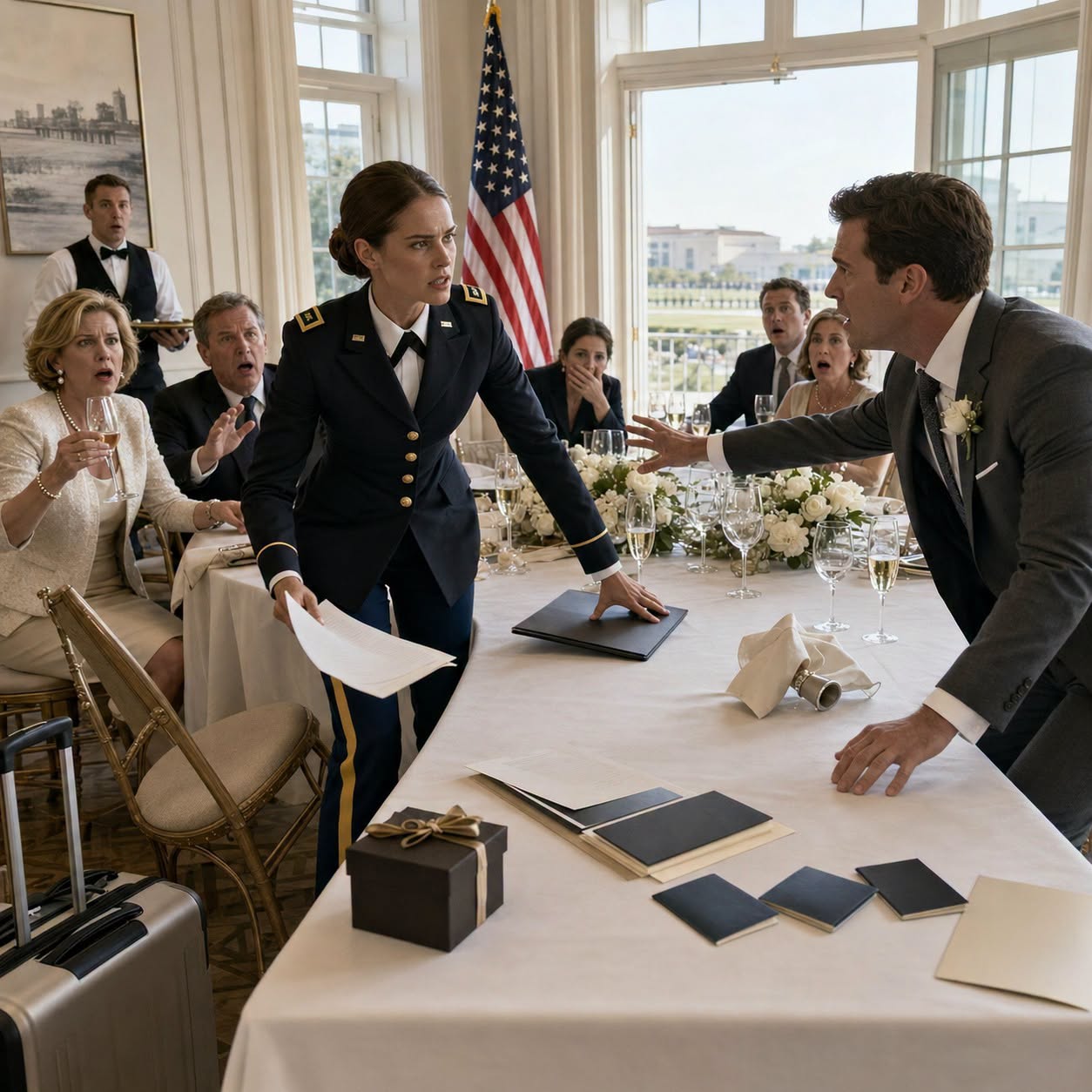
They spoke French as if the soldier at the table were furniture. I had been granted leave for my wedding. Fourteen days. After six years of service, after deployments that swallowed birthdays and holidays and the ordinary texture of a life, the Army had finally given me time to marry the man I loved. That same night his parents flew in from Europe. They sat at our table, smiled with practiced warmth, and discussed—in rapid, elegant French—exactly how they intended to end the engagement before the ceremony could take place
They never once considered that I might understand every word.
The envelope arrived on a gray Monday while rain tapped the narrow windows of the administrative building like impatient fingers. I read the dates three times. Fourteen days. Not the usual four-day pass that vanished before the body could remember what rest felt like. Real leave. The kind that allowed a person to stand in one place long enough to make a promise.
I called Adrian before I left the building.
He answered on the second ring. “Please tell me that silence means good news.”
“I got it.”
There was a long breath on the other end, then the broken sound of a man trying not to cry and failing. “You’re coming home?”
“I’m coming home.”
Three days later I stepped off a bus in Riverton, Virginia, in civilian clothes that still felt like borrowed skin. Adrian waited at the curb with flowers in one hand and coffee in the other—two sugars, no cream, lid pressed down twice because he knew I hated spills. When he pulled me against him I breathed in cedar soap, cold air, and the faint graphite scent that clung to him after long days at the architecture studio. For the first time in months my shoulders dropped.
Our wedding was ten days away. Small. An old converted farmhouse outside town, white lights strung through the oaks, dinner in a glass-walled barn. Adrian had carried most of the planning while I was overseas. There was only one element that still made something tight coil low in my chest.
His parents.
Lucien and Colette Mercer lived outside Lyon. We had spoken over video calls that never lasted long enough to become real. Colette asked about the weather. Lucien asked about my rank. Neither of them ever asked what I loved about their son. Adrian insisted they were simply traditional, the kind of people who required time and proof.
“They’ll love you once they know you,” he said as we drove toward his house.
I wanted to believe him. I needed to.
They arrived the following evening with Adrian’s younger sister, Camille. Adrian had prepared a welcome dinner—candles, roasted chicken, good bread, the expensive wine his father preferred. Colette entered in a cream coat that somehow remained immaculate after travel, trailing a perfume of white flowers and sharp pepper. She looked at me for half a second, then pulled me into an embrace that felt less like affection and more like assessment. Her fingers pressed firmly between my shoulder blades, testing the density of bone and muscle, as if measuring something she might later need to break.
“At last,” she said in lightly accented English. “The famous soldier.”
Lucien was quieter, taller, silver at the temples, eyes the same cool gray as Adrian’s but without the warmth. He shook my hand with precise pressure and immediately turned to examine the wine bottles on the sideboard.
We sat down to dinner.
For the first twenty minutes the conversation remained carefully bilingual and polite. Camille asked about the farmhouse. Adrian talked about the lighting design. I answered questions about the base, about the weather in Virginia, about nothing that mattered. Then, as if a silent signal had passed between them, Colette and Lucien switched entirely to French.
They did not lower their voices.
They simply assumed.
I kept my expression neutral and continued cutting my chicken into smaller and smaller pieces while their words arrived clear and cold across the table.
Colette spoke first, her tone light, almost affectionate. “She is competent, I’ll grant that. The posture, the discipline. But competence is not breeding. Adrian has always had a weakness for women who look like they can survive things. It is romantic until it becomes permanent.”
Lucien’s reply was softer, more measured. “The family name carries weight in certain circles. A military wife from nowhere complicates that. There are expectations. There are people watching. We cannot simply smile and accept it because he is temporarily infatuated.”
Camille glanced at me once, then quickly away. She said nothing.
Colette continued, almost gently. “We have already spoken with the notary in Lyon. There are ways to make an engagement… difficult. Financial pressure. Social pressure. A few carefully placed conversations with the right families. If necessary, we can delay the ceremony indefinitely. Or ensure it never happens at all.”
Lucien set down his glass. “He will listen to us eventually. He always does when it matters. She is a phase. Soldiers often are.”
Adrian, who had never learned more than restaurant French, smiled at something Camille said in English and reached for the bread basket, completely unaware.
I sat very still.
The plan unfolded with the calm precision of people who had already decided the outcome and were merely discussing logistics. They would not confront me directly. They would not create a scene. They would simply apply quiet, relentless force until Adrian chose blood over the woman sitting across from him. And they believed I would never know.
For a long moment the only sound in the room was the soft clink of cutlery and the rain beginning again outside the windows.
Then I set my fork down.
The room fell dead silent.
PART 2
I set my fork down with deliberate care.
The soft metallic sound cut through the room more sharply than any raised voice could have. Candlelight trembled across the polished wood. Outside, rain had begun again, a steady hush against the windows. Inside, no one moved.
Colette’s smile remained fixed for half a second too long. Lucien’s fingers tightened once around the stem of his wineglass. Camille stared at her plate as if the pattern of the porcelain had become suddenly fascinating. Only Adrian looked genuinely puzzled, glancing between us with the open, unguarded expression of a man who still believed the evening was unfolding normally.
I met Colette’s eyes and answered her in French.
My accent was not perfect—years of military briefings and field reports had roughened the edges—but it was clear, precise, and unmistakably fluent.
“You were discussing logistics,” I said. “How to end an engagement without creating a scene. Financial pressure. Social pressure. Conversations with the right families. A phase. A soldier from nowhere.”
The silence that followed was denser than the first.
Adrian’s face changed first—confusion sharpening into something closer to alarm. “Eleanor?” he said quietly. “What—”
Colette recovered with impressive speed. The warmth drained from her expression as cleanly as if a switch had been thrown. She set her napkin beside her plate and regarded me with new, colder interest.
“You speak French,” she said. Not a question.
“I do.”
Lucien’s voice was lower. “And you chose not to mention this.”
“I chose to listen.”
Something dangerous flickered behind Colette’s eyes—calculation, recalibration, the swift adjustment of someone who had just discovered the board was not arranged as she believed. She did not apologize. She did not soften. Instead she leaned back slightly, studying me the way one might study an unexpected obstacle on a map.
“Then you understand our concerns are not personal,” she said in English now, switching languages with the ease of someone accustomed to controlling the terrain of a conversation. “They are practical. Adrian has responsibilities that extend beyond romantic attachment. Our family has standing. Expectations. A marriage is not merely a private arrangement between two people.”
“It is for us,” Adrian said. His voice had gone quiet in a way I recognized—the tone he used when something precious was being threatened and he was still deciding how hard to fight. “I love her. We’re getting married in ten days.”
Colette’s gaze flicked to him, briefly softening with the practiced affection of a mother who had long ago learned how to wound without raising her voice. “You are young. You have always been idealistic. That is part of what makes you remarkable. But idealism does not protect a family name. It does not navigate the circles we move in. She is admirable in her way. Competent. Disciplined. But she is not—”
“Don’t,” Adrian said.
The single word landed with unexpected force. Camille flinched. Lucien’s expression tightened.
I kept my hands still on the table. Years of training had taught me how to remain motionless while everything inside accelerated. Rage was there, cold and precise. Humiliation was there too—the particular sting of being discussed like a logistical problem while sitting three feet away. But beneath both was something steadier: the hard clarity that came when a threat finally stepped into the open.
“You planned to apply pressure until he chose you over me,” I said. My voice remained even. “You assumed I would never know. You assumed, even if I did know, that I would accept it quietly because soldiers are trained to endure.”
Colette’s mouth curved, almost regretful. “Endurance is useful. It is not the same as belonging.”
Lucien spoke then, measured and final. “We are not monsters, Eleanor. We are protecting what matters. Adrian will understand in time. Young men often require guidance when emotion clouds judgment.”
Adrian pushed his chair back. The sound was abrupt in the quiet room. He stood, looking at his parents as if seeing the shape of something he had refused to name for years.
“You came into my house,” he said, “sat at my table, and planned—while she was sitting right there—to destroy the life we’re building. And you did it in a language you believed she couldn’t understand so you wouldn’t have to look her in the eye while you did it.”
Colette rose as well, smooth and controlled. “We did what was necessary. You will thank us later.”
“No,” Adrian said. “I won’t.”
The air between them felt charged, brittle. Camille remained frozen in her seat, eyes wide, caught between loyalty and horror. Lucien watched his son with the assessing stillness of a man recalculating distances and outcomes.
I stood last.
The movement drew every gaze back to me. I looked at Colette, then at Lucien, and spoke once more in French—quietly, clearly, without heat.
“You miscalculated.”
Colette’s expression did not change, but something in her posture shifted by a fraction. Lucien’s eyes narrowed.
Adrian’s hand found mine under the table’s edge. His fingers were cold. Mine were steady.
Outside, the rain hardened against the windows. Inside, the candles continued to burn, casting long, unstable shadows across faces that would never again arrange themselves into the polite shapes of earlier that evening.
No one spoke.
The next move belonged to someone.
And for the first time since I had stepped off that bus in Riverton, I understood that the real battle of this wedding would not be fought in a glass-walled barn under white lights.
It had already begun.
PART 3
No one moved for a long time.
The rain continued its steady assault on the windows. Candle flames leaned and recovered in the small drafts that found their way through the old house. Somewhere in the kitchen a clock ticked with indifferent precision. I remained standing, Adrian’s hand still closed around mine, and watched the careful architecture of the Mercers’ composure begin to fracture.
Colette was the first to speak. Her voice had lost its earlier silk. What remained was cooler, more metallic.
“You are making a mistake,” she told her son. “Both of you. Emotion is persuasive in the moment. It is rarely wise in the long view. We have given you every opportunity to see reason without forcing a public rupture. If you insist on proceeding, you will do so without our support. Financially. Socially. In every way that matters.”
Adrian did not look away from her. “Then we will proceed without it.”
Lucien’s chair scraped softly as he rose. He was taller than his son, broader across the shoulders, and for a moment the resemblance between them felt almost cruel—the same bone structure arranged into entirely different expressions. Where Adrian’s face held open grief and resolve, Lucien’s held only the closed calculation of a man already measuring losses.
“You are prepared to damage your future for a woman you have known for less time than some of our business partnerships?” he asked.
“I’m prepared to protect the future I actually want,” Adrian answered. “The one that includes her.”
Camille finally looked up. Her eyes were bright, uncertain. For a second I thought she might speak—might choose a side out loud—but she only pressed her lips together and lowered her gaze again. Some loyalties are heavier than others. Some take longer to set down.
Colette gathered her coat from the back of her chair with deliberate grace. The perfume of white flowers and pepper stirred once more as she moved. She paused beside me, close enough that I could see the fine lines at the corners of her eyes, the expensive restraint of her makeup, the faint tremor of controlled fury in the hand that adjusted her sleeve.
“You may win this evening,” she said quietly, in French again, as if the language itself might still grant her some private advantage. “Do not mistake it for winning the war. Families like ours have long memories. And longer reach.”
I met her stare without blinking. “Then you should remember that soldiers do too.”
Something unreadable passed through her expression—respect, perhaps, or simply the acknowledgment of an opponent who would not be easily dismissed. She turned away without another word.
Lucien followed. At the threshold he stopped and looked back at Adrian one final time. “When this ends badly, and it will, do not expect us to repair what you are choosing to break tonight.”
Adrian’s voice was steady. “I won’t.”
The front door closed behind them with a soft, final click. Camille hesitated, torn, then murmured a strained apology and hurried after her parents into the rain. The house exhaled into sudden, ringing quiet.
For several seconds neither of us spoke. Adrian’s hand remained in mine, but his grip had loosened. When I finally looked at him, his face was pale, the muscle in his jaw working once before he mastered it.
“I’m sorry,” he said. The words came out rough. “I should have seen it. I should have protected you from them long before tonight.”
I shook my head. “You couldn’t have known they would go this far.”
“I knew what they were capable of.” He released my hand only long enough to drag both of his through his hair, then reached for me again, both palms framing my face with a carefulness that felt almost reverent. “I kept telling myself they would come around. That once they met you—really met you—they would understand. I was wrong. And you had to sit there and listen to them plan the destruction of us while I smiled like an idiot and passed the bread.”
The shame in his voice cut deeper than anything his parents had said.
I covered his hands with my own. “You stood up. When it counted, you stood up. That matters more than the years of hoping they would be better.”
He leaned his forehead against mine. We stayed like that while the candles burned lower and the rain softened against the glass. In the quiet I felt the old soldier’s instinct rise—the need to assess damage, secure the perimeter, plan the next movement. But beneath it something quieter and more dangerous had taken root: the understanding that love, real love, was not the absence of battle. It was the decision to fight the right one.
After a long time Adrian spoke again, voice low against my skin.
“The wedding is still in ten days.”
“Yes.”
“They won’t come.”
“I know.”
“Some of the guest list will thin. Some of the funding will disappear. It will be smaller. Quieter. Possibly harder.”
I pulled back just far enough to meet his eyes. In them I saw the same man who had waited at the curb with coffee made exactly the way I liked it, who had planned a wedding across an ocean while I was deployed, who had just walked away from the only family he had ever known because the alternative was losing me.
“Then it will be ours,” I said. “Completely ours.”
A breath shuddered out of him—half laugh, half release. He kissed me then, not with the desperate heat of reconciliation, but with the slower, deeper certainty of someone who has chosen and will keep choosing. When we finally parted, the house felt different. Emptier of certain ghosts. Fuller of something else.
Outside, the storm was beginning to pass. Inside, we stood in the wreckage of an evening that had rewritten the terms of everything that would follow. The farmhouse, the lights in the oaks, the glass-walled barn—all of it still waited. So did the quieter, harder work of building a life without the approval we had once hoped to earn.
I had come home on leave to get married.
I had not expected to go to war at the dinner table.
But I had been trained for both.
And this time, the person standing beside me already knew which side he was on.
THE END