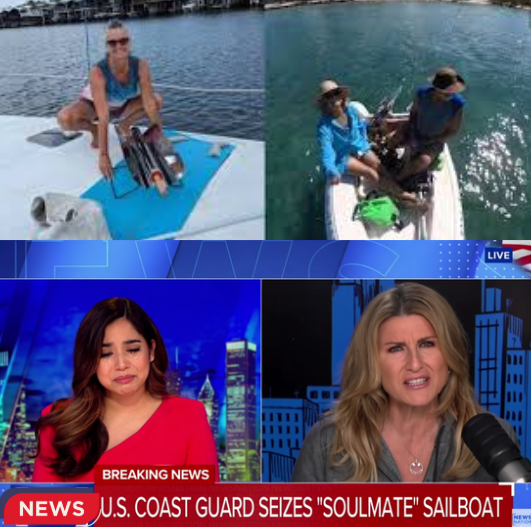
Lynette Hooker disappearance: US Coast Guard seizes sailboat
The turquoise waters of the U.S. Virgin Islands, typically a backdrop for luxury charters and idyllic vacations, have become the center of a somber federal investigation. The U.S. Coast Guard (USCG) recently confirmed it has taken physical custody of the Soulmate, a hired sailboat that served as the final known location of Lynette Hooker, a Michigan woman who vanished last month. The case, marked by conflicting emotions and rigorous forensic protocols, highlights the immense difficulty of investigating “man overboard” incidents in maritime environments.
This report examines the timeline of the disappearance, the technical significance of the vessel’s seizure, the challenges of maritime forensics, and the legal framework governing disappearances in territorial waters.
1. The Incident: A Night on the Water Turned Tragic
In early April, Lynette Hooker and her husband, Rawn Hooker, were enjoying a sailing excursion near St. Thomas. According to statements provided by Rawn Hooker to authorities, the trip took a devastating turn when Lynette allegedly fell into the water during a period of “choppy” sea conditions.
The Husband’s Account
Rawn Hooker reported that his wife went overboard while the vessel was in transit. In his communication with search and rescue teams, he described a sudden accident fueled by the movement of the boat and the state of the sea. Immediately following the report, the USCG launched an intensive search-and-rescue (SAR) operation involving cutters, aircraft, and local volunteers.
The Search and Rescue Effort
For several days, search crews scanned hundreds of square miles of the Caribbean Sea. The USCG utilized sophisticated modeling software—the Search and Rescue Optimal Planning System (SAROPS)—to predict drift patterns based on currents, wind speed, and water temperature. Despite these efforts, no sign of Lynette was found, and the active search was eventually suspended, transitioning the case from a rescue mission to a recovery and investigative one.
2. Taking Custody: Why the ‘Soulmate’ is Critical
The decision by USCG investigators to take custody of the Soulmate represents a significant escalation in the procedural handling of the case. While often a standard move in high-profile disappearances, it signals that authorities are looking beyond a simple accident.
Preservation of Evidence
The Soulmate is no longer just a sailboat; it is a crime scene—or, at the very least, a primary site of forensic interest. By taking custody, the USCG ensures that:
- Physical Integrity: No unauthorized persons can alter the deck, rigging, or interior of the cabin.
- Trace Evidence: Investigators can look for biological markers, signs of a struggle, or mechanical failures that might contradict or support the initial report.
- Electronic Data: Modern charter boats are equipped with GPS, Chartplotters, and sometimes Automatic Identification Systems (AIS). This data can provide a second-by-second account of the boat’s speed, heading, and exact location at the time Lynette was reported missing.
The “Choppy Water” Variable
A key focus for investigators will be verifying the environmental claims. If the husband cited “choppy waters” as a contributing factor, forensic meteorologists will cross-reference the vessel’s GPS logs with historical weather data from the National Oceanic and Atmospheric Administration (NOAA). If the data shows the seas were calm at the logged coordinates, it raises immediate red flags for the investigation.
3. The Forensic Challenge of the Maritime Environment
Investigating a disappearance at sea is fundamentally different from a land-based investigation. The ocean is a dynamic environment that actively destroys evidence.
The “Man Overboard” (MOB) Analysis
Investigators will perform a “reconstruction” of the fall. They will look at the height of the lifelines, the slip-resistance of the deck, and the stability of the Soulmate model. Could a person of Lynette’s height and weight accidentally tumble over the side?
- Mechanical Inspections: Were the railings secure? Was there a malfunction in the boat’s steering that caused a sudden jolt?
- Toxicology and Health: While sensitive, investigators must look into the physical state of both parties, including potential use of medication or alcohol, which is common on leisure charters.
The Absence of a Body
The most harrowing aspect of this case is the lack of a physical recovery. In many maritime cases, without a body, the investigation relies entirely on circumstantial evidence and the integrity of the vessel’s logs. The USCG Investigative Service (CGIS) often works alongside the FBI in these instances, especially when the missing person is a U.S. citizen on a vessel that may have touched international or varying territorial jurisdictions.
4. The Michigan Connection: A Family in Limbo
Back in Michigan, the community and Lynette’s family are grappling with the uncertainty. Disappearances like this create a unique form of “ambiguous loss,” where the lack of a body prevents the traditional grieving process.
Lynette Hooker has been described by friends as a vibrant woman, and her disappearance has sparked a wave of social media activity calling for “Justice for Lynette.” The family’s involvement and their pressure on federal authorities often play a role in how many resources are dedicated to a case once the initial search ends.
5. Legal and Jurisdictional Complexities
The U.S. Virgin Islands (USVI) present a complex jurisdictional map. While it is a U.S. territory, the surrounding waters can quickly transition into British Virgin Islands (BVI) territory or international waters.
The Role of the USCG Investigative Service (CGIS)
The CGIS is the federal law enforcement arm of the Coast Guard. Their involvement in taking custody of the Soulmate suggests they are exercising their authority under Title 14 of the U.S. Code, which gives the Coast Guard broad power to investigate marine casualties and incidents involving U.S. vessels or citizens.
Potential Outcomes
- Accidental Death: If the evidence on the Soulmate aligns perfectly with Rawn Hooker’s story, the case may eventually be closed as a tragic accident.
- Negligence: If the charter company or the operator failed to maintain safety equipment, civil or criminal negligence charges could follow.
- Criminal Foul Play: If forensic evidence (blood spatter, signs of a struggle, or inconsistent GPS data) suggests a non-accidental event, the case will shift into a criminal prosecution.
6. The Broader Context: Safety in the Charter Industry
The disappearance of Lynette Hooker brings renewed scrutiny to the private sailboat charter industry in the Caribbean.
- Safety Protocols: Many “hired” boats or small charters do not have the same rigorous “Man Overboard” alarms found on massive cruise ships.
- The “Solo Witness” Problem: In many private charters, a husband and wife are the only people on board. If one disappears, the only witness is the surviving spouse, creating a massive evidentiary hurdle for investigators.
7. Conclusion: Waiting for the Water to Give Up Its Secrets
As the Soulmate sits in a secure USCG facility, it remains the most vocal witness in the disappearance of Lynette Hooker. Every fingerprint, every line of digital code in the GPS, and every scratch on the hull will be scrutinized.
For the family in Michigan, the seizure of the boat is a step toward answers, though those answers may be painful. The investigation serves as a reminder that the sea is unforgiving, and when life is lost in its depths, the path to truth is often as turbulent as the waters themselves.
The USCG has not yet named a suspect or officially declared the incident a crime, maintaining that the investigation is ongoing. However, by taking custody of the sailboat, they have ensured that if the truth is on that boat, it will be found.