The Officer’s Salute Revealed the Truth My Stepmother Tried to Bury
PART 2
For one impossible second, I forgot how to breathe.
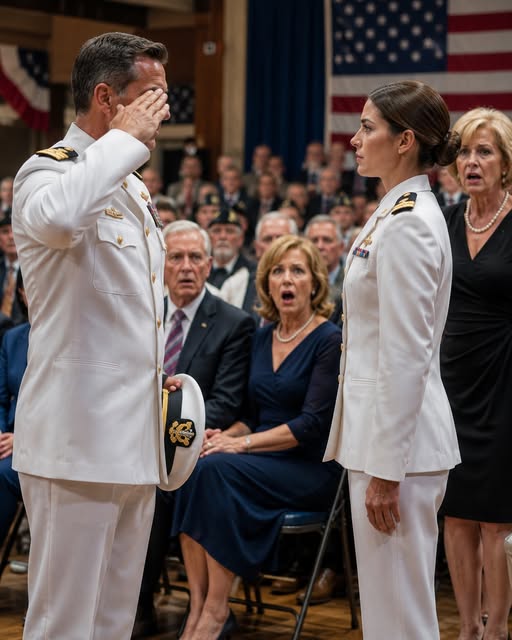
The officer’s hand remained raised in a salute, crisp and unwavering beneath the bright lights of the Veterans Hall. Around us, the room held its silence as though someone had pressed a hand over the mouth of the entire town.
I knew that salute.
I knew what it meant.
And I knew it was not supposed to happen here.
Not in front of my father.
Not in front of Gloria.
Not in front of the people who had spent the whole evening lowering their voices when I passed by.
Slowly, instinct overtook shock. My shoulders squared. My chin lifted. I returned the salute.
The tray I had set down beside me still rattled faintly from the movement, glasses chiming together like nervous little bells.
The officer lowered his hand first.
“Commander Parker,” he said.
The title landed in the hall like a stone dropped into still water.
A murmur moved through the room.
Commander.
Not former sailor.
Not failed recruit.
Not the poor girl who couldn’t handle the Navy.
Commander.
I felt every pair of eyes on me, but the only face I looked at was my father’s.
He stood near the front row, one hand resting on the back of a chair. His expression had gone completely still. Not angry. Not proud. Not confused.
Just stunned.
Beside him, Gloria’s smile had vanished so completely it was almost hard to believe it had been there moments before.
The officer turned slightly toward the room.
“For those of you who do not know me,” he said, his voice steady and formal, “I’m Rear Admiral Thomas Hayes, United States Navy. I apologize for interrupting the program, but I was instructed to deliver something personally.”
His gaze returned to me.
“And I was told not to leave until I had done so.”
My stomach tightened.
“Sir,” I said quietly, “this wasn’t necessary.”
A faint smile touched the corner of his mouth.
“That’s what you said last time too.”
A few people exchanged uncertain looks. They didn’t understand the meaning behind his words, but I did.
Last time had been in a closed conference room at Norfolk, behind secured doors, after months of classified work, sleepless nights, and a decision that had cost me more than anyone in this room could guess.
Admiral Hayes reached inside his jacket and removed a slim navy-blue folder embossed with a gold seal.
I stared at it.
The small card in my coat pocket suddenly felt heavy.
He held the folder out with both hands.
“Commander Emily Parker, by authority of the Secretary of the Navy, and on behalf of the Office of Naval Intelligence, I have the honor of presenting official commendation for exceptional service, leadership, and discretion during Operation Lantern Watch.”
The words moved through the hall, but only a few of them seemed to make sense to the crowd.
Exceptional service.
Leadership.
Discretion.
Someone near the coffee station whispered, “Operation what?”
Admiral Hayes didn’t explain.
He couldn’t.
That was the whole point.
I accepted the folder because protocol demanded it, though every part of me wanted to disappear through the nearest exit.
“Thank you, sir,” I said.
His eyes softened in a way only I could see.
“You earned more than a folder.”
Then, louder, he said, “Ladies and gentlemen, Commander Parker’s service record cannot be discussed in detail. What can be stated is this: she did not fail in the Navy. She did not leave under disgrace. She has served her country with distinction in ways most people will never hear about, and she has carried that silence with remarkable dignity.”
The words struck harder than any insult could have.
Not because they were grand.
Because they were true.
For years, silence had been my uniform.
Silence when people asked why I missed holidays.
Silence when my father left voicemails I couldn’t return.
Silence when rumors filled in the spaces where explanations should have been.
I had told myself I was used to it.
But standing in that hall, with Admiral Hayes giving voice to what I had not been allowed to say, something inside me trembled.
The emcee stood frozen on stage, program cards clutched in both hands.
Admiral Hayes turned toward him with professional courtesy.
“I apologize again for the interruption. Please continue.”
But no one moved.
The entire ceremony had shifted around me.
I wanted to sit down. I wanted the floor to open. I wanted my father to stop staring at me as though I had become someone he didn’t recognize.
Instead, Admiral Hayes stepped beside me and lowered his voice.
“May I speak with you privately after the ceremony?”
I nodded.
“Yes, sir.”
His expression changed, just slightly.
There was something else in his eyes.
Not ceremony.
Not pride.
Concern.
Before I could ask, he turned and walked toward the front row, where my father finally remembered how to move. Dad stepped forward automatically, shook the admiral’s hand, and said something too low for me to hear.
Gloria remained beside him, her face pale beneath the carefully applied makeup.
I picked up the tray again because I needed something to do with my hands.
A man I recognized from church cleared his throat as I passed him.
“Commander Parker,” he said awkwardly, accepting a glass of water.
The title sounded strange from him.
Respectful.
Uneasy.
I gave him a small nod.
A few minutes later, the ceremony resumed, but the atmosphere had changed. Every speech, every applause break, every mention of service and sacrifice seemed to bend subtly toward the back row where I had tried so hard to become invisible.
I sat down and opened the folder just enough to see the first page.
My name.
My rank.
A commendation written in careful, restrained language.
And beneath it, a second sealed envelope.
My fingers stilled.
That envelope had not been part of the commendation.
It was marked with my full name in handwriting I recognized.
Captain Daniel Mercer.
My former commanding officer.
A man who had died eight months earlier.
My throat tightened.
I closed the folder immediately.
Across the room, my father was no longer watching the stage. He was watching me.
When the final hymn ended and the crowd rose to mingle, people approached me in hesitant waves.
Some were kind.
Some were curious.
Some looked embarrassed.
Miss Bev from the coffee shop touched my arm and whispered, “Honey, I’m sorry.”
“For what?” I asked gently.
Her eyes filled with regret.
“For listening.”
That was the most honest apology anyone gave me that night.
Others tried to dress their discomfort in compliments.
“Well, you certainly kept that quiet.”
“Your father must be proud.”
“We had no idea.”
No, I thought.
You didn’t.
But you were comfortable deciding anyway.
Still, I smiled when I could. I answered what I could. I avoided what I couldn’t.
Gloria did not approach me.
She moved through the hall with stiff grace, collecting empty cups and speaking too brightly to anyone who would listen. But people were listening differently now. Their eyes flicked from her to me, then away.
Not accusing.
Just aware.
That was enough.
I eventually slipped into the hallway near the coatroom, grateful for the dimmer lights and cooler air. I pressed the folder against my chest and let out a breath I had been holding all evening.
“Emily.”
My father’s voice came from behind me.
I closed my eyes briefly before turning.
He stood several feet away, uncertain in a way I had rarely seen. Robert Parker had always seemed like a man built from oak and discipline. A retired Army sergeant who believed problems could be solved with punctuality, hard work, and silence.
Now he looked old.
Not weak.
Just older than he had that morning.
“Dad.”
He glanced at the folder.
“Commander?”
I tried to smile.
“It happened a while ago.”
“A while ago,” he repeated.
There was hurt in his voice. Not anger yet. Hurt.
I looked down.
“I couldn’t tell you much.”
“You couldn’t tell me your rank?”
“I could have,” I admitted. “But by the time I could, I didn’t know how.”
He absorbed that quietly.
From the hall, applause rose as someone announced a raffle winner. The normal sounds of a community event carried on, unaware of the small fracture opening between father and daughter in the hallway.
“I thought you left,” he said.
“I know.”
“Gloria said—”
He stopped himself.
I waited.
His jaw tightened.
“She said you were embarrassed. That you didn’t want anyone asking questions. That you needed space.”
I looked at him sharply.
“She told you that?”
His eyes searched mine.
“You didn’t call much.”
“I couldn’t always call.”
“You didn’t visit.”
“I wasn’t always in the country.”
He looked away, the pieces shifting behind his eyes.
For years, I had thought my father chose distance because silence was easier than disappointment. Now, standing beneath the buzzing hallway light, I wondered how much of that distance had been built by someone else’s careful hands.
“Dad,” I said softly, “what exactly did Gloria tell you?”
Before he could answer, footsteps approached.
Gloria appeared at the end of the hall.
“There you are,” she said, breathless but smiling. “People are asking for photos. Robert, the mayor wants one with you and Admiral Hayes.”
My father did not move.
Gloria’s eyes flicked to the folder in my hands, then to me.
“Emily, that was certainly unexpected.”
Her tone was smooth, but something brittle lived beneath it.
“Yes,” I said. “It was.”
She gave a light laugh.
“Well, you can hardly blame anyone for being confused. You never explained anything. People fill in blanks.”
“Some people filled them in more eagerly than others,” I replied.
Her cheeks colored.
Dad looked between us.
“Gloria,” he said slowly, “what did you tell me about Emily leaving the Navy?”
She blinked.
“What?”
“You heard me.”
A small silence stretched between the three of us.
Then Gloria sighed, as though exhausted by unfairness.
“Robert, this is not the place.”
“It seems like the place where everyone else heard it.”
Her mouth tightened.
“I repeated what I understood.”
“And what did you understand?”
She glanced toward the hall, where guests moved in warm clusters of conversation.
“I understood that Emily came home less and less. That she avoided family events. That she refused to discuss her work. That she acted like this town was beneath her.”
“That isn’t what I asked,” Dad said.
His voice was calm, but I knew that tone. It was the one he used when something mattered.
Gloria looked at me then, and for the first time that day, the polished sweetness disappeared.
“You let people wonder,” she said. “You let your father worry. You could have said something.”
“I did say something,” I replied. “I told you more than once that I was still serving.”
Her eyes flickered.
Dad went very still.
“When?” he asked.
I didn’t answer right away.
Memory rose: phone calls Gloria answered before Dad came to the line. Messages that never received replies. Christmas cards returned unopened because “the address must have changed.” One email from Dad, strangely cold and brief, asking me not to bring “military drama” to a family fundraiser.
I had assumed the words were his.
Now I wasn’t sure.
“Emily,” Dad said, quieter this time, “when did you tell her?”
I looked at Gloria.
“When she asked me not to wear my uniform to Mom’s memorial service.”
My father flinched as if struck.
Gloria inhaled.
“That is not fair.”
“It was three years ago,” I said. “I had just come back from deployment. I told you I was still active duty. You said the uniform would draw attention.”
Dad’s face changed.
My mother’s memorial had been small, held ten years after her passing when the church dedicated a garden in her name. I had flown in late, exhausted and grieving in a way I hadn’t expected. I remembered standing in the guest room with my dress uniform pressed and ready, then Gloria at the door saying Dad thought it might be better if I wore something simple.
Dad thought.
That phrase had done a lot of damage in my life.
“I never said that,” my father whispered.
I believed him instantly.
The realization hurt more than if I hadn’t.
Gloria crossed her arms.
“It was a family memorial, not a Navy event.”
“It was my mother,” I said.
For once, my voice shook.
Gloria looked away first.
Admiral Hayes appeared at the hallway entrance before the silence could deepen further.
“Commander Parker,” he said, reading the room in a single glance. “Apologies. I don’t mean to interrupt.”
I straightened.
“No, sir.”
He looked at my father.
“Mr. Parker, your daughter has represented your family and this country with extraordinary honor.”
My father’s eyes shone, though he blinked it away quickly.
“Thank you, Admiral.”
Hayes turned back to me.
“I need a word.”
The concern I had noticed earlier returned.
I followed him toward a small office near the side entrance. Behind us, my father started to come too, then stopped himself. Gloria remained in the hall, silent.
The office smelled of paper, dust, and old coffee. A framed photo of the Veterans Hall founders hung crookedly above a filing cabinet.
Admiral Hayes closed the door but did not sit.
“Emily,” he said, and the use of my first name made me uneasy.
“What’s wrong?”
He nodded toward the folder.
“You saw the envelope.”
“Yes.”
“It was delivered to my office yesterday with instructions that it be given to you only after the commendation was presented publicly.”
My skin prickled.
“Delivered by whom?”
“A legal courier. Mercer’s estate.”
Captain Mercer’s handwriting waited inside that folder like a voice from the grave.
I swallowed.
“He died eight months ago.”
“I know.”
“Why now?”
Hayes looked toward the closed door, then back at me.
“Because Daniel Mercer apparently expected certain things to happen after his death.”
A chill moved through me.
Operation Lantern Watch had ended officially two years earlier. Unofficially, it had never really ended. Not for the people who had lived inside it.
Mercer had been careful. Brilliant. Tired in the way people get tired when they know too many secrets and trust too few rooms.
“What kind of things?” I asked.
Hayes hesitated.
“That’s what I hoped you could tell me.”
I opened the folder and removed the envelope. My fingers hovered over the seal.
It felt wrong to open it under fluorescent lights in a side office while a veterans’ ceremony carried on outside. But Mercer had chosen this moment for a reason.
I broke the seal.
Inside was a single sheet of paper, folded once.
Emily,
If you are reading this, then Hayes did what I asked, and you are standing in the one place you least wanted your service dragged into the light.
I am sorry for that.
But I needed witnesses.
I read the line twice.
I needed witnesses.
My pulse began to beat harder.
Admiral Hayes watched my face.
“What does it say?”
I continued.
You trusted silence because we taught you silence kept people safe. Most of the time, it does. But sometimes silence protects the wrong person.
There is something unfinished from Lantern Watch. Something I should have told you before I died.
Do not assume the leak came from inside the Navy.
Start at home.
I stopped reading.
The office seemed to tilt.
Admiral Hayes stepped closer.
“Emily?”
I couldn’t answer.
Start at home.
The words blurred, then sharpened again.
My hometown.
My family.
My father’s ceremony.
Gloria.
No.
The thought came too quickly, too easily, and I rejected it almost at once. Gloria was vain, controlling, resentful. She liked appearances and influence. She liked being important in rooms where importance was measured by who knew your name.
But a leak?
Something connected to Lantern Watch?
That was something else entirely.
I forced myself to read the rest.
The charity accounts are not what they appear to be. Your father may be innocent. I believe he is. But his name has been useful to someone.
Ask about the Patriot Families Fund.
And Emily—do not let them make you doubt what you remember from Savannah.
D.M.
I lowered the letter.
For several seconds, the only sound was the muffled laughter from the hall beyond the door.
Savannah.
I had not thought about Savannah in years.
Or rather, I had trained myself not to.
A hotel lobby.
A fundraiser.
Gloria in a silver dress.
My father across the room speaking with donors.
A man near the elevators whose face had later appeared in an intelligence briefing under a different name.
I had told myself it was coincidence. The world was full of almost-familiar faces. I had been tired. Overworked. Suspicious of shadows because shadows had been my job.
Mercer apparently hadn’t thought so.
Admiral Hayes took the letter when I handed it to him. He read it quickly, his expression tightening by degrees.
“Patriot Families Fund,” he said.
“My father’s veterans charity.”
“I know.”
That surprised me.
He looked up.
“It came up in a financial review last year. Nothing conclusive. Small transfers. Shell vendors. Donations routed through several accounts. The kind of pattern that could be poor bookkeeping.”
“Or laundering,” I said.
He didn’t deny it.
My heart sank.
“My father wouldn’t be part of that.”
“I don’t believe he is.”
“But someone used his name.”
“That is what Mercer suspected.”
I pressed my hand against the edge of the desk.
Outside, the ceremony was ending. Chairs scraped. People laughed. Someone called my father’s name.
All my life, I had thought coming home meant stepping backward into old disappointments.
Now it felt like walking into the center of something that had been waiting for me.
“Why present the commendation tonight?” I asked. “Why not send the letter privately?”
Hayes folded the paper with care.
“Because Mercer said you would be dismissed here unless the room was forced to see you clearly.”
I looked away.
That sounded like him.
Captain Mercer had never wasted sentiment, but he understood people better than he let on.
“He also said,” Hayes continued, “that if anyone reacted strongly to your recognition, we should pay attention.”
Gloria’s pale face flashed in my mind.
But so did Miss Bev’s apology.
The whispers.
The mayor lingering too close to the donation table.
The bank president avoiding my gaze after the salute.
“How many people are involved?” I asked.
“We don’t know.”
The answer was honest, which made it worse.
A knock sounded on the office door.
Both of us went still.
“Emily?” my father called from the other side. “Is everything all right?”
I looked at Admiral Hayes.
He gave the slightest nod.
I opened the door.
Dad stood there alone. His eyes moved from my face to the letter in Hayes’s hand.
“What is it?” he asked.
I wanted to protect him.
That was my first instinct, sudden and fierce.
For all our distance, all our misunderstandings, he was still my father. He was still the man who taught me how to check tire pressure, how to stand up straight when afraid, how to fold a flag without letting it touch the ground.
But silence had already cost us too much.
“Dad,” I said carefully, “I need to ask you about the Patriot Families Fund.”
His brow furrowed.
“What about it?”
“Who manages the accounts?”
“Gloria handles most of the event planning. The treasurer handles the books.”
“Who is the treasurer?”
He frowned deeper.
“You know him. Martin Keller. From First Georgia Bank.”
Of course I knew him.
Everyone knew Martin Keller.
He sponsored Little League uniforms, sang bass in the church choir, and remembered everyone’s birthday. He had shaken my hand earlier that night and said, “Welcome home,” with a smile that didn’t reach his eyes.
Admiral Hayes and I exchanged a glance.
Dad caught it.
“What’s going on?”
I stepped into the hallway and lowered my voice.
“There may be questions about the fund’s accounts.”
His face hardened immediately.
“What kind of questions?”
“The serious kind.”
He stared at me.
Then, slowly, he looked toward the main hall where Gloria stood beside the donation table, speaking with Martin Keller.
Keller was leaning close, his expression pleasant.
Gloria’s hand rested on the edge of a locked cashbox.
My father took one step forward.
I caught his arm.
“Not here.”
His muscles were rigid beneath my hand.
“That fund helps widows, Emily. It pays heating bills. It buys groceries. It helped Eddie Morales keep his house after his surgery.”
“I know.”
“If someone touched that money—”
“We need to be careful.”
He looked at me then, and for the first time all night, he did not look at me like a stranger.
He looked at me like a soldier recognizing another one.
“All right,” he said.
The word carried trust.
Small, fragile, but real.
We returned to the hall separately.
I stayed near the back, watching.
Gloria laughed at something Keller said. Too bright. Too quick.
Keller noticed me watching and lifted his cup in polite greeting.
I nodded back.
A few minutes later, my father took the stage again to thank everyone for attending. His voice was steady, but I heard the strain beneath it. He thanked the veterans, the volunteers, the donors.
Then he paused.
“And I want to thank my daughter, Emily.”
My chest tightened.
Heads turned toward me once more.
Dad gripped the podium.
“There are times a parent thinks he understands his child’s life, only to discover he has been looking through a fog. Tonight, I learned my daughter has served with honor in ways I did not know. I am proud of her.”
His voice roughened.
“And I am sorry I did not know sooner.”
The room grew quiet again, but this silence was different.
Not stunned.
Gentle.
I felt tears burn behind my eyes and looked down before anyone could see.
When I looked up, Gloria was staring at my father as if he had stepped off a path she had carefully laid for him.
After the closing prayer, people began drifting toward the exits. The hall slowly emptied of laughter, folding chairs, and paper cups. Outside, the Georgia night pressed warm and dark against the windows.
I helped stack chairs because it gave me a reason to remain useful and invisible. Old habits die hard.
My father came to stand beside me.
“You don’t have to do that,” he said.
“I know.”
He picked up a chair anyway.
For a while, we worked side by side without speaking.
Then he said, “I missed a lot.”
I slid another chair onto the rack.
“So did I.”
He nodded.
“Maybe we stop missing things now.”
It was not a grand apology. Not a dramatic reconciliation.
It was better.
It was a beginning.
Across the hall, Gloria was putting on her coat. Martin Keller had already left. Admiral Hayes stood near the entrance, speaking quietly on his phone.
I watched Gloria tuck something into her purse.
A white envelope.
My body went still.
Maybe it was nothing.
A donation receipt.
A program.
A grocery list.
But then she looked toward the office where Mercer’s letter had been opened.
And for one unguarded moment, her expression was not embarrassed or angry.
It was afraid.
“Dad,” I said softly.
He followed my gaze.
Gloria saw us looking.
Her face smoothed instantly.
“I’m exhausted,” she called. “Robert, I’ll meet you at home.”
She moved toward the side exit.
Admiral Hayes ended his call and turned just as she pushed through the door.
“Commander,” he said.
I was already moving.
Outside, the parking lot was half-empty under yellow lights. Gloria walked quickly toward her car, heels clicking against the pavement.
“Gloria,” I called.
She stopped but did not turn.
The night air smelled of cut grass and distant rain.
When she finally faced me, she looked composed again.
“What now, Emily?”
“I need to ask you something.”
She laughed quietly.
“You’ve had quite an evening. Maybe enjoy your victory.”
“This isn’t a victory.”
“No?” Her eyes flashed. “You came home, said almost nothing, and somehow ended the night with a room full of people admiring you and your father questioning me.”
“I didn’t ask for any of that.”
“You never ask,” she said. “Things just seem to happen around you.”
I studied her face.
“Were you in Savannah five years ago at the Harbor Light fundraiser?”
Her expression changed so slightly most people would have missed it.
But I had spent years reading rooms where one blink could matter.
“Yes,” she said. “With your father. You know that.”
“Who did you meet there?”
“Donors. Veterans. Boring men with expensive watches.”
“Did you meet Martin Keller?”
She rolled her eyes.
“Everyone knows Martin.”
“Did you meet a man named Adrian Voss?”
The name came from the deepest locked room of my memory.
Gloria’s lips parted.
Only for a second.
But it was enough.
“I don’t know that name,” she said.
Behind me, Admiral Hayes stepped into the parking lot.
Gloria’s gaze moved past my shoulder, then back to me.
“You should be careful,” she said quietly.
It did not sound like a threat.
It sounded like advice.
That unsettled me more.
“Careful of what?”
She opened her purse and removed the white envelope I had seen earlier.
For one wild second, I thought she might hand it to me.
Instead, she held it against her chest.
“I tried to keep your father out of it,” she whispered.
My heartbeat slowed.
“Out of what?”
A car engine started at the far end of the lot.
Gloria flinched.
A black sedan rolled slowly past the Veterans Hall entrance, its headlights sweeping across us.
For a moment, the driver’s face was visible.
Older now.
Thinner.
But unmistakable.
The man from Savannah.
The man from the intelligence briefing.
Adrian Voss.
Gloria’s face drained of color.
She shoved the envelope into my hands.
“Don’t open it here,” she said.
Then she turned, got into her car, and drove away without another word.
I stood beneath the parking lot light, the envelope trembling slightly between my fingers.
Admiral Hayes stopped beside me.
“Emily,” he said carefully, “where did you get that?”
I looked down.
There was no name on the front.
Only a line written in my mother’s handwriting.
A handwriting I had not seen in more than fifteen years.
For Emily, when the truth finally comes home.
END OF PART 2 – LIKE, SHARE AND COMMENT “THE ENTIRE STORY” IF YOU WANT TO READ THE FULL STORY