The Stranger I Helped at a Diner Was a Four-Star General
Part 2
The office went so quiet I could hear the air conditioner humming above the ceiling tiles.
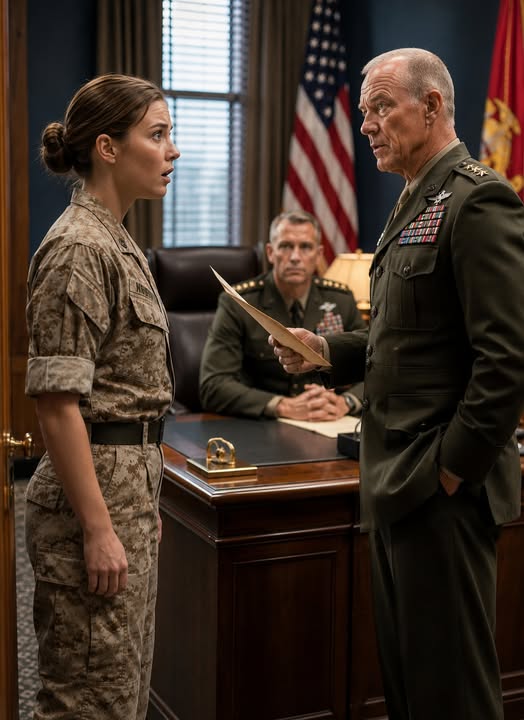
General Whitaker stood beside my commanding officer’s desk, one hand resting lightly on the folder that held my future. The document lay open in front of me, the inked signature at the bottom looking sharper than any blade.
Lieutenant Colonel Harris.
My commanding officer.
The man who had signed off on my evaluations. The man who had once told my platoon that Marines either carried their weight or got out of the way. The man who now stood three feet from me with his jaw clenched and his eyes fixed somewhere beyond the window.
General Whitaker looked at him.
“Explain yourself.”
Lieutenant Colonel Harris did not answer immediately.
He was a hard man to read. Square shoulders. Steel-gray hair. A voice that rarely rose because it never needed to. Until that moment, I had always believed he was fair.
Strict, yes.
Demanding, absolutely.
But fair.
Now I wasn’t sure what I believed.
“Sir,” Harris said at last, “my recommendation was based on operational concerns.”
General Whitaker’s expression did not change.
“Operational concerns.”
“Yes, sir.”
“About Corporal Reynolds.”
“Yes, sir.”
The general turned one page in the folder.
“Interesting. His physical fitness scores are excellent. Rifle qualification, expert. Leadership evaluations, consistently above standard. Disciplinary record, clean. Deployment readiness, high.”
He looked back at Harris.
“What operational concern did you discover that nobody else in this chain of command noticed?”
Harris’s face hardened.
“Judgment.”
The word landed in the office like a thrown stone.
I forced myself not to react.
General Whitaker’s gaze flicked toward me, then returned to Harris.
“Be specific.”
Harris clasped his hands behind his back.
“Corporal Reynolds has shown a pattern of acting on instinct rather than command structure. He is well-liked, physically capable, and motivated. But Special Operations requires more than courage. It requires discipline under pressure.”
My pulse beat against my throat.
General Whitaker tilted his head slightly.
“Are you referring to the diner?”
“No, sir.”
“Then what?”
Harris hesitated.
For the first time, I saw something beneath his control.
Not guilt.
Fear.
“I am referring,” Harris said slowly, “to the Ridgeway incident.”
My stomach dropped.
The Ridgeway incident.
I had not heard that name spoken aloud in months.
General Whitaker looked down at the folder.
“I read the report.”
“With respect, sir, reports do not always capture consequences.”
“No,” the general said. “Sometimes they hide them.”
Harris’s eyes sharpened.
I stood at attention, staring forward, but the walls of the office began to blur into another place.
A training range outside Ridgeway.
Rain.
Mud.
Shouting.
A young Marine named Lance Corporal Tyler Knox pinned beneath a flipped utility vehicle after a night movement exercise went wrong. Fuel leaking. Smoke rising. Radio traffic tangled with panic.
I remembered running before anyone ordered me to.
I remembered Harris’s voice on the radio telling everyone to wait for the recovery team.
I remembered Knox screaming.
And I remembered thinking that some orders are written for situations where no one is dying yet.
I pulled him out.
Seconds later, the vehicle caught fire.
The official report called it “unauthorized movement into a hazardous zone resulting in successful casualty extraction.”
The unofficial whispers called it reckless.
Knox called it being alive.
Harris stepped toward the desk.
“Corporal Reynolds disobeyed a direct command during a live training emergency.”
General Whitaker said, “He saved a Marine.”
“He risked becoming a second casualty.”
“But he did not.”
“That does not make it correct.”
The general’s eyes cooled.
“No. But your signature on this removal request was not about Ridgeway.”
Harris said nothing.
General Whitaker opened another envelope from the folder and removed a photograph.
He placed it on the desk.
My eyes dropped despite myself.
It showed the diner.
The cracked red booths.
The register.
The old veteran in the faded Vietnam cap.
Me standing with my card in my hand.
I looked up.
General Whitaker watched me.
“I told you,” he said, “I was observing several Marines. What I did not tell you was that I was also trying to find the source of a leak.”
A leak.
The word shifted the room again.
Harris’s face went pale.
General Whitaker continued.
“For the past six months, names of candidates under consideration for Special Operations assessment have been leaving restricted channels. Some candidates received threats. Others were pressured to withdraw. A few were suddenly buried under anonymous complaints.”
My mouth went dry.
The general looked at Harris.
“Corporal Reynolds was one of them.”
Harris’s voice became quiet.
“Sir, I don’t know anything about that.”
“No?”
“No, sir.”
General Whitaker slid another document across the desk.
“This request to remove Corporal Reynolds was submitted under your credentials at 0437 this morning.”
Harris nodded once.
“Yes, sir. I submitted it.”
“From a terminal inside the logistics annex.”
Harris froze.
For one second, it was almost invisible.
Almost.
But the general saw it.
So did I.
My commanding officer’s office was not in the logistics annex.
“It must have routed incorrectly,” Harris said.
General Whitaker’s voice remained calm.
“Systems do not accidentally route biometric logins.”
Harris said nothing.
The general’s tone lowered.
“Where were you at 0437 this morning, Lieutenant Colonel?”
Harris looked toward me.
Then back to the general.
“At home.”
The office seemed to shrink.
General Whitaker nodded once, as if confirming something he already knew.
“Then either you are lying, or someone used your credentials.”
Harris’s jaw flexed.
“Sir, I need to contact legal.”
“You will have that opportunity.”
My commanding officer looked at me again.
This time there was something in his eyes that I did not expect.
Not anger.
Warning.
Before I could understand it, a knock sounded at the door.
“Enter,” General Whitaker said.
A major stepped in wearing service uniform, followed by two men in dark suits. One carried a laptop. The other held a sealed evidence pouch.
The major saluted.
“General, Naval Criminal Investigative Service is ready.”
NCIS.
My skin prickled.
This was no longer about a recommendation packet.
One of the men in suits looked at Harris.
“Lieutenant Colonel Harris, please step away from the desk.”
Harris did not move.
General Whitaker said his name once.
“Harris.”
Something passed between them.
History, maybe.
Or regret.
Then Harris stepped back.
The NCIS agent moved to the computer on the side table and began connecting the laptop. The other agent opened the evidence pouch and removed a small black device.
A keycard scanner.
My commanding officer’s eyes fixed on it.
General Whitaker turned to me.
“Corporal Reynolds, remain where you are.”
“Yes, sir.”
I had never felt more like a witness to my own life.
The agent at the computer began typing.
The office monitor lit up with lines of access logs, timestamps, and base network locations.
The major read from a tablet.
“Entry to logistics annex recorded at 0419. Credential used: Harris, Mark D. Exit recorded at 0452.”
Harris said nothing.
The agent with the keycard scanner added, “Fingerprint match incomplete.”
General Whitaker’s eyes narrowed.
“Meaning?”
“Credential was used with a partial biometric override. Someone had access to the colonel’s card and a copied print fragment.”
Harris breathed out slowly.
“Copied print fragment?” the major asked.
The agent nodded.
“Lifted from a glass, adhesive surface, or similar object.”
I looked at Harris.
He looked older than he had ten minutes ago.
General Whitaker stepped closer to him.
“Who had access to your card?”
“My staff,” Harris said.
“Who else?”
Harris’s mouth tightened.
“My family.”
The office went still again.
That answer clearly cost him something.
General Whitaker’s expression changed for the first time. It became heavier.
“Your son.”
Harris closed his eyes briefly.
My mind raced.
His son?
I knew Lieutenant Colonel Harris had a son in the Marines. Everyone on base knew it.
Sergeant Owen Harris.
Force Recon candidate.
Golden boy.
Fast runner. Perfect uniform. Family name attached to him like a polished brass plate.
And he was also on the selection list.
My selection list.
The general turned to me.
“Corporal Reynolds, do you know Sergeant Owen Harris?”
“Yes, sir.”
“Have you had conflict with him?”
I hesitated.
“Answer honestly.”
“Yes, sir.”
“What kind?”
I felt Harris watching me.
I chose every word carefully.
“Professional conflict, sir. During joint field exercises. Nothing formal.”
General Whitaker’s eyes stayed on mine.
“Did he threaten you?”
The memory came back.
The equipment shed after evening formation.
Owen Harris stepping close enough that I could smell the peppermint gum on his breath.
“You don’t belong on that board, Reynolds. Some doors open for men built for them. Some men just get in the way.”
I had laughed it off then.
Not because it was funny.
Because Marines are trained to keep moving.
“Yes, sir,” I said. “Once.”
Lieutenant Colonel Harris looked down.
The general’s face turned grave.
“Why didn’t you report it?”
“I didn’t think it mattered, sir.”
“It mattered.”
Those two words hit harder than I expected.
Because I realized then how many small things I had dismissed.
A missing training file that suddenly reappeared.
A rumor that I had cheated on land navigation.
A complaint that I had shown disrespect to an officer I had never met.
A vehicle inspection failure for gear I knew had been placed in my truck after I parked it.
At the time, each incident seemed like bad luck.
Now they lined up like footprints.
General Whitaker turned back to the NCIS agents.
“Bring him in.”
The major stepped into the hallway.
A minute later, Sergeant Owen Harris entered the office.
He was tall like his father, broad-shouldered, with the same steel-gray eyes. But where Lieutenant Colonel Harris looked burdened by command, Owen looked polished by entitlement.
His expression faltered when he saw me.
Then it changed completely when he saw General Whitaker.
“Sergeant Harris,” the general said.
Owen snapped to attention.
“Sir.”
“Do you know why you’re here?”
“No, sir.”
General Whitaker picked up the removal request.
“Someone attempted to eliminate Corporal Reynolds from Special Operations consideration using your father’s credentials.”
Owen did not blink.
“That’s serious, sir.”
“Yes, it is.”
“I hope you find who did it.”
General Whitaker watched him in silence.
Owen held his posture perfectly.
Too perfectly.
The general finally said, “Where were you at 0437 this morning?”
“In the barracks, sir.”
“Can anyone confirm that?”
“My roommate, sir.”
The major looked up from his tablet.
“Your roommate signed out for medical at 0310.”
A tiny muscle moved in Owen’s cheek.
“I was asleep when he left, sir.”
General Whitaker nodded to the NCIS agent.
The agent placed a printed photograph on the desk.
It showed a grainy security image from the logistics annex hallway.
A Marine in a hooded sweatshirt.
Face turned away.
But the build was unmistakable.
Owen looked at it.
“That could be anyone, sir.”
The agent placed a second photo beside it.
This one showed the same Marine entering a side door.
On his right wrist was a distinctive braided bracelet.
Red, black, and gold.
Owen’s sleeve covered his wrist now.
But not before I saw his hand twitch.
General Whitaker said, “Show us your wrist.”
Owen did not move.
“Sergeant.”
Slowly, Owen pulled back his sleeve.
The bracelet was there.
The room changed temperature.
Lieutenant Colonel Harris whispered, “Owen.”
His son did not look at him.
General Whitaker’s voice sharpened.
“Did you use your father’s credentials to remove Corporal Reynolds from selection consideration?”
Owen stared forward.
“No, sir.”
The NCIS agent tapped his laptop.
“We recovered deleted messages from a private device seized this morning. They include references to Reynolds, the selection board, and a payment routed through a veteran outreach nonprofit.”
Owen’s eyes flicked toward the agent.
Payment.
That word struck me differently.
This was bigger than jealousy.
General Whitaker opened yet another page.
“Sergeant Harris, who is Patrick Voss?”
Owen’s face finally changed.
Fear.
Real fear.
Lieutenant Colonel Harris looked between them.
“Owen, who is Patrick Voss?”
Owen said nothing.
The general answered for him.
“Patrick Voss is a former contractor with connections to private military recruitment networks. He has been identifying high-performing enlisted Marines and steering them away from official programs toward private security work overseas.”
The words sank in slowly.
Private security work.
Unofficial pipelines.
Names leaking from restricted lists.
Candidates pressured out.
My own name nearly erased.
General Whitaker continued.
“We believe someone inside this command has been feeding candidate information to Voss.”
Owen swallowed.
“I want counsel.”
General Whitaker nodded.
“You’ll have it.”
For the first time, Lieutenant Colonel Harris stepped toward his son, not as an officer but as a father.
“Owen, tell me you didn’t.”
Owen’s jaw tightened.
“I did what I had to do.”
Harris recoiled.
“What does that mean?”
Owen’s eyes flashed.
“It means you spent my whole life telling me the Corps rewards merit. But that’s not true. It rewards stories. Poor kid from nowhere. Quiet hero. Diner kindness. Everybody loves that.”
He looked at me then, and the resentment in his face was raw.
“You think you’re humble, Reynolds? You walk around acting like you don’t want attention, and somehow that makes everyone notice you more.”
I didn’t answer.
Because there was nothing to say.
Owen turned back to his father.
“I was supposed to get that slot.”
Lieutenant Colonel Harris looked devastated.
“You tried to destroy another Marine for a slot?”
“No,” Owen said. “I tried to correct a mistake.”
General Whitaker’s voice became ice.
“The mistake was believing no one important was watching.”
Owen flinched.
The same words the general had said about the diner now carried a different weight.
The NCIS agent stepped forward.
“Sergeant Harris, you need to come with us.”
Owen looked at his father one last time.
But Lieutenant Colonel Harris did not save him.
He couldn’t.
Maybe he wouldn’t.
As the agents led Owen out, his shoulder brushed mine.
He leaned close enough that only I could hear.
“You have no idea what you walked into.”
Then he was gone.
The door closed behind him.
For several seconds, nobody spoke.
Lieutenant Colonel Harris stood motionless, staring at the closed door as if his entire life had just exited through it.
General Whitaker’s face remained controlled, but his voice softened.
“Mark.”
Harris did not respond at first.
Then he said, “I didn’t know.”
The words were quiet.
Almost broken.
General Whitaker studied him.
“I believe you.”
Harris closed his eyes.
That seemed to hurt him more than accusation would have.
“My son used my credentials.”
“Yes.”
“And I signed the request after he drafted it.”
I looked at him sharply.
Harris turned toward me.
There was shame in his eyes now. Not fear. Not warning.
Shame.
“He came to my house last night,” Harris said. “He told me you had compromised a training evolution. He said you were unstable under pressure. He said command was ignoring it because you had become popular after Ridgeway.”
My throat tightened.
“I never asked anyone for that attention, sir.”
“I know that now.”
He looked down at the desk.
“I should have verified every word before signing anything. I allowed personal trust to outrank command responsibility.”
General Whitaker said nothing.
Harris faced me fully.
“Corporal Reynolds, I owe you an apology.”
I did not know what to do with that.
A lieutenant colonel apologizing to a corporal was not something that happened casually. Not in a closed office. Not in front of a four-star general.
I held my posture.
“Sir.”
“No,” Harris said. “You’ll hear it. I failed you. I let my son’s ambition cloud my judgment. I nearly damaged your career without giving you the respect of truth.”
His voice roughened.
“And I was wrong about Ridgeway.”
That hit me hardest.
Harris looked at the general, then back at me.
“I gave the order to wait because that was procedure. You moved because Knox was burning alive. I spent months telling myself you were reckless because it was easier than admitting you had made the call I hesitated to make.”
For the first time, the room no longer felt like a tribunal.
It felt like something worse.
A place where men stripped rank from truth and stood exposed beneath it.
General Whitaker closed the folder.
“Corporal Reynolds.”
“Yes, sir.”
“Your name will remain on the selection list.”
My chest tightened.
“Yes, sir.”
“That is not a reward for paying my diner bill. Understand that clearly.”
“Yes, sir.”
He stepped closer.
“It is also not a rescue. Selection will not care that you are kind. It will not care that someone tried to remove your name. It will break you down and see what is left.”
“I understand, sir.”
“Do you?”
I met his eyes.
“I believe so, sir.”
The general studied me long enough that I felt as if he could read every doubt I had ever buried.
Then he said, “Good. Doubt is useful when it keeps arrogance out.”
A faint breath escaped me.
Not quite a laugh.
Not quite relief.
General Whitaker looked toward the door.
“There is one more matter.”
Of course there was.
The day had already turned from impossible to unreal. Why stop now?
The major handed him a sealed envelope.
This one was different.
No ordinary memo.
No recommendation packet.
It had a red stripe across the top.
General Whitaker did not open it immediately.
Instead, he looked at Lieutenant Colonel Harris.
“Mark, you are relieved of duties connected to the selection process pending investigation.”
Harris nodded once.
“Yes, sir.”
“You will cooperate fully with NCIS.”
“Yes, sir.”
“And you will not contact your son about this matter.”
That one hurt.
I saw it.
Harris absorbed the blow like a Marine, but it landed like a father’s punishment.
“Yes, sir.”
General Whitaker then turned back to me.
“Corporal Reynolds, what I am about to tell you does not leave this room.”
My heartbeat slowed.
The kind of calm that comes before impact settled over me.
“Yes, sir.”
He opened the envelope and removed a single sheet.
“Patrick Voss is not simply recruiting Marines for private security. We believe he is building something. A network. Former military, active-duty contacts, intelligence brokers, logistics specialists.”
My mouth went dry.
“For what purpose, sir?”
“That is what we need to determine.”
The general placed a photograph on the desk.
A man in his fifties. Expensive suit. Cold eyes. Smile too perfect to be trusted.
Patrick Voss.
I had never seen him before.
At least, I thought I hadn’t.
Then the general placed a second photograph beside it.
My stomach tightened.
The diner.
Again.
But this time, the focus was not on me or the general.
It was on a man seated at the far counter wearing a rain jacket, head slightly lowered, coffee untouched in front of him.
The truck driver with the newspaper.
I remembered him.
Barely.
He had seemed ordinary.
Invisible.
General Whitaker tapped the image.
“This man was watching you.”
I stared at the photo.
“Voss?”
“No. One of his recruiters.”
The general’s eyes hardened.
“The diner was not only my observation site. It was theirs.”
A cold line moved down my spine.
I thought back to that night.
The rain.
Linda at the register.
The old man’s declined card.
Me standing up.
The truck driver not looking at me, yet somehow seeing everything.
General Whitaker said, “After you paid my bill, Voss’s recruiter marked you as unsuitable.”
I blinked.
“Unsuitable?”
“For corruption.”
The word settled heavily.
“Men like Voss do not want the strongest Marines,” the general said. “They want the ones who can be bought, isolated, flattered, or made bitter. Your act at the diner told them something about you.”
I looked at the photograph again.
“What did it tell you, sir?”
General Whitaker’s expression softened slightly.
“That you remembered what uniform means even when you weren’t wearing one.”
I swallowed.
For some reason, that felt harder to accept than criticism.
The general continued.
“Unfortunately, it may also have made you visible.”
Lieutenant Colonel Harris straightened.
“Sir, are you saying Reynolds is in danger?”
“I am saying Voss lost access to the selection list this morning. His inside channel has been exposed. He will want to know what else has been compromised.”
The room became very still.
“And he may believe Corporal Reynolds is connected to that exposure.”
I felt the air leave my lungs.
“Sir, I don’t know anything.”
“Correct,” General Whitaker said. “Which makes you less useful to him alive than frightened.”
Harris stepped forward.
“With respect, General, he needs protection.”
The general looked at him.
“He needs awareness. Protection can become a cage, and cages make Marines predictable.”
Then he turned to me.
“You will report to temporary quarters tonight. You will speak to no one about this meeting. Not your friends. Not your family. Not Linda at the diner.”
The mention of Linda made my chest tighten unexpectedly.
“Sir, is Linda involved?”
“No,” he said. “But her diner may be.”
I thought of the cracked vinyl seats, the rain-streaked windows, the coffee, the elderly couple sharing pie.
Ordinary places were supposed to stay ordinary.
But now even that memory had shadows.
General Whitaker gathered the documents.
“Selection begins in seventy-two hours.”
I stared at him.
“Still, sir?”
“Especially now.”
I almost asked why.
He answered anyway.
“Because if Voss is targeting candidates, we need to know which candidates he approaches next. Selection will gather them in one place.”
I understood then.
Not fully.
Enough.
The selection course was not only a test anymore.
It was bait.
And somehow, I was standing in the middle of it.
General Whitaker stepped closer, lowering his voice.
“Corporal Reynolds, you did a decent thing for a stranger on a rainy night. That does not make you special. But it does tell me what you do when the world gives you an easy excuse to look away.”
He held out his hand.
Not for a handshake.
For the diner receipt.
I remembered then.
I had folded it into my wallet without thinking.
I pulled it out and handed it to him.
He looked at the faded paper.
“Eight dollars and seventy-six cents,” he said.
“Yes, sir.”
“That was the price of admission into a war you did not know existed.”
A chill moved through me.
The general handed the receipt back.
“Keep it.”
I tucked it away.
“Yes, sir.”
A knock sounded again.
The major opened the door and listened to someone outside. His face changed.
“General.”
Whitaker turned.
“What is it?”
The major stepped inside and closed the door behind him.
“NCIS just searched Sergeant Harris’s vehicle.”
Harris stiffened.
“And?” General Whitaker asked.
“They found cash. A burner phone. And a list of names.”
The major hesitated.
General Whitaker’s expression darkened.
“What names?”
The major looked at me.
“Selection candidates.”
My mouth went dry.
He continued.
“Corporal Reynolds is circled in red.”
For a moment, nobody moved.
Then the major added, “There was something written beside his name.”
General Whitaker’s voice dropped.
“Read it.”
The major swallowed.
“It says: Diner Marine. Confirmed by Whitaker. Use the brother.”
The room tilted.
My brother.
No one spoke.
Not Harris.
Not the major.
Not even the general.
Because there was no reason Patrick Voss should know about my brother.
Eli Reynolds.
Twenty-two years old.
Civilian mechanic.
The only family I had left after our father died.
A kid who still texted me pictures of old cars he was fixing and pretended he didn’t need help paying rent.
My hand went instinctively toward my pocket.
My phone was there.
Silent.
Too silent.
General Whitaker noticed.
“Call him.”
Military discipline vanished beneath blood.
I pulled out my phone and dialed Eli.
One ring.
Two.
Three.
No answer.
My pulse climbed.
I called again.
Straight to voicemail.
Then a message appeared on my screen from an unknown number.
No words.
Just a photograph.
Eli standing outside his garage under a flickering security light.
He was looking down at his phone, unaware.
Behind him, across the street, sat a black SUV.
My fingers tightened around the phone.
A second message arrived.
This one had six words.
Tell Whitaker the bill is due.
General Whitaker read the message over my shoulder.
His face changed in a way I had not seen before.
For the first time, the four-star general looked not surprised.
Not angry.
Haunted.
He whispered one name.
“Voss.”
Then my phone began to ring.
Unknown number.
The entire room seemed to hold its breath.
General Whitaker looked at me.
“Answer it.”
I tapped the screen and raised the phone to my ear.
A man’s voice spoke softly through the line.
“Corporal Reynolds, you bought the wrong stranger dinner.”
Outside the office window, thunder rolled across Norfolk.
And somewhere beyond the base gates, my brother disappeared into the rain.
THE END OF PART 2 – LIKE, SHARE AND COMMENT “FULL STORY” IF YOU WANT TO READ FULL STORY.