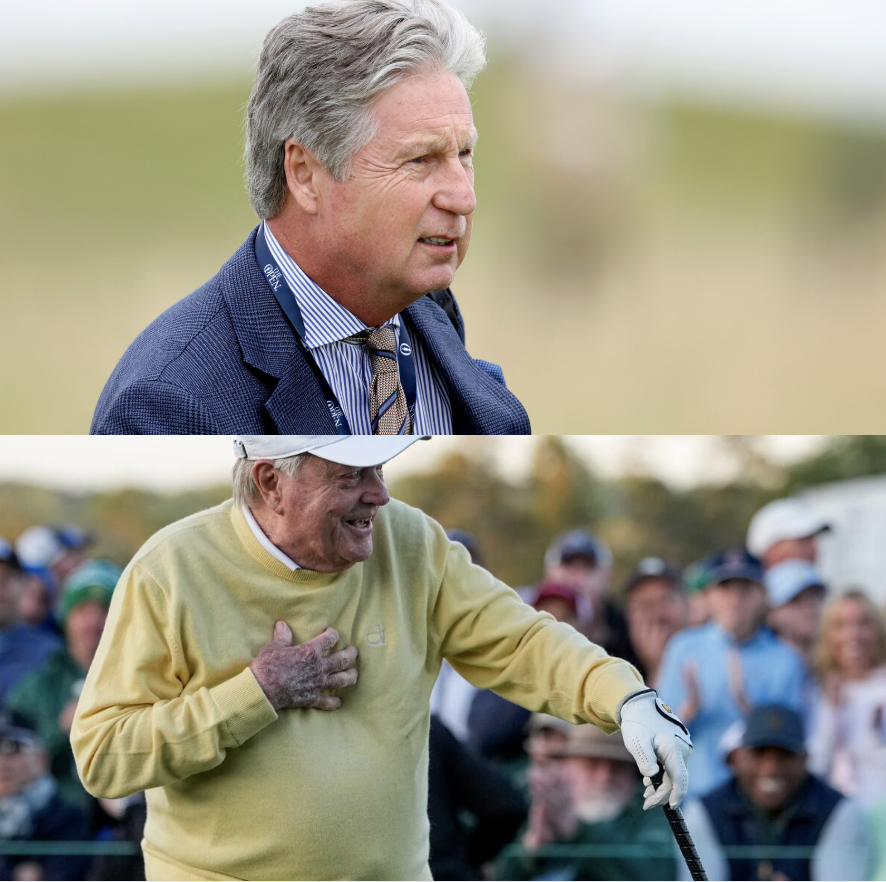
SHOCKING: EXPERT DELIVERS A FATAL BLOW TO THE NEW GENERATION OF GOLFERS, SPECIFICALLY CALLING A LEGEND TO INSULT THEM!
The atmosphere in the world of golf has just been ignited by a fierce statement from veteran analyst Brandel Chamblee. In a shocking analysis of the current culture of unruly behavior on the course, he bluntly used the glorious past of Jack Nicklaus as a benchmark to expose the uncivilized behavior of young stars. This scathing statement, cutting short the media coverage, has caused a firestorm of debate, dividing fans, players, and pundits alike over the evolving standards of professionalism in the game.
Chamblee, a longtime Golf Channel analyst known for his outspoken views, unleashed his critique during coverage of the 2026 U.S. Open at Shinnecock Hills. The comments were sparked by recent on-course incidents, including club-throwing penalties and audible profanity, which he argues have become far too commonplace among the sport’s rising generation.
Chamblee’s Scathing Comparison
“I never saw Jack Nicklaus throw a club. Never heard him yell an F-bomb. Never heard a profane word from him on the golf course,” Chamblee declared. He contrasted this with modern displays of frustration, noting that players today frequently toss clubs, damage tee markers, and let profanity fly, even with cameras and fans—especially children—watching.
Chamblee went further, suggesting that composure itself is a vital skill often overlooked in today’s game. “It’s lazy to throw clubs and it’s lazy to drop F-bombs when you know the whole world is watching,” he added. He expressed concern for families attending tournaments: “You take your kids out to watch a golf tournament and F-bombs raining everywhere.”
The analyst praised recent efforts by golf’s governing bodies—including the USGA, R&A, PGA of America, and Augusta National—to enforce stricter codes of conduct in 2026, aimed at preserving the sport’s traditions of sportsmanship and respect.
Targeting the New Generation and Tiger’s Influence
Chamblee’s remarks specifically target what he perceives as a shift in the culture among younger players and those influenced by more intense, emotional styles. While he stopped short of naming current stars directly in every instance, the implication was clear: the new wave of talent often prioritizes raw passion over the stoic professionalism exemplified by legends like Nicklaus and Arnold Palmer.
He even pointed to Tiger Woods as a potential catalyst for this change, noting that Woods’ fiery competitiveness revolutionized the game’s popularity but may have normalized more volatile on-course behavior for subsequent generations. This layered critique—invoking the “Golden Bear” to highlight shortcomings in today’s stars—has been interpreted by many as a direct insult to the current crop of players chasing major glory.
Reactions Pour In: Outrage, Agreement, and Debate
The golf world has erupted in response. Supporters of Chamblee applaud him for defending the game’s etiquette, arguing that professionalism separates golf from other sports and that unchecked outbursts set a poor example. “Composure is part of the skill set,” one veteran observer echoed.
However, critics accuse Chamblee of being out of touch. Younger players and their fans argue that golf has evolved, that emotion humanizes athletes, and that the intense pressure of modern competition—amplified by social media and big-money stakes—justifies visible frustration. Some point out that even past greats had their moments of temper, and that Tiger’s passion grew the sport exponentially.
Social media platforms lit up with divided opinions. Hashtags like #ChambleeVsNewGen and #RespectTheGame trended rapidly, with players subtly responding through their own channels. No major star has directly confronted Chamblee yet, but the conversation has dominated golf podcasts and forums in the wake of the U.S. Open.
A Broader Conversation on Golf’s Soul
This controversy arrives at a pivotal time for golf. With league divisions, technological advances, and a younger audience, the sport grapples with balancing tradition and accessibility. Chamblee’s invocation of Nicklaus—the player with a record 18 major championships and a reputation for unmatched class—serves as a powerful rhetorical device, forcing a reckoning with what “professional” means in 2026.
Governing bodies appear aligned with Chamblee’s call for accountability, with new penalties for misconduct already influencing play, as seen in recent high-profile incidents. Whether this leads to genuine cultural change or further backlash remains to be seen.
As one fan summarized online: “Golf isn’t boxing. There’s a reason it’s called a gentleman’s game. But these guys are human too.”
Brandel Chamblee has never shied away from tough talk, and his latest salvo ensures the debate over golf’s next generation will rage on long after the final putt drops at Shinnecock. In invoking the incomparable Jack Nicklaus, he has delivered a challenge to today’s stars: live up to the standards of the past, or risk tarnishing the future of the game.
The ball is now in the court of the young guns. Will they respond with improved composure, or will the fiery exchanges continue both on and off the course?