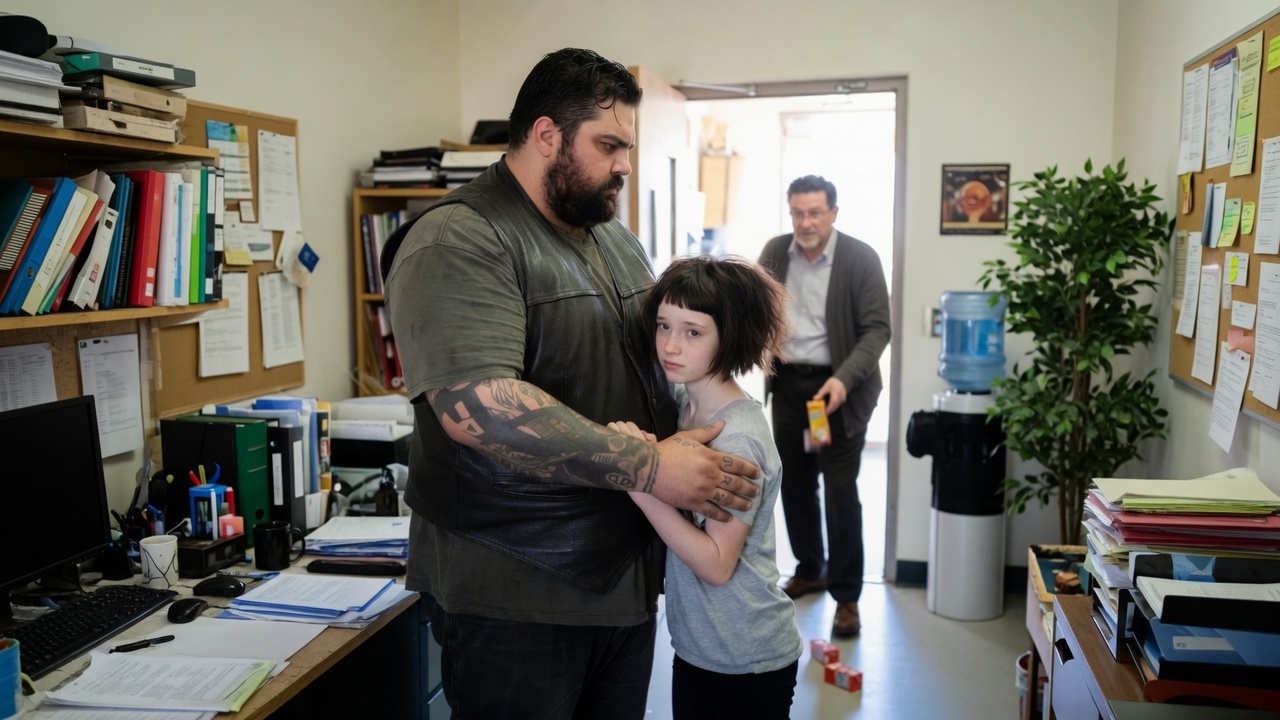
The door to the principal’s office slammed open with a force that rattled the cheap plastic blinds. In strode Brick Harlan, all six-foot-four of him wrapped in faded denim and leather that smelled of oil, asphalt, and old smoke. His arms, thick as bridge cables, were a living gallery of ink—skulls, roses, and runes that told stories most people in this sleepy suburb would rather not hear. Behind him, half-swallowed by his shadow, was nine-year-old Lily, her small hand fisted in the back of his cut.
On the scarred oak desk, Brick placed a pair of classroom scissors. The metal caught the fluorescent light like a quiet accusation.
“I’m here,” he said, voice low and rough as gravel under tires, “because you people keep calling what happened to my daughter ‘horseplay.’”
Outside in the hallway, teachers clustered like startled birds, whispering behind cupped hands. Someone had already dialed the resource officer. Through the half-open door, Principal Hargrove’s hand drifted toward the phone on his desk, slow, almost casual, the way men do when they’re trying not to look afraid.
Lily peeked out from behind her father’s enormous frame, her newly hacked hair sticking up in uneven tufts. The girl’s eyes—too old for her face—darted between the adults, measuring the distance to the next safe place.
Brick did not raise his voice. He did not slam fists or issue threats. Instead, he laid both scarred hands flat on the desk, palms down, the way a man might steady himself on the edge of a cliff. The tattoos there—old gang marks crossed out and rewritten—spoke of roads walked and doors closed forever.
“Why does your conflict report say there was gum in her hair?” he asked. “We checked. There wasn’t any.”
Hargrove swallowed. “Mr. Harlan, this is a misunderstanding—”
Brick’s gaze didn’t waver. “Then explain it to me.”
The room grew still, the kind of silence that presses against the eardrums. Lily shifted behind her father. From the pocket of her faded denim jacket—cut to match his—she pulled a folded sheet of paper, creased so many times it had begun to tear at the edges. Without a word, she placed it on the desk between her father’s hands.
Brick unfolded it slowly.
Twelve names. Twelve children. And beside each, in careful, childish handwriting, the places they used to hide during recess: behind the dumpsters, inside the hollow oak by the fence, under the stage in the auditorium. A private map of fear.
At the bottom of the page, underlined twice, was one more name.
The respected school volunteer. The man who always brought extra snacks, who knew every child’s birthday, who smiled with the easy warmth of someone who had nothing to hide.
Brick’s breath left him in a slow, controlled exhale. Recognition hit like a piston. Six years ago, his motorcycle club had voted him out in a closed meeting behind a shuttered warehouse. The reasons had been ugly enough that even the hardest men in the room had looked away. They had given him a choice: disappear or be disappeared.
And now he was here, trusted by parents, beloved by teachers, moving among children like a ghost who had learned how to wear a friendly face.
Brick’s fingers tightened on the paper until the edges bit into his calluses. The ink on his knuckles—*Lily* in delicate script—stood out against the older, darker marks.
For the first time since entering the office, his voice dropped to something colder than winter steel.
“You let this man near my daughter?”
The principal’s hand froze above the phone. The teachers outside fell silent. Lily pressed her face into her father’s side, trembling not from fear of the man in front of her, but from the weight of what she had carried alone.
Brick stared at the name until it burned behind his eyes. The air in the room thickened, heavy with the promise of truths about to claw their way into the light—truths that had been hiding in plain sight, just like the children on that list.
And somewhere down the hallway, footsteps approached.
PART 2
The footsteps in the hallway grew louder—measured, confident, the gait of a man who belonged. Brick’s jaw tightened, a muscle jumping beneath the faded ink of a broken chain tattooed along his throat. He had spent years outrunning ghosts, but some ghosts learned how to smile for school photos and coach soccer on weekends.
Principal Hargrove finally found his voice, thin and reedy. “Mr. Harlan, I assure you, Mr. Caldwell is one of our most dedicated volunteers. Background check came back clean. The children adore him.”
“Clean,” Brick echoed, the word tasting like rust. He slid the folded paper across the desk with two fingers, as if it might burn him. “Then explain why my daughter drew this.”
Lily stepped out from behind him, small but no longer hiding. Her uneven hair framed a face that had aged in the last ten minutes. In a voice barely above a whisper, yet clear as shattered glass, she spoke.
“He told us it was a game. Hide so no one finds you. If you stayed quiet, you got a sticker. If you cried… he said bad things would happen to our families.” Her fingers twisted the hem of her jacket. “I stopped crying after the third time.”
The temperature in the room seemed to drop. Outside, the cluster of teachers had gone deathly still. One of them—a young woman who taught art—covered her mouth, eyes wide with dawning horror.
Brick did not move. But inside, something ancient and feral uncoiled. He remembered the night six years ago: the circle of bikes under sodium lights, the vote, the man they had called “Preacher” begging for mercy while blood ran from his split lip. They had let him live. Mercy, they called it. Weakness, Brick thought now.
The door opened wider.
Mr. Caldwell stood there, cardigan neat, silver hair perfectly combed, carrying a tray of juice boxes like a peace offering. His smile faltered for half a heartbeat when his eyes met Brick’s.
“Everything alright in here?” he asked, the picture of concerned innocence.
Lily shrank back. Brick rose slowly, all two hundred and forty pounds of scarred muscle and barely leashed rage. The scissors on the desk suddenly looked too small for what this moment demanded.
“You,” Brick growled, the single syllable carrying every mile of bad road he had ever ridden. “You don’t get to wear that face anymore.”
Caldwell’s tray trembled. A juice box slipped, hitting the floor with a soft splash of red liquid that spread like accusation. For the first time, the mask cracked—something oily and ancient flickered behind his pleasant eyes.
Principal Hargrove stood up so fast his chair toppled. “Security! Someone call—”
But Brick was already moving, not with violence, but with the terrible gravity of a man who had crossed lines before and knew exactly where they were. He stepped between Caldwell and his daughter, a living wall of ink and regret. In that frozen second, the air hummed with the weight of every secret about to detonate.
Lily’s small hand slipped into her father’s. She looked up at him—not with fear, but with something fiercer. Trust.
And in that touch, Brick understood the true cost of the life he had tried to leave behind. The past had never left. It had simply waited for his daughter to grow old enough to bleed.
The climax hung there, razor-sharp, as Caldwell’s pleasant mask dissolved completely and the first real scream tore through the hallway.
PART 3
Caldwell dropped the tray entirely. Juice boxes scattered across the linoleum as he tried to back away, but Brick was already there— not striking, not yet, but close enough that the man could smell the leather and the years of penance that had never quite washed clean. Teachers flooded the doorway. Someone screamed for the police. Hargrove fumbled with his phone, voice cracking as he finally understood the depth of the rot growing in his school.
“You expelled me,” Caldwell hissed, the pleasant mask gone, revealing the hollow thing beneath. “You and your filthy club thought you could play judge. I built a new life. These children… they needed guidance.”
“Guidance?” Brick’s voice was thunder wrapped in quiet. He kept Lily behind him, one massive arm shielding her like a fortress wall. “You turned recess into a hunting ground.”
Lily’s voice rose then, small but piercing, cutting through the panic. “He has pictures. In his phone. He showed me once and said if I told, he’d hurt Daddy like the old days.”
The words landed like bullets. Caldwell lunged—not at Brick, but toward the door, desperation twisting his features into something feral. But the art teacher, the one who had first covered her mouth in horror, blocked his path with surprising steel. Others joined her. The hallway became a wall of adults suddenly awake to the evil they had invited in.
Brick did not chase. He knelt instead, eye-level with his daughter, scarred hands gentle as they brushed the ruined strands of her hair. “I’m sorry, baby girl. I thought leaving that life behind would keep you safe. I was wrong.”
Tears welled in Lily’s eyes, but she shook her head fiercely. “You came. That’s what matters.”
Sirens wailed in the distance, growing louder. Police would swarm soon, statements would be taken, devices seized, and the list of twelve names would unravel a darkness far wider than one school. Caldwell—Preacher—would not escape this time. The man’s eyes, wild with defeat, met Brick’s one last time before cuffs clicked around his wrists. In that gaze passed the ghosts of old betrayals, of mercy misspent, and the terrible knowledge that some sins refuse to stay buried.
Later, as the sun dipped low over the suburban rooftops, Brick sat on the curb outside the school with Lily curled against his side. Yellow police tape fluttered in the breeze. Parents arrived in waves, faces pale with shock and gratitude. The motorcycle club he had left years ago would hear the story by nightfall; some debts, it seemed, demanded payment across time.
He traced the tattoo of her name on his knuckle, the ink a vow renewed. Fatherhood had not erased his past—it had sharpened it into something worth fighting for. The road ahead would be hard: therapy for Lily, investigations, whispers in the town. But for the first time in years, Brick felt the weight of his scars not as shame, but as armor.
“I won’t let anyone hide from you again,” he whispered into her hair.
Lily nodded, exhausted but unbroken. “And I won’t hide anymore, Daddy.”
As the last ambulance pulled away and the school doors closed on a chapter stained with fear, Brick lifted his daughter onto his shoulders—the way he had when she was smaller and the world simpler. The tattooed biker and the girl with the crooked haircut walked toward his waiting bike under a sky turning crimson.
Some monsters wore cardigans. Others wore leather and carried scissors to the truth. In the end, only one kind had chosen to stand between the darkness and the light.
THE END