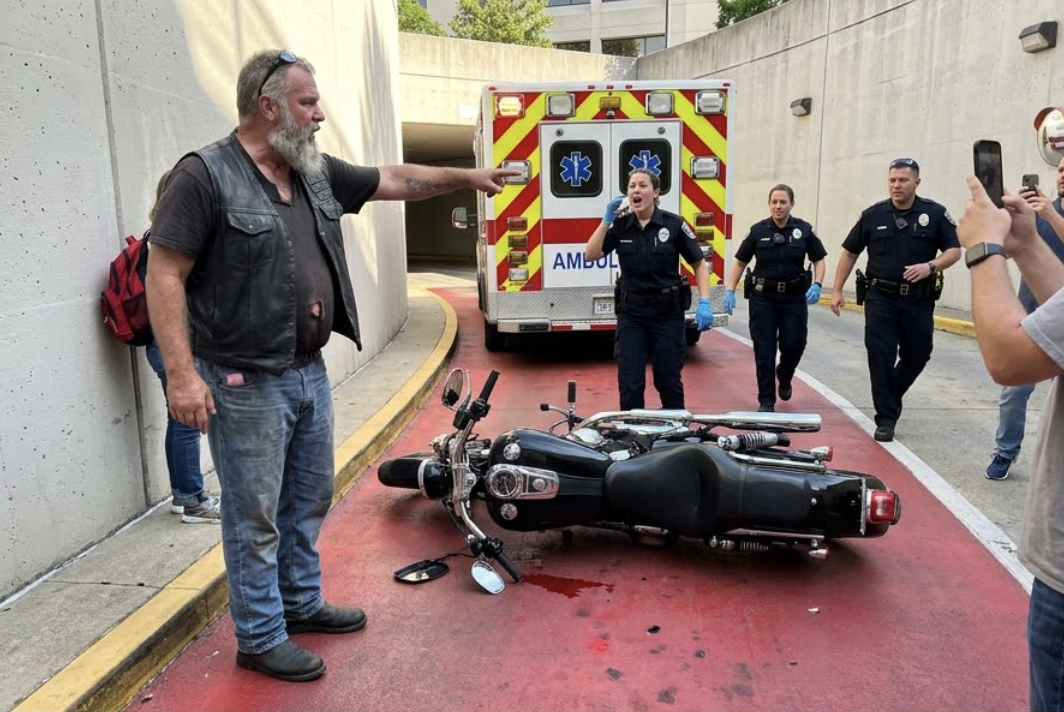
A 57-Year-Old Biker Dropped His Harley Across a Hospital Ambulance Lane — Then Police Read the Sentence He Had Been Unable to Shout
Part 2 — Six Fridays Beside the Blind Curve
The biker’s name was Dale Rourke, although the men who rode with him called him Mute.
They did not invent the name after his surgery. Dale had carried it since his twenties, when he worked nights towing wrecked cars from Interstate 40 and rarely spoke during club meetings. Back then, he had a deep voice that could be heard over an idling V-twin, but he preferred a wrench, a nod, or a hand placed on a brother’s shoulder.
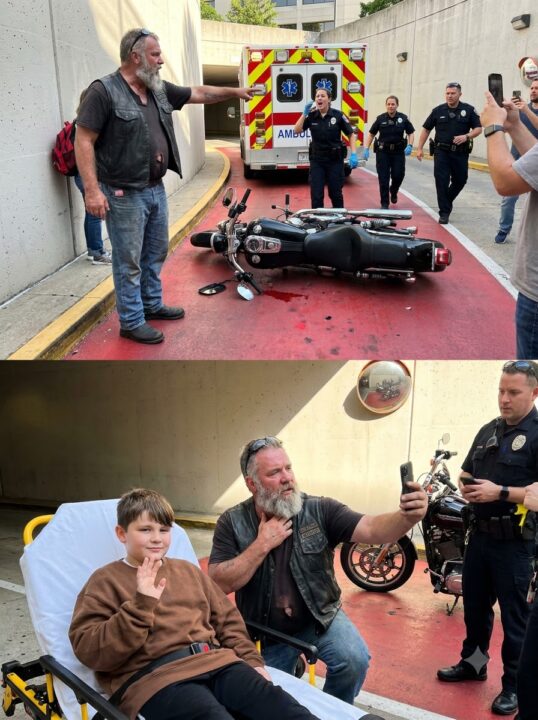
At fifty-seven, silence was no longer a preference.
Dale had undergone a total laryngectomy eleven months before I handcuffed him. Cancer took his larynx, part of his thyroid, and the voice his late wife, Maria, once described as “gravel dragged through warm coffee.”
The surgery left a permanent stoma at the base of his throat. He breathed through it. He carried cleaning supplies in his saddlebag, covered the opening with a soft black cloth when he rode, and used a phone or a small electronic speech device when strangers needed more than gestures.
He hated the device.
It gave every sentence a mechanical vibration. Children stared. Adults pretended not to.
Dale was at St. Anne’s that Friday for an oncology scan. Three members of the High Desert Saints had ridden with him because his previous scan contained a shadow near the surgical margin.
Nobody said recurrence.
Hawk Bell, the club president, brought two thermoses of road coffee and talked about a carburetor problem for most of the ride. Lewis “Doc” Haney carried Dale’s medical folder inside his vest. Benny Cruz kept enough distance behind the Road King to watch for dizziness, a complication Dale had experienced after radiation.
They were not escorting a fearless man.
They were escorting a frightened brother who could no longer hide fear behind his old voice.
Dale finished the scan at 2:38 p.m. The radiologist requested additional images, so Hawk and Doc remained upstairs. Dale went outside because the disinfectant smell reminded him of the night Maria died.
He had been returning to the same corner for six Fridays.
A boy had been waiting there.
The boy’s name was Micah Reed. He was eleven years old, though malnutrition made him appear younger. His mother, Tessa, moved between temporary shelters, weekly motels, and the back seat of an abandoned Buick after escaping a boyfriend who had broken her jaw.
Tessa washed dishes at a diner on Central Avenue when she could find someone to watch Micah. On the other days, the boy accompanied her and waited near the kitchen exit with a school workbook.
Then Tessa collapsed during a shift.
A customer called an ambulance. Tessa was brought to St. Anne’s without identification because her purse remained locked inside the diner office. Micah followed in a city bus but arrived after she had been taken for neurological imaging.
He was too afraid to enter the main hospital.
The last time he had asked an institution for help, a caseworker separated him from his mother for nine weeks. The placement had been safe, but Micah understood only that he had asked a question and lost her.
So he waited outside.
Dale first noticed him sitting behind the oxygen wall with a bruised apple and an empty water bottle. He offered the boy cash.
Micah refused.
Dale offered food.
The boy asked whether he would have to give his name.
Dale shook his head.
They ate two turkey sandwiches on opposite sides of the concrete strip. Dale communicated by typing into his phone. Micah answered mostly through shrugs.
Before leaving, Dale showed him the sign for water.
Micah copied it.
The next Friday, the boy returned. His mother had been discharged and was staying at a women’s shelter, but the shelter required residents to leave during daytime hours. Micah waited near St. Anne’s because Tessa attended treatment in the behavioral-health annex and feared losing her place if staff learned her son had nowhere to stay during appointments.
Dale brought a paper bag containing sandwiches, oranges, socks, and a cheap reusable bottle.
Micah noticed the scar.
“Does it hurt?”
Dale typed, NOT TODAY.
“What happened to your voice?”
Dale wrote, DOCTORS TRADED IT FOR MORE TIME.
Micah considered that.
“Was it a good trade?”
Dale looked toward the hospital windows before answering.
STILL COUNTING.
Their meetings became a quiet arrangement. Dale never photographed the child. He never asked Micah to perform gratitude. He kept food in the right saddlebag and sat far enough away that the boy could leave.
On the fourth Friday, Micah taught himself four signs from a library book: food, mother, safe, and thank you.
On the fifth, Dale gave him a card for the Mesa House family shelter. Micah put it in his backpack but made no promise.
On the sixth Friday, the temperature reached ninety-four degrees.
Dale emerged from the cancer clinic dizzy from contrast dye and saw Micah stumble behind the blind curve. He crossed the lane, but an ambulance entered before he reached the boy.
He waved.
The driver did not see him.
Dale pulled out his phone. One glove came off easily. The second caught on his silver skull ring. By the time the screen unlocked, the ambulance’s reverse lights were already glowing.
He typed two words.
LOOK BEHIND.
Then he heard the change in the engine as the driver shifted into reverse.
Dale looked at Micah.
He looked at the ambulance.
Then he looked at the Road King Maria had helped him buy twenty-nine years earlier.
The motorcycle was the last thing large enough.
He mounted, accelerated across the bay, cut the handlebars, stepped free, and drove his right boot into the crash bar. The Harley struck the concrete sideways.
The ambulance stopped.
That was the part the phones recorded.
They missed the six Fridays before it.