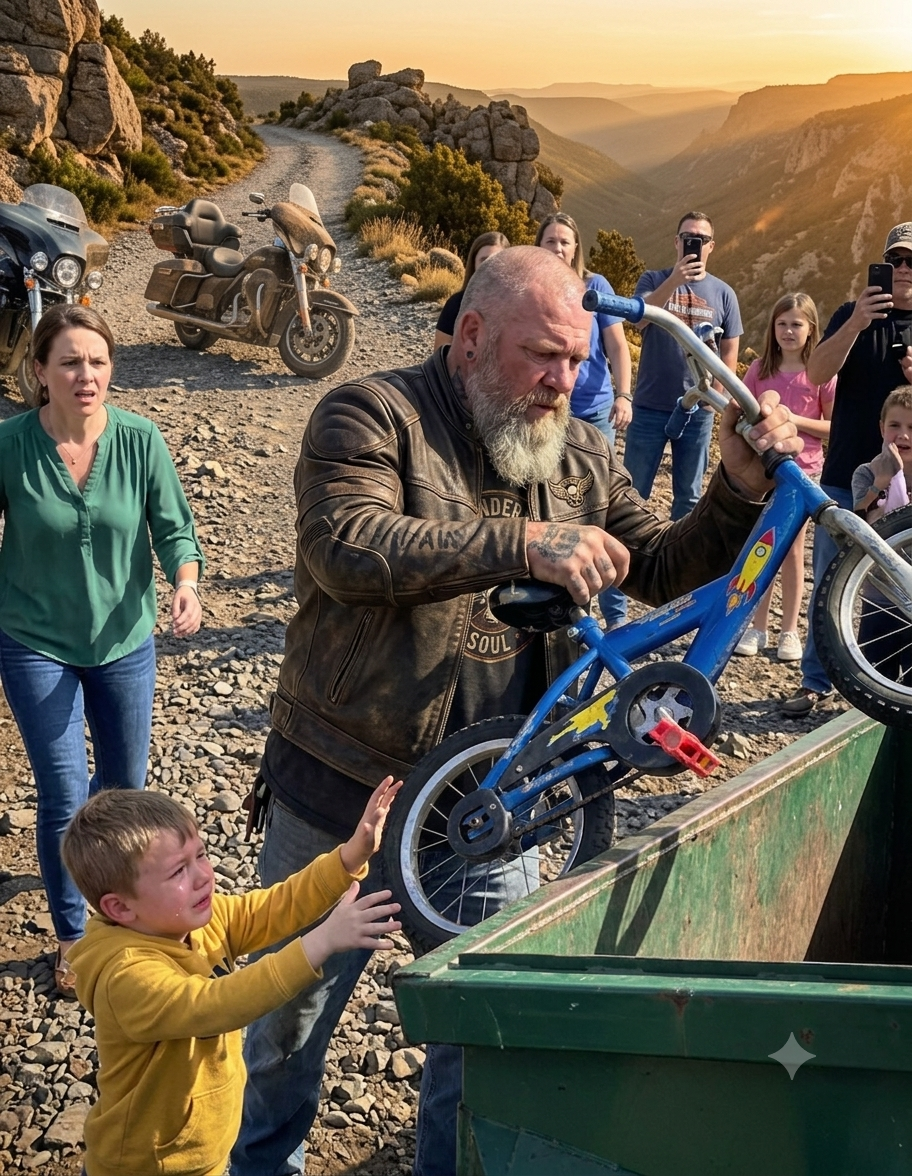
Part 2: A Biker Threw a Little Boy’s Bicycle Into a Dumpster Before a Downhill Race — The Mother Called Him a Monster Until the Frame Broke Open
Part 2 — The Man Everyone Blamed
My name is Claire Ellis, and until that Saturday in Chattanooga, I believed dangerous people usually announced themselves through anger. Hank Mercer taught me that sometimes the angriest-looking man in a parking lot is the only person studying what everyone else has overlooked.
Officer Ruiz stopped the garbage truck and ordered the driver to lower the dumpster. Two firefighters helped retrieve the bicycle without disturbing it further. The blue frame had separated just behind the head tube, leaving the handlebars and front wheel attached to one jagged section while the seat, crank, and rear wheel remained connected to the other.
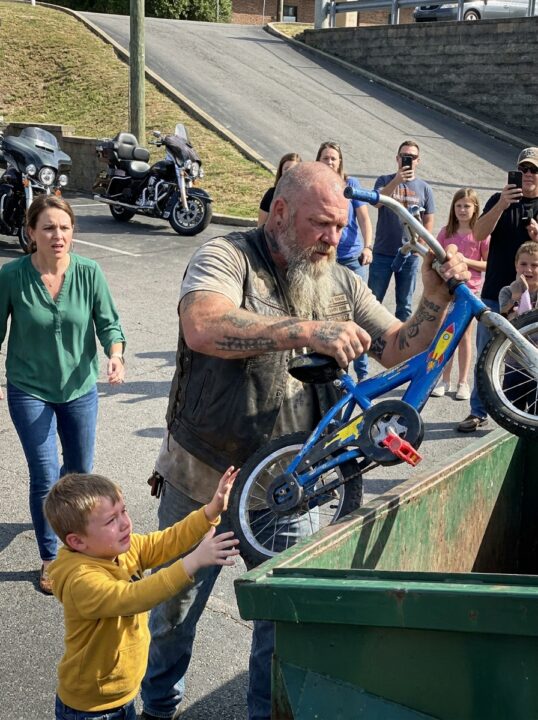
Hank did not say, “I told you so.”
He stood beside Noah with his hands open and visible, waiting until my son chose to come closer. When Noah finally looked inside, Hank positioned his broad body between the child and the sharp metal.
“That’s not where you threw it,” I said.
“No.”
The break had occurred four inches below the place where the frame struck the dumpster floor. Around the separation was a dark crescent of rust, powdered filler, and silver spray paint. Half of the metal had been cracked for months. Only a thin strip had still been holding the front of the bicycle together.
The rocket sticker I had added covered the outer edge.
My stomach tightened as I pictured Noah entering the first bend of Juniper Hill, squeezing the brakes while his weight shifted over the handlebars. If that last strip had failed, the front wheel would have continued in one direction while the rest of my child went in another.
Officer Ruiz photographed everything.
“How did you see it?” she asked Hank.
“The fork was walking backward under load.”
I did not understand.
He pointed without touching. “The gap between the tire and the frame was wrong. Front brake made the crack open. Brown dust appeared under the sticker.”
“Why didn’t you simply tell us?”
“I tried.”
I remembered him saying, Stop the boy.
I had assumed the order came from arrogance. Noah had assumed the biker wanted to keep him out of the event. The music, engines, parents, and announcer had swallowed whatever Hank said next.
“He was already pushing off,” Hank continued. “I had one hand on the bar and about three seconds.”
“You could have laid it down.”
“He picked it back up.”
Noah lowered his head. He had done exactly that. Hank had tipped the bicycle onto its side, but Noah, embarrassed in front of the other children, had yanked it upright and put one foot on the pedal.
So Hank made the bicycle impossible to ride.
It was a brutal decision. It was also the correct one.
Officer Ruiz did not arrest him, though she warned that destroying someone else’s property could not become his standard safety procedure. Hank accepted the warning with a short nod.
Then he turned toward the blue trailer.
The bicycle drive had been organized by the Iron Lantern Riders, a registered community club whose members included mechanics, veterans, a retired teacher, two nurses, an elevator technician, and one tattoo artist. They looked intimidating because most were large, weathered people wearing leather. That morning, however, their trailer contained helmets, repair stands, juice boxes, and bicycles intended for children.
Hank had founded the drive twelve years earlier.
Every donated bicycle was supposed to pass a forty-three-point inspection at Mercer Motor & Cycle, his repair shop on Rossville Boulevard. Bearings were checked, cables replaced, wheels trued, and frames cleaned down to bare metal wherever rust or impact damage appeared.
But the forty-seven blue-tag bicycles had arrived late.
Wade Pritchard, the club’s road captain, had found them through a regional surplus dealer three days before the event. The frames looked nearly new, and the dealer claimed they came from an overstocked youth camp that had closed.
Hank had been in Knoxville visiting his younger brother.
Wade and four riders worked through two nights to make the bicycles ready. They replaced tires, grips, chains, and seats, but because the frames appeared freshly painted, nobody stripped them.
“We did the checks,” Wade insisted. “I personally rode six.”
“You weigh two hundred sixty pounds,” Mercy said. “You didn’t ride the children’s frames.”
“I load-tested them.”
“Not the head tubes.”
Wade looked toward the waiting families. His face carried the trapped expression of a man who had tried to do something generous and now feared that admitting one mistake would erase every good intention behind it.
“It could be one damaged bike,” he said.
Hank opened the trailer.
“Then we prove it.”
He selected a small red bicycle from the same shipment and carried it to the repair stand. Beneath a glossy decal near the front was another faint brown line.
The crowd quieted.
Hank pressed the brake, braced one boot against the rear wheel, and applied controlled pressure to the handlebars. A hairline opening appeared beneath the paint.
Two bicycles.
Mercy found a third.
By noon, seven frames showed concealed cracks, four near the head tube and three beneath the bottom bracket. Someone had filled the damage, sanded it, and sprayed the frames before selling them as usable donations.
The children’s ride was canceled.
Parents who had waited for hours became furious. Some accused the club of giving away junk. Others demanded that Hank let their children take the bicycles that appeared undamaged.
Hank refused.
“We promised safe bikes,” he said. “Today we don’t have them.”
A father pointed at a green bicycle his daughter had already named Clover. “You can’t prove that one is cracked.”
“No.”
“Then give it to us.”
“No.”
The man stepped closer. The club shifted behind Hank, boots scraping pavement. For a second, I feared the parking lot would become what everyone had expected when the motorcycles arrived.
Hank raised one scarred hand.
Every rider stopped.
“No child leaves on a blue-tag frame,” he said. “If that costs us the drive, it costs us the drive.”
Wade removed his road-captain patch and placed it on the trailer floor.
“I bought them,” he said. “This is mine.”
Hank looked at the patch but did not pick it up.
“It becomes yours if you walk away.”
That was the first test.
Wade stayed.