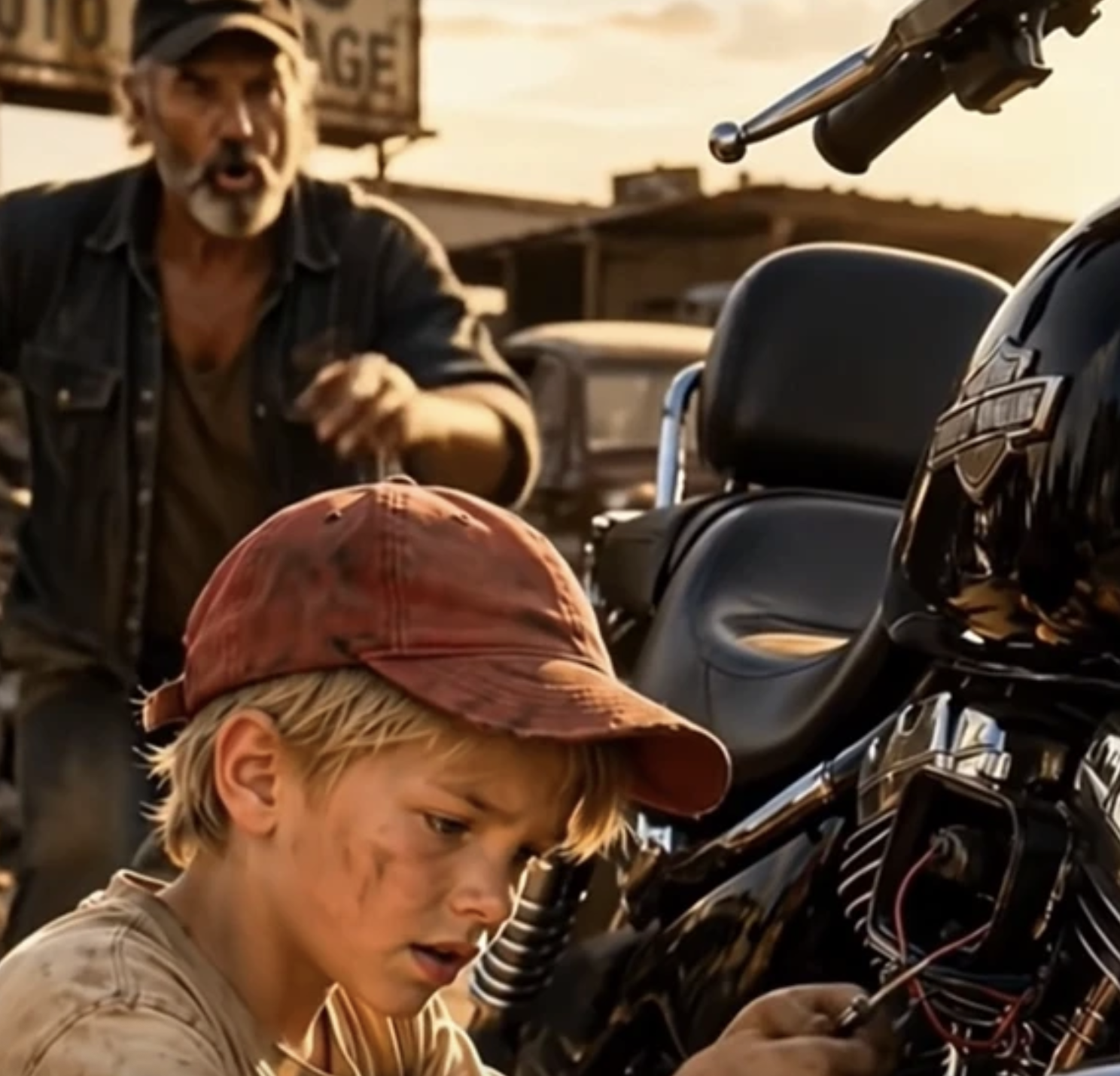
He Fixed the Motorcycle in Silence. By Nightfall, the Whole Town Was Shaking.
He Fixed the Motorcycle in Silence. By Nightfall, the Whole Town Was Shaking.
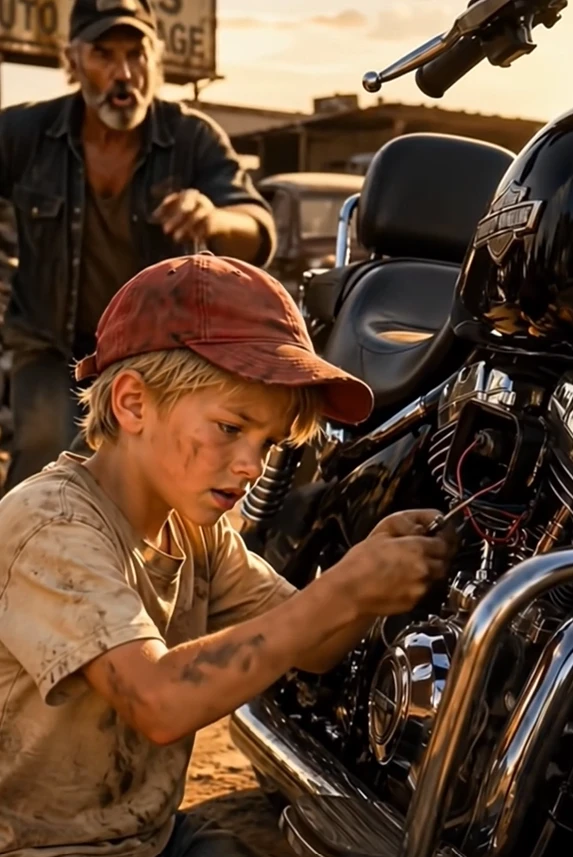
The first hard lesson Noah Mercer ever learned came on a Tuesday.
Not because Tuesdays were special, but because in the faded trailer at the edge of **Silver Rock, Arizona**, Tuesday was the day hope either showed up or didn’t. It was the day the assistance check arrived. The day there might be bread in the cabinet, soup in a pot, and maybe — if God was merciful — enough money left for **Elena Mercer’s medicine**.
Noah was only **eight years old**, all sharp elbows, dusty sneakers, and pale blond hair his mother trimmed herself over the kitchen sink. But his blue eyes carried a seriousness that didn’t belong to childhood. They belonged to boys who had already seen too much.
That morning, he stood in the kitchen doorway and watched his mother try not to cry.
Elena sat at the little table beside the window, a chipped coffee mug trembling in her hand. The trailer hummed softly with the weak rattle of the old air conditioner. Sunlight slipped through the stained curtains and fell across her face, showing too clearly how thin she had become.
“Mama,” Noah asked gently, “why is your hand doing that?”
She looked up too fast and forced a smile. “It’s not doing anything, sweetheart. Mama’s just tired.”
“It is too,” he whispered. “It’s shaking the coffee.”
She set the mug down before it spilled.
When Noah stepped closer, he noticed the cabinet behind her was nearly empty again. He already knew, of course. He always knew. In that kitchen, there was never enough food to forget where anything was.
“Is the medicine gone again?” he asked.
She didn’t answer.
That was answer enough.
Noah swallowed hard. “Mama?”
“Eat something first.”
“There’s almost nothing left.”
Elena closed her eyes for one painful second. When she lifted her hand to her mouth, Noah caught sight of a **dark stain she tried to hide against her apron**.
His chest tightened.
“Mama, you’re sick again.”
“Noah.”
“I saw it.”
She reached across the little table and took both his hands. Her palms felt warm, but fragile — as though less and less of her remained each week.
“Listen to me, baby,” she said softly. “I’m going to be all right. I just need rest. But I need your help today.”
He nodded before she even asked.
“Can you go down to **Wilkes Auto Salvage** and see if Mr. Wilkes needs anything done? Even a few hours. Just something small.”
“Yes, ma’am.”
“That’s my brave boy.”
Noah leaned forward and kissed her cheek. Her skin felt dry and feverish. Then he grabbed his cap from the counter and stepped out into the Arizona heat.
He already knew the cost of her medicine.
**Forty-three dollars and eight cents.**
He had memorized it the way other children memorized cartoons.
Wilkes Auto Salvage sat two miles down a blistered road, surrounded by rusted frames, stacked tires, and sun-faded vehicles that looked like they had surrendered years ago. The yard smelled like oil, dust, and old metal baking in the heat.
Earl Wilkes spotted Noah from across the lot and groaned before the boy reached him.
Earl was carved from desert weather and bad habits — leathery skin, gray beard, and an unlit cigar forever hanging from the corner of his mouth.
“No,” Earl called.
Noah kept walking.
“Mr. Wilkes.”
“I said no, son. I’m not running a camp for children.”
“I’ll work for less.”
That made the old man pause.
Noah spent the morning sweeping, sorting bolts, carrying light tools, and wiping grease from things no one else cared enough to clean. He did it all without complaint. Every minute mattered. Every dollar meant medicine.
By late afternoon, heat shimmered above the salvage yard like smoke. That was when the motorcycle came in.
It growled into the yard half-dead, coughing and rattling, before going silent with a final angry clank. The rider swung off in a slow, controlled motion that made everyone nearby instinctively give him space.
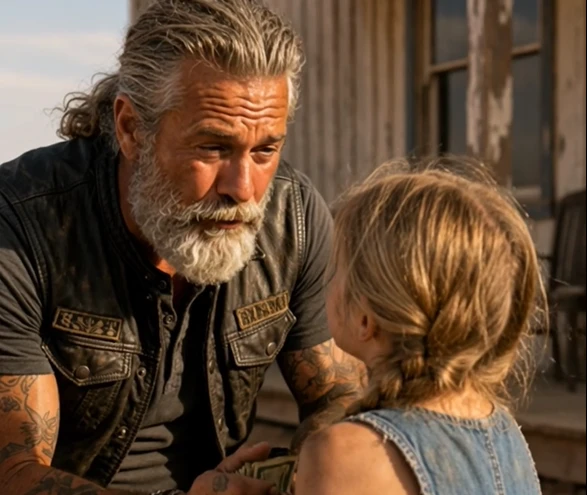
He was huge. Broad shoulders. Road-worn face. Dark beard streaked with gray. Tattoos disappearing beneath the sleeves of a black leather vest. On the back was the patch of a club Noah didn’t recognize, but Earl clearly did.
Earl’s posture changed immediately.
“Well,” the biker said in a voice like gravel, “that doesn’t sound cheap.”
Earl bent down, checked a few things, then stood up wiping his hands. “Depends how bad it is.”
“Tell me.”
“Could be your ignition feed, could be more. Hard to know without tearing in. Won’t be fast.”
The biker muttered a curse under his breath and pulled out his phone. “I need to make a call.”
He walked toward the far fence, leaving the motorcycle behind.
Noah stared at it.
He couldn’t help himself.
He had always loved machines. Even broken things made sense to him in a way people sometimes didn’t. Machines had logic. Cause. Effect. A reason for every sound.