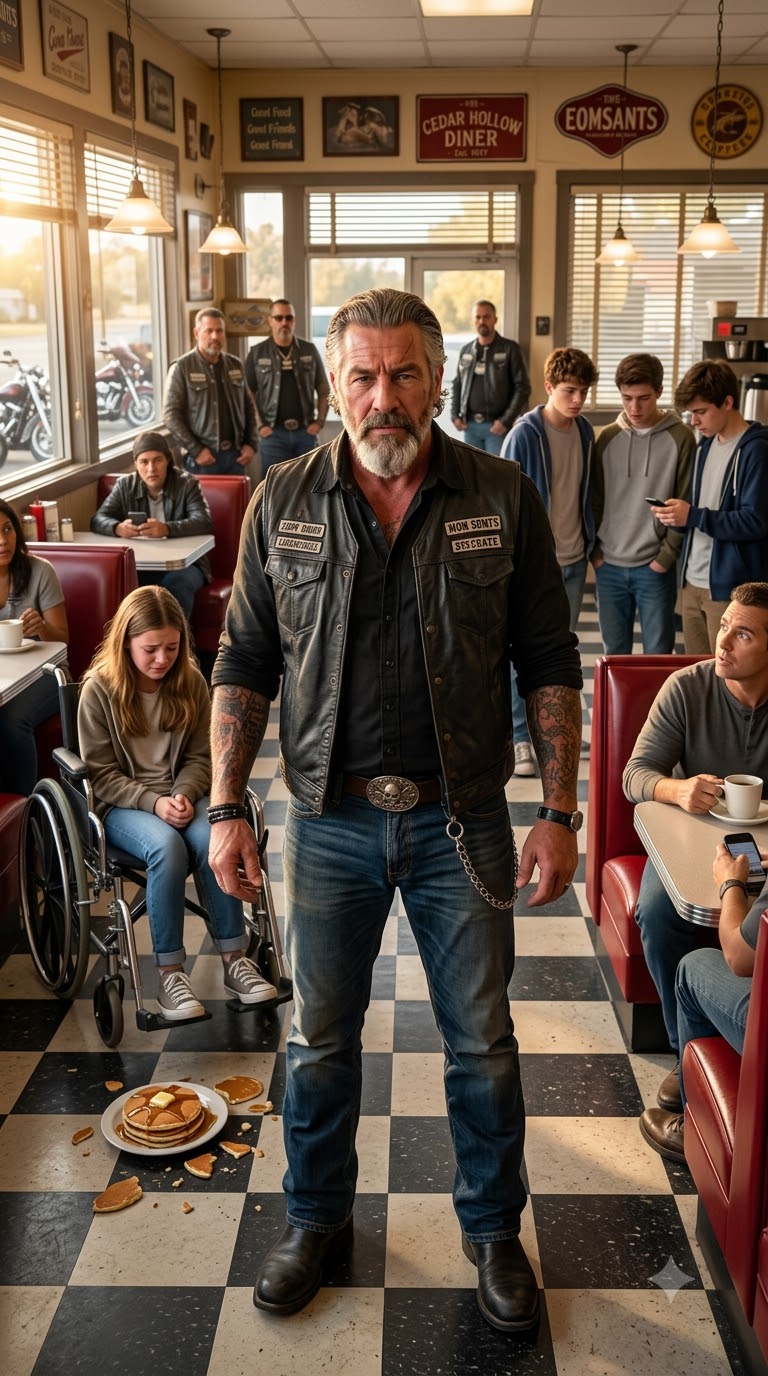
They Thought No One Would Care. They Were Wrong.
She nodded once.
The big man turned.
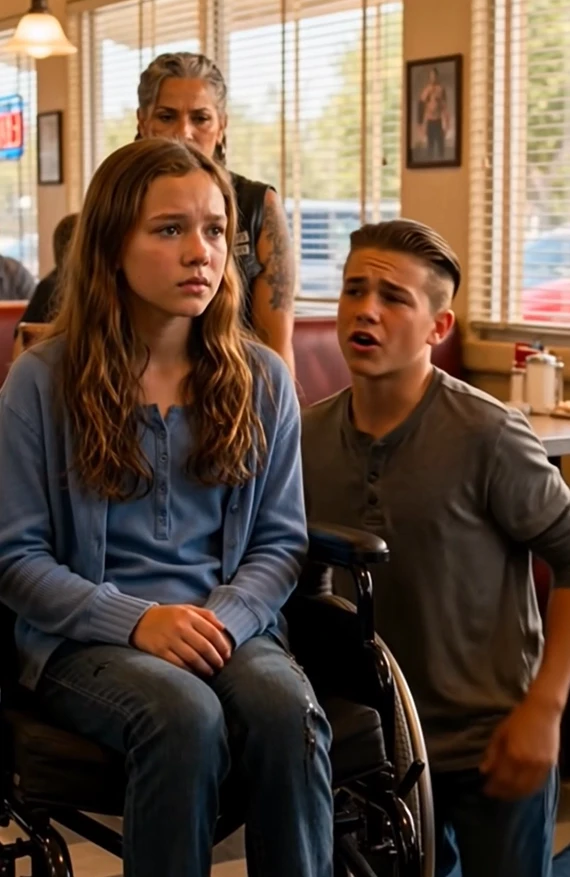
The air changed.
One of the boys tried to laugh. “Hey, relax. It was just a joke.”
The silver-braided woman took one step forward. “Funny,” she said. “No one’s smiling.”
The youngest boy slid a little deeper into the booth.
Marlene came closer to Eliza, placing a trembling hand on her shoulder. “You all right, sweetheart?”
Eliza nodded again, though she wasn’t. Not really.
The leader of the bikers approached the booth. Not fast. Not loud. Just certain. “Stand up,” he said.
The boy who had knocked the plate over forced a grin. “You can’t tell me what to—”
“I said,” the biker replied, now close enough that the boy had to tilt his head back to meet his eyes, “stand up.”
They did.
All four of them.
The room was silent except for the hiss of bacon on the grill.
“You think being stronger than someone makes you important?” the biker asked. “You think humiliating a girl who can’t easily defend herself makes you men?”
No one answered.
The biker with the prosthetic leg stepped forward beside him. “Want to know what weakness looks like?” he said quietly. He tapped the metal of his leg. “It’s not this. **It’s needing an audience to feel powerful.**”
One of the boys muttered, “We didn’t mean anything.”
The silver-braided woman gave a humorless smile. “That’s usually what cowards say after witnesses show up.”
Then something unexpected happened.
Eliza spoke.
Not a whisper this time. Clearer. Stronger. Still shaking, but real.
“They laughed,” she said. “When they pushed me, they laughed.”
Every face turned toward her.
The words seemed to cost her something, but once they were out, her shoulders lifted just a little, as if truth itself made room to breathe.
The leader nodded. “Thank you for saying it.”
Then he looked to the room—at the diners, the men at the counter, the people who had watched and done nothing.
“And the rest of you?” he asked. “You all saw.”
No one could meet his eyes.
It was Marlene who broke first. “I should’ve stepped in sooner,” she said, voice unsteady. “I’m sorry, honey.”
A trucker near the door stood up. “She’s right. We all should have.”
Then another voice joined. Then another. Small, shame-filled admissions rising from around the diner like people waking from a spell.
The boys lost all swagger now. Without the protection of silence, they looked exactly what they were: young, scared, and small.
The leader pointed to the mess on the floor. “Clean it.”
They blinked.
“Now.”
Marlene handed over a mop and towels without a word.
Under the eyes of the entire diner, the boys knelt and cleaned the spilled syrup, the coffee, the smashed pancakes. One of them had tears in his eyes, though whether from humiliation or remorse, no one could yet tell.
When they were done, the biker gestured toward Eliza. “Apologize.”
The boy who had shoved her wheelchair looked sick. “I’m sorry,” he muttered.
The silver-braided woman folded her arms. “Try again. Like she’s human.”
His face crumpled. He looked directly at Eliza for what seemed like the first time. “I’m sorry,” he said, voice shaking now. “What I did was cruel. You didn’t deserve that.”
The others followed, one by one, each apology awkward but real enough to hurt.
Eliza listened. She didn’t forgive them right away. **Some wounds don’t close on command.** But she held their gaze. She made them see her.
The leader turned back to her. “Would you allow us to buy you breakfast?”
For the first time that morning, a tiny smile touched her mouth. “Only if you sit with me.”
The diner exhaled.
Chairs shifted. Coffee was poured. Marlene brought fresh pancakes, then added bacon and fruit on the house. The Iron Saints took the surrounding booths, suddenly transformed from thunderous strangers into an unlikely shield wall of leather and kindness.
The big man introduced himself as **Wade**. The silver-braided woman was **Rosa**. The man with the prosthetic leg was **Micah**, a former marine who now mentored injured veterans and disabled teens through adaptive sports programs. When Eliza shyly admitted she used to love sketching motorcycles but had never ridden on one, Rosa grinned and said, “That can be fixed someday.”
For the first time in a long while, Eliza laughed.
Not because anything was funny.
Because the room no longer belonged to cruelty.
When she finished eating, Wade asked where she was headed. “To see my mother,” she said. “She’s at St. Anne’s.”
Micah exchanged a glance with Rosa. “Library worker? Hartwell?” he asked.
Eliza blinked. “Yes.”
Rosa smiled softly. “Your mother used to run a reading hour for kids at the shelter. Years ago. She stayed late for a little girl who never spoke to anyone.” Rosa touched her chest. “That was my daughter.”
Eliza stared at her.
Wade reached into his vest and pulled out an envelope. “We were actually on our way here to find you.”
Her pulse jumped. “Me?”
Micah nodded. “There’s an adaptive arts scholarship in town. Anonymous donor funded it. Your name was recommended. We’ve been helping the program find local students with grit.” He slid the envelope across the table. “After what we just saw, I’d say they picked right.”
Eliza opened it with trembling fingers.
Inside was an acceptance letter.
And a check large enough to cover her first year.
She looked up, stunned. “This… this can’t be real.”
“It is,” Wade said. “Your mother never told you?”
Eliza shook her head.
Marlene, standing nearby with tears in her eyes, whispered, “Honey, your mama came in last month asking if we knew anyone connected to the arts board. She said you were too talented to stay hidden.”
Eliza pressed a hand over her mouth.
All morning she had felt invisible.
Now she realized something astonishing: **someone had been quietly fighting for her future all along.**
When she finally rolled out of Cedar Hollow Diner later that morning, the sun seemed brighter than before. The boys were gone. The fear was not. Neither was the memory. But something stronger had taken root beside it.
Not all silence is peace.
Some silences are permission.
But once broken, they can reveal the truth with shocking force: **all it takes is one person to stand up, and suddenly everyone remembers how.**