THE SILENT STITCH: LEGACY OF THE INVISIBLE ADMIRAL
PART 2: THE CRYPTOGRAPHY OF FABRIC
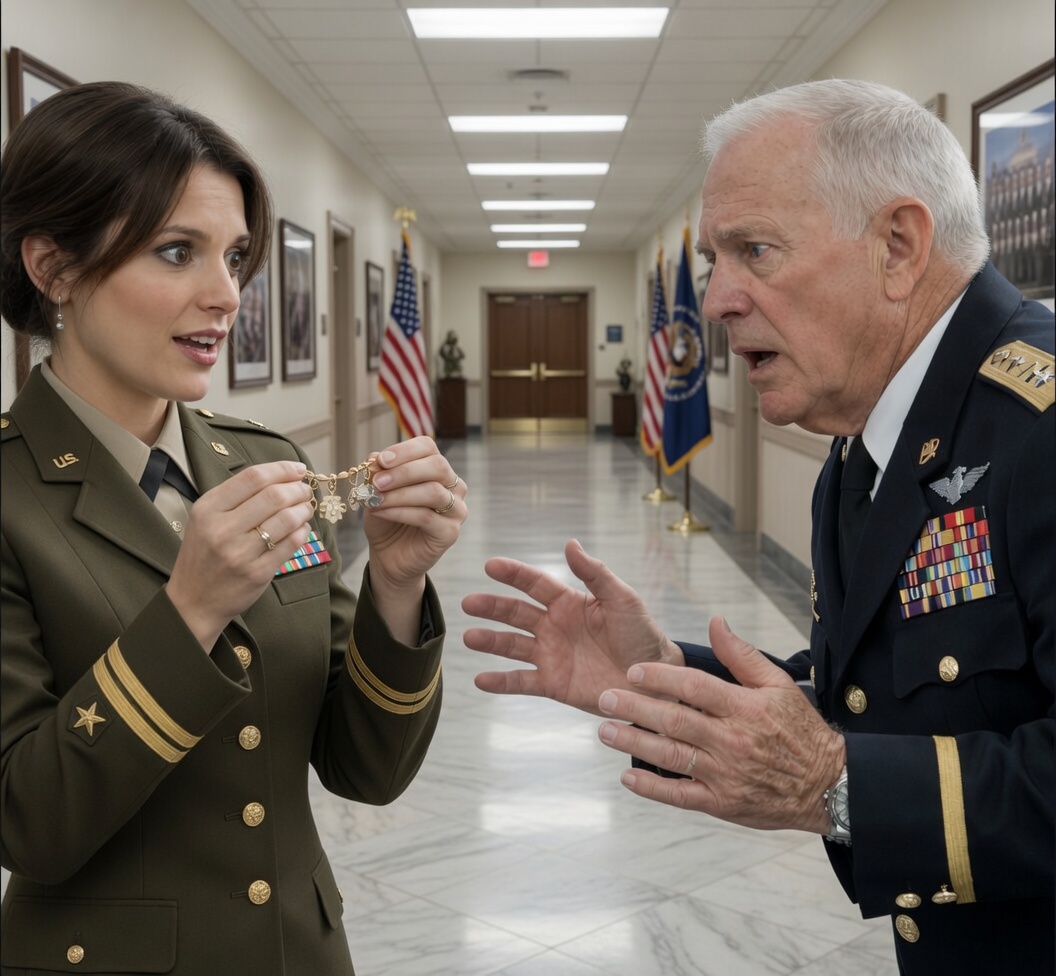
The Colonel led me through a heavy set of oak doors into a dimly lit library at the back of the estate. The smell of old leather and expensive cigars usually felt comforting, but tonight, it felt like a trap. He locked the door behind us with a definitive click and turned to face me, his posture stiffening as if he were back on active duty.
“You think your grandmother spent her life hemming trousers for the locals in Whitfield, don’t you?” he asked, his voice low and jagged.
“She was a seamstress, Colonel,” I replied, my hand instinctively covering the silver bracelet. “I grew up watching her at that machine. My mother has the receipts from forty years of alterations to prove it.”
The Colonel let out a short, mirthless laugh. “Receipts. Eleanor was always meticulous about the paper trail. But Clara, did you ever look at the patterns? Did you ever wonder why a woman with her steady hand and ‘lack of ambition’ stayed in a house that sat directly on a bedrock of limestone and lead, forty miles from any major military hub?”
He walked to a mahogany desk and pulled out a magnifying glass, gesturing for me to step into the light. “That bracelet isn’t jewelry. It’s a biometric cipher. And your grandmother wasn’t Eleanor Marsh, the seamstress. She was ‘The Tailor’—the single most effective deep-cover encryption specialist the intelligence community ever produced.”
I felt the blood rush from my head. I thought of the small woman who made me peach cobbler and taught me how to thread a needle. The woman my father called “unremarkable.”
“During the Cold War,” the Colonel continued, his eyes burning with a strange intensity, “we needed a way to move high-level intelligence without digital footprints. Eleanor developed a method of stitching binary code into the very weave of fabric. A silk tie, a military lapel, a wedding dress—it didn’t matter. She could hide an entire nuclear silo blueprint in a floral pattern. She was a ghost, Clara. She lived in that quiet house because it was the perfect blind. No one looks at a woman sewing buttons. No one suspects the grandmother who grows okra.”
My mind raced back to the “long sleeves” she wore even in the blistering Tennessee humidity. I remembered the heavy, humming sound of her Singer machine late at night—a rhythm that was too fast, too precise for simple mending.
“Why now?” I whispered. “Why is this happening now?”
“Because,” the Colonel leaned in, his shadow stretching across the floor, “Eleanor was the only one who held the master ledger. She kept the names of every ‘sleeper’ and every dirty deal made in the shadows of the eighties. When she died, the vultures assumed the ledger died with her. But seeing that bracelet on your wrist… it tells them the ledger is still live. And it tells them you are the key to unlocking it.”
He grabbed a heavy book from the shelf, revealing a hidden safe. “I wasn’t your grandmother’s friend, Clara. I was her handler. And I wasn’t the only one. There are men in this very ballroom who would burn that town of Whitfield to the ground just to get what’s on your wrist.”
Just as he spoke, the library door shuddered. A heavy, rhythmic thud echoed through the wood—someone was trying to kick it in. The Colonel didn’t panic; he reached into his waistband and pulled a sleek, silenced pistol.
“The window, Clara! Go!” he hissed. “Get back to that house in Whitfield. Don’t call your parents. Don’t call the police. They’re already compromised. Find the machine. Find the ‘last stitch.’ If you don’t, they’ll erase your grandmother’s legacy—and you along with it.”
I didn’t wait. I scrambled through the casement window into the cold Tennessee night, the silver bracelet pulsing against my skin like a heartbeat. As I ran toward my car, I heard the library door give way, followed by the muffled thwip-thwip of suppressed gunfire. My family had left Eleanor to die alone because they thought she was nothing. Now, I was the only one left to prove she was everything.
PART 3: THE HOUSE AT THE END OF THE ROAD
The drive back to Whitfield felt like a descent into a nightmare. The familiar scenery of rolling hills and rusted barns took on a jagged, threatening edge. Every pair of headlights in my rearview mirror felt like a predator closing in. I drove without music, the silence of the cabin filled only by the frantic drumming of my fingers on the steering wheel.
I reached the gravel road at 3:00 AM. The little white house sat at the end of the drive, looking smaller and more fragile than I remembered. It was bathed in the pale, sickly light of a waning moon. For twenty years, I had walked through that front door expecting the smell of cinnamon and starch. Now, I expected a bullet.
I fumbled with the spare key hidden inside a chipped ceramic gnome. The door creaked open, and the stillness of the house hit me. It was the smell of her—lavender and old paper—but beneath it was something cold. Something clinical.
I bypassed the kitchen and headed straight for the sewing room. The old Singer machine sat there, draped in a dusty floral cover. To my parents, this was a piece of junk to be sold at an estate sale. To me, it was now a monolith of secrets.
I pulled the cover off. The black cast iron gleamed. I touched the silver bracelet to the metal base, and to my horror, the machine didn’t just sit there. There was a soft, hydraulic hiss. The floorboards beneath the heavy desk groaned as they began to shift, sliding back to reveal a narrow, steel-lined shaft leading straight into the dark.
“Oh, Grandma,” I whispered, my breath hitching. “What did you do?”
I climbed down the ladder, the air growing colder and crisper with every rung. At the bottom, a motion-sensor light flickered on, revealing a space that didn’t belong in a rural Tennessee cottage. It was a clean-room, filled with racks of servers, vintage filing cabinets, and a secondary sewing station that looked like it belonged in a NASA lab.
On the main desk sat a single, half-finished project: a white military dress glove.
I approached it slowly. The stitching on the palm was intricate—beautiful, really—but when I tilted it toward the light, I saw the patterns the Colonel had described. It wasn’t a design. It was data.
Then, the monitor on the desk flared to life. A video file began to play.
It was Eleanor. She looked tired, her eyes sunken but sharp. She was sitting in the very chair I was standing next to. “Clara,” her voice crackled through the speakers. “If you’re seeing this, it means you stayed. It có nghĩa là you’re the only one who bothered to look past the fabric. I’m sorry for the burden, but your father… your father chose a different path. He didn’t just ignore me, Clara. He sold me out.”
The world tilted. My father? The man who treated her like an unwanted relic?
“He thinks the ledger is in the bank,” the video continued. “He doesn’t realize that the ledger is the bracelet you’re wearing. It’s a proximity key. But you have company, Clara. They’ve tracked the signal.”
On the security feed above the desk, I saw three black SUVs scream into the gravel driveway. Men in tactical gear—the same ones from the gala—poured out, their weapons drawn. And leading them, looking calm and cold in a tailored suit, was my father.
He wasn’t there to mourn. He was there to harvest.
PART 4: THE FATHER’S BETRAYAL
I watched the screen in a state of paralysis as my father kicked open the front door of the house he had refused to visit for years. He didn’t look like the bumbling, arrogant man I knew. He moved with a clinical precision, barking orders to the mercenaries like a seasoned commander.
“Check the floorboards!” his voice echoed through the house’s hidden microphones. “The old woman was clever, but she was sentimental. She would have kept the physical backup near the machine.”
I realized then that my father’s “disdain” for Eleanor had been the ultimate cover. He hadn’t ignored her because she was boring; he had distanced himself to avoid suspicion while he waited for her to pass. He was a broker. He dealt in the secrets she created, and now that she was gone, he wanted the “master key” to retire as a billionaire.
“Clara’s here,” one of the men shouted from the sewing room. “The car is still warm.”
My father’s face appeared on the camera near the sewing machine. He looked directly into the lens, as if he knew I was watching from the bunker below. “Clara, honey,” he said, his voice dripping with a fake, paternal warmth that made my skin crawl. “I know you’re down there. I know Mom gave you the bracelet. Just come up. We can talk about this. We can be the family she never let us be.”
I gripped the edge of the desk, my knuckles white. The “family” she never let us be? She spent her life protecting us from the very monsters he had invited into her home.
“The glove, Clara,” my grandmother’s recorded voice whispered from the speakers, almost as if she were in the room with me. “Put on the glove. It’s the only way to trigger the lockdown.”
I grabbed the white military glove from the desk. It was stiff, the silver-threaded embroidery feeling like a cage for my hand. As I slid it on, the bracelet on my other wrist began to glow with a faint, blue light. The two pieces of tech recognized each other.
The bunker lights turned a deep, warning red. A countdown appeared on the main monitor: 05:00.
“The system is wiping,” I whispered.
But it wasn’t just wiping the data. The security feed showed the floor of the sewing room beginning to vibrate. Eleanor hadn’t just built a vault; she had built a trap. If the ledger wasn’t extracted within five minutes by a verified bloodline member, the entire limestone foundation was rigged to collapse, swallowing the house—and everyone in it—into the deep Tennessee earth.
I had five minutes to decide: Do I save the father who betrayed us, or do I let the “quiet seamstress” have the final word?
PART 5: THE LAST STITCH
I scrambled back up the ladder, not to escape, but to face the man who had turned our family into a transaction. I burst through the floorboards of the sewing room just as my father was reaching for the Singer machine’s motor.
The mercenaries leveled their rifles at me, but my father held up a hand. He stared at the glowing bracelet and the silver-threaded glove. His eyes weren’t filled with love; they were filled with a terrifying greed.
“You have no idea what that’s worth, Clara,” he said, stepping over the ruined furniture. “That glove contains the bypass codes for the entire Eastern seaboard’s power grid. Mom was a genius, but she was a hoarder. She kept the world’s most valuable weapon in a sewing kit.”
“She kept it away from people like you!” I shouted, the house groaning as the countdown reached 02:00. “The house is rigged, Dad. If we don’t leave in two minutes, this entire place becomes a sinkhole.”
The mercenaries looked at each other, their professional veneer cracking. But my father didn’t flinch. “She’s bluffing. She doesn’t have the stomach for it.”
“Look at the floor!” I screamed.
The floorboards were literalizing parting. A crack had formed down the center of the hallway, revealing the dark, churning limestone beneath. The sirens from the bunker began to wail, a high-pitched scream that shook the windows.
The mercenaries didn’t wait for orders. They turned and bolted for the door, leaving my father standing alone in the center of the room. He looked at the bracelet on my wrist, then at the abyss opening at his feet.
In that moment, I saw the man he truly was—not a mastermind, but a small, desperate gambler who had bet his mother’s life and lost.
“Clara, give me the hand,” he pleaded, reaching out. “We can still get it out. We can still sell it.”
“It’s not for sale,” I said, stepping back toward the window. “It was never for sale.”
I dove through the glass just as the first support beam snapped. I hit the gravel and rolled, the sound of the house collapsing behind me sounding like a localized earthquake. I didn’t look back until I reached the edge of the woods.
The little white house was gone. In its place was a jagged scar in the earth, a hole so deep the moonlight couldn’t find the bottom. The “quiet seamstress” had taken her secrets—and the man who tried to steal them—into the dark forever.
I stood there in the silence, the silver bracelet cold on my wrist. I was the only one at her funeral. I was the only one who stayed. And now, I was the only one who knew that the “last stitch” wasn’t a piece of data.
It was justice.
PART 6: THE SILENT NETWORK
The dust from the collapse hadn’t even settled before the sirens began to wail in the distance—not the local police, but something far more coordinated. I stood at the edge of the woods, my lungs burning from the grit in the air, looking down at the silver-threaded glove still gripped in my hand. The glowing blue light of the bracelet had faded into a dull, ominous hum. I was a 28-year-old ER nurse with no tactical training, yet I had just witnessed my father’s disappearance into a limestone abyss and the destruction of my childhood sanctuary.
I didn’t have time to mourn.
A black sedan, idling without lights, pulled up to the edge of the gravel drive. The door opened, and a woman stepped out. She was in her late sixties, wearing a simple tan trench coat and sensible shoes. She looked like someone’s grandmother—until she pulled a high-tech tablet from her pocket and scanned the perimeter with the efficiency of a shark.
“Get in, Clara,” she said. Her voice was sandpaper and velvet, authoritative and weary. “Before the ‘cleaners’ arrive. Your father was a fool, but his associates are much more thorough.”
“Who are you?” I stammered, clutching the glove to my chest.
“My name is Martha,” she said, finally looking at me. Her eyes were the same steel-gray as Eleanor’s. “I was your grandmother’s ‘Bobbin.’ Every Tailor needs one. I handled the logistics while she did the stitching. We’ve been watching you since the funeral.”
I got into the car, my world spinning. As we sped away from the ruins of Whitfield, Martha handed me a burner phone. “The bracelet you’re wearing is a master key, but it’s also a beacon. Eleanor didn’t just hide a ledger; she built a Silent Network. There are women like her in every major city—seamstresses, librarians, florists. Women that men like your father think are ‘invisible.’ They are the ones who actually keep the world’s secrets from spilling over.”
Martha explained that the $2 million ‘valuation’ the Colonel had mentioned was a low-ball. The data on my wrist was priceless. It contained the ‘Last Stitch’—a protocol that could shut down every clandestine operation on the planet. “Your grandmother knew the world was getting too loud, too violent. She wanted to give someone the power to pull the thread and unravel the whole mess.”
“Why me?” I asked, looking at my reflection in the dark window.
“Because you were the only one who didn’t want anything from her,” Martha replied. “You were the only one who saw the woman, not the asset.”
We pulled into a nondescript warehouse in Nashville. Inside, dozens of women were working at stations that looked identical to Eleanor’s bunker. The sound of sewing machines filled the air, but it wasn’t the sound of fabric being joined. It was the sound of data being encoded.
“Welcome to the Atelier, Clara,” Martha said. “The Colonel’s people are already tracing the bracelet’s last ping. We have four hours to move the ledger to a dead-drop in Zurich, or the ‘Invisible’ world goes to war. Are you ready to learn how to sew?”
PART 7: THE ATELIER RECKONING
The warehouse in Nashville—The Atelier—was a hive of activity. I watched as women in their sixties and seventies moved with military precision, their “knitting circles” actually being high-level strategy briefings. It was a “shattering” realization: the world was being held together by the very people society had dismissed as “past their prime.”
Martha led me to a central terminal. “The bracelet is locked to your DNA, Clara. To move the data, you have to ‘thread the needle.’ You have to manually authorize the transfer using the glove.”
As I stepped toward the console, the warehouse’s perimeter alarms screamed. On the monitors, I saw the Colonel. He hadn’t been killed in the gala shootout; he was standing outside with a small army of private contractors. He looked “chillingly” calm.
“He doesn’t want the ledger for the government,” Martha whispered, her hand going to a concealed holster. “He wants to sell the bypass codes to the highest bidder. He’s been waiting for Eleanor to die for twenty years.”
The Colonel’s voice boomed over the warehouse’s external speakers. “Clara! I know you’re in there with the ‘Bobbins.’ Give me the bracelet, and I’ll make sure your mother stays out of prison. I’ll even tell you where your father really is.”
My heart stopped. “He’s alive?”
“The sinkhole was a distraction,” Martha hissed, grabbing my arm. “The Colonel had a recovery team in the well. They pulled your father out before the collapse. He’s their leverage now.”
The “vibrant” fear I felt earlier turned into a cold, hard anger. My father had betrayed Eleanor, and now he was being used as a pawn by a man who saw us all as “inventory.” I looked at the silver-threaded glove. I didn’t know how to fight with a gun, but I knew how Eleanor thought. She didn’t win by force; she won by being the smartest person in the room that no one noticed.
“Martha,” I said, my voice steady. “How do I reverse the feed? If they want the data so badly, let’s give them exactly what they deserve.”
“You want to ‘Scorch the Fabric’?” Martha asked, a grim smile touching her lips. “It’ll destroy the bracelet and the ledger forever. You’ll just be a nurse again.”
“I was never just a nurse,” I said, sliding the glove on. “I’m Eleanor Marsh’s granddaughter. Let’s pull the thread.”
PART 8: SCORCHING THE FABRIC
The Colonel’s men breached the warehouse doors with a “shattering” explosion of flashbangs and smoke. I stood at the center of the Atelier, the glowing blue light of my bracelet illuminating the haze. The Colonel stepped through the debris, his eyes fixed on my wrist with an “outrageous” level of greed.
“Hand it over, Clara,” he commanded, his pistol leveled at my chest. “The ‘Invisible’ era is over. It’s time for the professionals to take back control.”
I didn’t move. “You think Eleanor was a professional? She was a protector. You’re just a looter.”
I slammed my gloved hand onto the console. The “digital labyrinth” on the screen turned a violent, pulsing red. The data didn’t upload to Zurich; it began to feed back into the global network—but not as information. It was a “calculated” virus, a “Last Stitch” designed to erase every digital footprint associated with the Colonel’s black-ops career.
“What are you doing?” he screamed, lunging forward.
“I’m erasing you,” I said.
On his own tablet, the Colonel watched in horror as his bank accounts, his military records, his very identity began to flicker and vanish. To the world’s servers, he was becoming a ghost. The mercenaries behind him lowered their weapons as their own “black cards” and encrypted comms went dark. They weren’t being paid anymore; they were just men in a warehouse.
The “shattering” truth hit the Colonel: without his secrets, he was nothing. He lunged at me, but Martha was faster. She stepped out of the shadows and delivered a “game-defining” strike that sent him to the floor.
“The Tailor always has a backup plan, Colonel,” she said, looking down at him. “And the backup plan just deleted your pension.”
As the sirens of the actual authorities grew louder—the ones who had been tipped off by the “Silent Network”—I felt the bracelet on my wrist grow hot, then shatter into a thousand pieces of harmless silver dust. The ledger was gone. The secrets were buried.
PART 9: THE AFTERMATH OF THE AVALANCHE
The “shattering” fallout of the Atelier incident dominated the news for weeks, though the public only saw the “official” version: a massive bust of a high-level corruption ring and the recovery of stolen government property. The Colonel and my father were processed into a federal facility whose location doesn’t appear on any map. My father’s “ambition” had finally landed him exactly where he belonged—in a quiet room with no one to sell out.
My mother tried to call me. She wanted to know about the “inheritance.” She wanted to know if there was any money left in the Whitfield property. I didn’t answer. Some “simmering family wounds” are better left to heal in silence.
I returned to Whitfield one last time. The sinkhole had been filled, and the government had cleared the debris. Standing on the spot where the little white house once stood, I felt a “vibrant” sense of peace. The world thought Eleanor Marsh was a “quiet seamstress,” and in a way, she was. She had mended the holes in the world’s fabric until her hands were too tired to continue.
Martha met me at the edge of the property. “The Network is still active, Clara. We don’t have the master ledger anymore, but we have the ‘Silent’ trust. There’s a position open in the Nashville bureau. We need someone who knows how to handle an emergency.”
I looked down at my bare wrist. The skin was pale where the bracelet had been, a permanent reminder of the “last stitch.”
“I’m an ER nurse, Martha,” I said. “I save lives.”
“Exactly,” Martha replied. “And sometimes, to save a life, you have to know how to cut the thread.”
PART 10: THE NEW PATTERN
Six months later, I sat in a small apartment in Nashville. On the table before me sat an old Singer sewing machine—not the one from the bunker, but a gift from Martha. I wasn’t encoding state secrets or hunting mercenaries. I was just learning the craft.
The “shattering” chaos of the past year had settled into a “vibrant” new reality. I still worked at the hospital, but two nights a week, I met with a group of women at a local library. To the world, we were just a “knitting circle” of different generations. But beneath the table, we traded “digital breadcrumbs” and kept watch over the vulnerable.
I had learned that the “Augusta Shadow” of my grandmother’s life wasn’t a burden; it was a legacy. She had taught me that the most powerful people aren’t the ones in the ballrooms or the ones with the stars on their shoulders. They are the ones who are “invisible”—the ones who notice when a neighbor is missing, when a ledger is crooked, or when a “quiet” life is actually a shield for the truth.
I picked up a piece of white silk and began to stitch. My hands were steady. My gaze was fixed. I wasn’t just mending fabric; I was building a “new pattern” for my own life.
My father had once said Eleanor had “no ambition.” He was wrong. Her ambition was to ensure that people like him never won. And as I finished the final stitch on a small, silver-threaded handkerchief, I knew she would be proud.
The “Secret Seamstress” was gone, but the “Silent Network” was just getting started. And this time, we were making sure the world knew exactly what we were capable of—without ever saying a word.