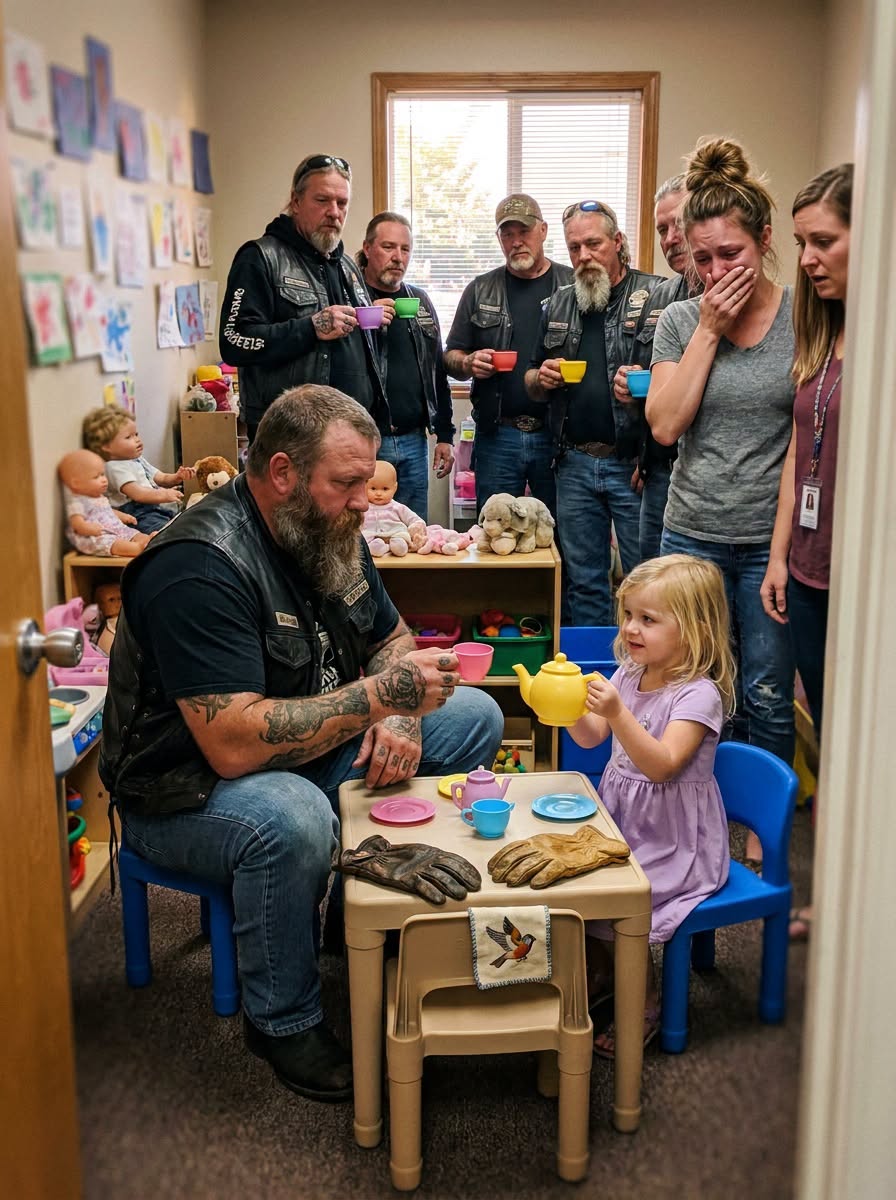
PART 3 – Twenty Bikers Walked Into a Preschool Carrying Toy Teacups. Then a Four-Year-Old Turned an Empty Chair Toward Them—and Asked If Heaven Could See the Party.
Lily did not look at the door after that.
She looked at the empty chair, as if the sentence had given it a different kind of weight. The plastic cup there sat exactly as she had left it: two imaginary sugars, a badly folded napkin, the quiet dignity of a place saved.
“Closer than the hallway,” she repeated, testing the words the way children test whether a bridge will hold.
Walter nodded.
“Some people leave a room,” he said. “Some people stay in the part you can’t see. Your daddy was the second kind. That’s why we knew how to find the table.”
Lily picked up her own little cup. She did not drink. She held it with both hands, the way you hold something that might spill if you forget you are allowed to keep it.
Then she did the smallest, bravest thing in the room.
She turned the empty chair a few inches toward the circle, so it was no longer facing the wall of cubbies, but the tea, the dolls, the men and women on the floor. An adjustment so slight an adult might have missed it. No one in that room missed it.
“You can stay,” she told the chair.
After that, the party became a party.
Not loud. Not the bright chaos of an ordinary afternoon. It was the other kind: careful, almost ceremonial, twenty people remembering how to be guests. They passed the teapot as if it mattered. They complimented the paper crowns. Someone asked the teddy bear whether he took lemon. Lily corrected them when they used the wrong names. She was four, and grief had not taken from her the right to run a table.
I stood by the sink and did not interrupt. There are days a teacher’s work is instruction. There are days it is simply not to break what has begun to mend.
When the office buzzed for first pickup, Denise appeared in the doorway and did not speak. She only looked, and whatever she had feared in the parking lot was gone from her face. Outside, parents were gathering with the usual mix of hurry and habit. None of them came in. The hallway had learned, for a few minutes, how to wait.
Lily poured one last time into the empty cup.
“For later,” she whispered.
Walter rose the way large men rise when they do not want the floor to notice. He set the pink cup back in its place among the others.
“We’ll come again if the queen sends word,” he said.
Lily considered this with the gravity of state.
“Only if you bring cups,” she said. “Real guests don’t come empty.”
A few of them smiled then. Not the broad kind. The kind that hurts a little on the way out.
They left as they had entered: two at a time, boots soft, cups carried like something that still belonged to the table even as they took them away. Through the window I watched the lot fill with engines again, lower than before, as if volume itself had learned manners.
Lily stayed at the table after the door closed. She did not cry. She straightened the napkin at the empty place, once, and then she picked up a crayon and began to draw.
Not a motorcycle this time.
A table.
Many chairs.
And above it, very small, a pair of wings that did not need to be explained.
I let her draw until the last parent came.
Some absences do not fill.
They change shape.
That afternoon, in a classroom that still smelled of tempera and apple slices, twenty borrowed teacups and one turned chair were enough to teach a roomful of adults what a child had known all along:
Love does not always walk back through the door.
Sometimes it sends the people who still know where to sit.
THE END