The Biker They Put at the Bottom of the List Was Bleeding Around a Stray Cat. The Richest Man in the Waiting Room Recognized Her — and His Daughter Said the Words That Destroyed Him: “That Was Great-Grandma’s Cat.”
PART 1 – The Cat Who Knew the Engine
I watched an old biker bleed for three hours while the clinic treated animals whose owners could afford to be impatient.
I am Dr. Leah Patel. For nineteen years I have worked the rooms at Mesa Vista in Albuquerque, where the waiting area smells of disinfectant and fear in equal measure, and where money arrives dressed as urgency.
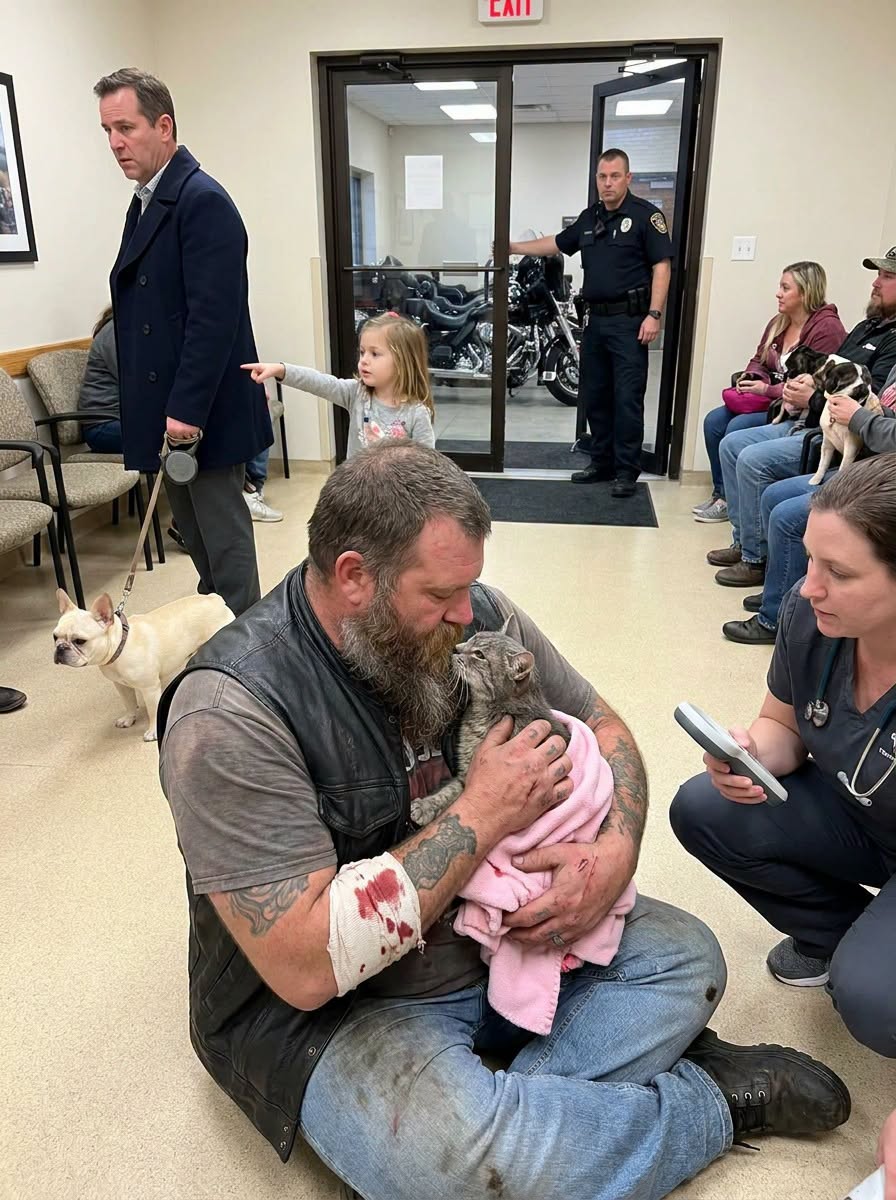
Ray Dawson came in with a gray tabby inside his leather jacket.
People called him Hammer.
He was a large white American biker, shaved head, long gray beard, inked forearms, hands mapped with old work. Faded jeans. Motorcycle boots. A silver skull ring that had learned the shape of his finger. He carried the expression of a man used to being decided before he was heard.
The cat had decided too.
She had scratched him five times. Blood darkened the shop rag around his wrist. He did not put her down. One palm held her injured hind leg as if the bone were a thing that could still be persuaded to stay. The other hand shielded her face from the fluorescent lights.
The staff gave him forms.
He could not finish them.
Name of owner: unknown.
Name of animal: unknown.
Age: old.
Breed: cat.
Reason for visit: Found hurt behind empty house.
He put every bill from his wallet on the counter. It was not enough for imaging, bloodwork, wound care, medication, the possibility of surgery.
He offered the title to his motorcycle.
The clinic manager refused it.
Then she moved his name down the board.
I did not see that at first. I was with Winston, a French bulldog belonging to Graham Avery, the developer whose name was already bolted to our new surgical wing in brushed steel. Winston had eaten too much steak. He had vomited once. He needed watching and a mild protocol. He was stable.
The cat in Hammer’s arms was not.
A six-year-old girl in the corner noticed before the rest of us agreed to notice. She was waiting with an old dachshund and a pink blanket she had been using as a throne. She carried the blanket across the room and asked Hammer if his cat was dying.
“Ain’t mine,” he said.
The tabby pressed her face into his beard.
The girl lifted one eyebrow, the small precise judgment of a child who has already learned when adults are lying for comfort.
Hammer corrected himself.
“Not yet.”
Outside, the Iron Saints arrived one engine at a time. The glass in the waiting room trembled. They did not come in. They understood what a room full of frightened animals would do with ten men in leather. They stood beside the bikes and passed an old helmet down the line.
Cash collected in it like rain in a dented bowl.
Each time a V-twin turned over, the tabby’s breathing slowed.
When the engines stopped, she cried.
Hammer asked one rider to start his Harley again.
The man did.
The cat began to purr against Hammer’s chest, a thin motor answering a larger one.
That sound reached Graham Avery.
I saw the recognition first. It passed across his face the way weather passes across glass: present, then denied.
“Keep that stray away from my daughter,” he said.
The little girl beside him frowned.
“Dad. That was Great-Grandma’s cat.”
The room changed temperature.
Graham told her to be quiet.
Our technician ran the scanner along the tabby’s shoulder. The chip spoke in the flat voice of a machine that does not care who is listening.
Registered to Eleanor Avery.
Graham’s grandmother.
Dead eight months. Ninety-one.
I knew Eleanor.
Anyone who had worked animals along the old Route 66 corridor knew her, though few knew the full ledger. Every December she arrived with a paper envelope and a handwritten list. A widow’s terrier. A janitor’s beagle. Three cats from a family burned out of their kitchen. She paid the balances and left before anyone could thank her in a way that would make the kindness smaller.
The last bill she covered belonged to one of my own technicians.
When Hammer heard her name, the man who had offered a motorcycle title as if it were spare change lowered his head until his beard touched the pink blanket.
“She fed me,” he said.
Not the cat.
Him.
In 1998 he had been homeless under the San Mateo overpass, drinking, sleeping in the kind of cold that teaches a body which parts it can afford to keep. Eleanor brought food. She let him wash. She gave him the garage where he rebuilt the Harley now idling beyond the glass.
The tabby had grown up with that sound in the walls.
That was why she knew the engine.
Graham stood and reached for Winston’s leash.
I stepped between him and the door.
The cat’s collar had cut a dark ring into the fur at her neck. Caught under the buckle was a luggage tag, the cheap kind people use when they expect to come back. The address on it belonged to the house Graham had sold after Eleanor died.
A neighbor’s camera would later show his SUV at the curb.
The passenger door.
The old cat set down on the concrete as if the sidewalk were a solution.
Graham called it a misunderstanding.
Animal welfare would use a colder word.
Hammer used none at all, not then.
He only looked at the tag, then at the man whose name was on the surgical wing, then at the cat who had chosen a bleeding stranger over the bloodline that had left her behind an empty house.
In a kitchen drawer eight months earlier, Eleanor had left a final note.
It named the one person she trusted if her family failed the animal she could no longer protect.
I had not read that note yet.
I would.
And when I did, I would pick up a pen and draw a line through a bill the clinic had already decided Hammer could not pay.
TO BE CONTINUE…