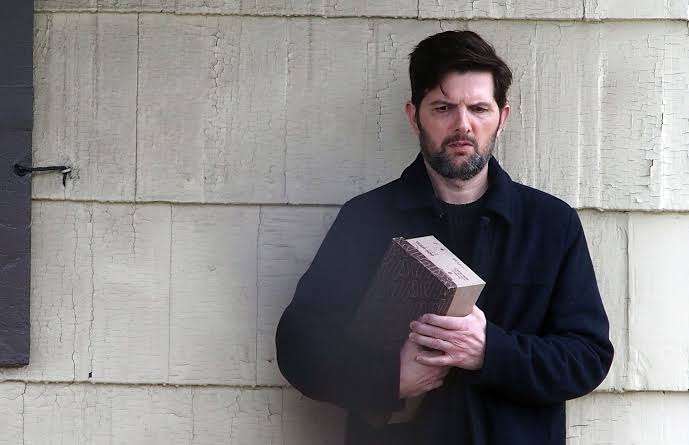
NETFLIX FINALLY REVEALS ADAM SCOTT’S DARK UNMISSABLE PSYCHOLOGICAL THRILLER
That line is not a marketing flourish. It is the invitation at the center of The Whisper Man, the psychological thriller Netflix is finally putting in front of a global audience. On the surface it looks like another missing-child story. Underneath, it is something colder: a portrait of a man who thought grief had already taken everything from him, only to discover that the house he chose for peace sits inside a predator’s unfinished pattern.
Adam Scott stars as Tom Kennedy, a crime writer who has already buried his wife and is trying, clumsily, to keep his eight-year-old son Jake from disappearing into the same silence. He wants a quieter town, a half-repaired life, a door he can leave ajar without listening for footsteps. Instead he walks straight into territory that has been waiting. A local child vanishes under the exact same ritual that froze this community two decades earlier. The old playground rhyme comes back. Neighbors lock windows they had stopped thinking about. Parents start measuring the gap under bedroom doors. Paranoia does not arrive as a sudden scream. It arrives as a whisper that everyone pretends they cannot hear.
The Whisper Man is based on Alex North’s 2019 bestseller, adapted by Ben Jacoby and Chase Palmer and directed by James Ashcroft, whose earlier work already understood how ordinary rooms become traps. The Russo brothers’ company AGBO produced it for Netflix. The official logline is almost brutally simple: when Tom’s son is abducted, the widowed writer turns to his estranged father, a retired detective who once put away the serial killer known as the Whisper Man, and finds the new crime braided into the old one. What the caption promises — “the shocking truth exposed right after this shot” — is the film’s real engine. It is not just who took the child. It is how a town, a family, and a man who writes about monsters for a living can live next to a pattern and still refuse to name it.
Scott is the unexpected center of gravity. Viewers who know him from Severance or Parks and Recreation will recognize the tight smile and the intelligence that never quite saves him. Here that intelligence becomes a liability. Tom is a man who has spent years turning other people’s worst nights into chapters. When the night belongs to his own son, language fails first. The performance is not a transformation into a hard-boiled hero. It is the opposite: a father who keeps reaching for the next sentence and finding only the sound of a house that is too quiet.
Opposite him, Robert De Niro plays Pete Willis, the retired detective who caught Frank Carter — the original Whisper Man — and then spent the rest of his life trying not to become the case. Their scenes together are the film’s bruised heart. This is not a warm reunion. It is two men who share blood and almost no language, forced to stand in the same room because a child is missing and the old method may be the only one that still works. Michelle Monaghan, as Detective Amanda Beck, refuses to treat the investigation as folklore. She is the one who has to decide whether the rhyme is a copycat’s costume or evidence that the original monster never fully left. Michael Keaton appears as Frank Carter, and even from the limited glimpses Netflix has allowed, the performance has the stillness of someone who no longer needs to raise his voice.
The film understands something most thrillers rush past: fear in a small town is social before it is supernatural. After the first disappearance matches the twenty-year-old pattern, every half-open door becomes an accusation. People who once waved across the street start timing how long a porch light stays on. Children are pulled inside earlier. Rumors travel faster than official statements. The Whisper Man uses that collective dread without turning the town into a cartoon of suspicion. The menace is specific. Someone is listening at the glass. Someone knows which windows are left unlatched. The old verse — If you leave a door half open, soon you’ll hear the whispers spoken. If your window is left unlatched, you’ll hear him tapping at the glass. If you’re lonely, sad, and blue, the Whisper Man will come for you — stops sounding like a children’s chant and starts sounding like instructions.
That is why the caption’s hook lands. Tom did not move toward danger. He moved toward solace and found the map already drawn. The two-decade cold case is not background color. It is the architecture of the place. The original Whisper Man is locked away. The new vanishing follows his signature anyway. The question the film keeps circling is the one audiences will take into the dark after the credits: if the man in the cell cannot leave, who is still speaking in his voice?
Ashcroft shoots the story like a memory that will not stay still. Hallways feel longer than they should. Night interiors hold just enough light to make the next room worse. The camera does not lunge at jump scares so much as wait, the way a parent waits after calling a child’s name and hearing nothing back. Runtime sits just under two hours, rated R for violence, disturbing images, language, and the kind of emotional rawness that does not need gore to feel invasive. The source novel already mixed grief, folklore, and procedural dread; the film tightens the family line — father, son, grandfather — until the investigation and the reconciliation are the same wound.
None of this requires a twist dump to sell it. The “shocking truth” the promotional shot teases is best left where Netflix put it: after the image that makes you lean forward. What can be said without spoiling the lock is this. The Whisper Man is not interested in a clean monster under the bed. It is interested in the people who left the door half-open because they were tired, or lonely, or convinced the past had already been sentenced. It is interested in a writer who thought he understood predators because he put them on the page. And it is interested in a town that recited a rhyme for twenty years as if reciting it were the same as being safe.
For Scott, the role is a pivot that feels overdue. He has spent years playing men whose minds are the battlefield. Tom Kennedy is that same intelligence dropped into a nightmare that will not be organized into a plot outline. De Niro’s presence raises the temperature without swallowing the film; the younger man’s panic and the older man’s worn authority keep colliding until neither can pretend this is only police work. Monaghan’s detective is the audience’s ballast: someone who still believes procedure can outrun a legend, even as the legend starts answering back.
Netflix has been sitting on a stack of literary thrillers. The Whisper Man is the one that feels built for late-night watching with the volume low and the hallway light on. It is dark without being empty, unmissable not because it shouts but because it makes the smallest sound — a tap at glass, a child’s name spoken once and not returned — feel like the start of something that has been waiting in the walls.
The film arrives on Netflix on August 28. Leave the door closed if you want. The whispers, the film suggests, already know the way in.