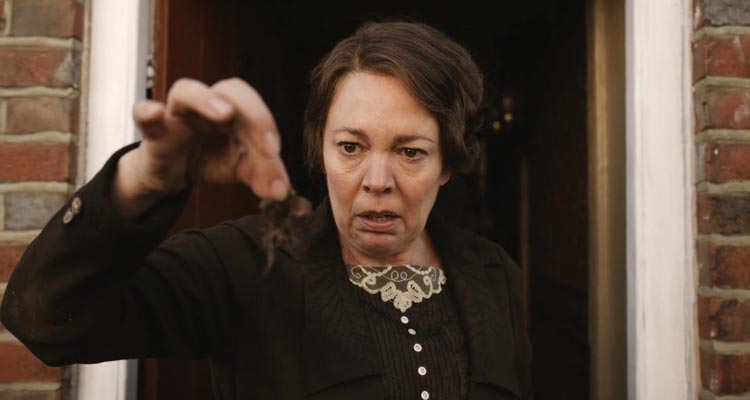
STREAMING NOW ON NETFLIX: OLIVIA COLMAN IN A MASTERCLASS PERFORMANCE OF OBSESSION AND CRIME!
When the desperate, agonizing struggle to maintain a perfect moral reputation turns into a bizarre, calculating psychological war. On Netflix, Olivia Colman captures the suffocating dread of a woman living under constant social scrutiny and severely repressed desire. The twisted, disturbing discovery she inspects with trembling hands right after this frame proves that the most dangerous enemy is not the neighbor next door — it is the life she has been forced to live.
In the seaside town of Littlehampton in 1920, respectability is not a virtue. It is a prison. Wicked Little Letters drops the viewer into a world of starched collars, church pews, and whispered judgments, where a single misplaced word can destroy a woman’s standing. Edith Swan, played by Olivia Colman with terrifying precision, is the model of piety. She lives with her overbearing father and gentle mother, attends church without fail, and presents herself as the kind of woman the town can point to as proof that order still exists after the war. Everything about her is controlled. Her voice is measured. Her smiles are careful. Her desires, if they exist at all, have been locked away so long they have begun to rot.
Then the letters arrive.
They are filthy. They are specific. They are written in a language so crude it feels like a physical assault on the quiet streets of Littlehampton. Edith is the primary target, but the poison spreads. Neighbors receive them. Family associates receive them. The words are so shocking that they become a national curiosity, the kind of scandal newspapers cannot resist. Suspicion falls immediately on Rose Gooding, the Irish migrant next door — loud, unmarried in the eyes of the town, a single mother who swears freely and refuses to shrink herself to fit the local idea of a decent woman. Jessie Buckley plays Rose with volcanic energy, a woman who has already paid the price for being visible in a place that prefers its women silent.
What follows is not a simple mystery. It is a psychological siege.
Edith’s father marches to the police. The machinery of small-town justice, already tilted against anyone who looks or sounds different, begins to grind. Rose is arrested. A trial looms. The town splits along familiar lines: those who believe a woman like Rose must be guilty because she is everything Edith is not, and those who start to notice that the story does not quite add up. A young police officer, Gladys Moss, becomes the quiet engine of the investigation. The women of the town, tired of being told what to think, begin looking for themselves.
Colman’s performance is the film’s beating heart and its most unsettling weapon. She does not play Edith as a cartoon of repression. She plays her as a woman who has spent years converting rage into righteousness. Every tight smile, every trembling hand, every moment of public piety is a performance Edith has rehearsed so long she no longer knows where the act ends. The film understands something cruel about respectability: it does not just constrain behavior. It colonizes the inner life. Desire that cannot be spoken does not disappear. It finds other doors.
The letters themselves become a kind of confession in disguise. They say the things Edith cannot say in her own voice. They attack the very order she claims to defend. They are obscene because the life she is living is obscene in its smallness — a life of duty without agency, of moral superiority without freedom. The more the town congratulates her for her suffering, the more isolated she becomes. Colman lets the audience see the calculation behind the tears. This is not a woman simply receiving hate. This is a woman who has learned that victimhood can be a form of power when every other form has been denied to her.
The “discovery” the caption teases is not a single prop or a single letter. It is the moment the mask slips far enough for the viewer to understand the architecture of the crime. Edith inspects the evidence of her own making with the same trembling hands she uses to open her Bible. The horror is not only what she has done. The horror is how inevitable it feels once you have lived inside her house, under her father’s control, inside a town that rewards women for disappearing. The film is funny — often wildly, shockingly funny — because the language of the letters is so out of place in that buttoned-up world. But the laughter curdles. The comedy is the sound of a pressure cooker finally splitting.
Wicked Little Letters is based on a true scandal, the Littlehampton libels of the early 1920s, a case so strange it was debated in Parliament and followed across the country. The real Edith Swan and Rose Gooding lived this collision of class, gender, and reputation. The film compresses years of letters, trials, and reversals into a taut, viciously entertaining story, but it keeps the essential truth: a woman who looked like the safest person in town was capable of a campaign that destroyed another woman’s life and nearly destroyed her own. The police eventually used marked stamps and invisible ink. The courts eventually caught up. Justice, when it arrived, was late and incomplete, as it often is when the accused is the kind of woman society already wants to punish.
What makes Colman’s work a masterclass is that she never asks for easy sympathy and never settles for easy villainy. Edith is ridiculous and tragic, petty and wounded, calculating and trapped. You watch her and feel the weight of every year she spent being “good.” You understand why the letters exist even as you recoil from what they do. The film is about crime, yes. It is also about what happens when a society tells women that their only acceptable emotion is gratitude, and then acts surprised when something darker leaks out through the only channel left.
Streaming now on Netflix, Wicked Little Letters is not a cozy period piece. It is a study of obsession wearing a church hat. It is a reminder that the most chilling wars are the ones fought in kitchens and post offices, with words instead of weapons, by people who have been told they are not allowed to want anything at all. Watch Colman’s hands. Watch what she does when no one is supposed to be looking. The discovery after that frame is not just a plot twist. It is a diagnosis.