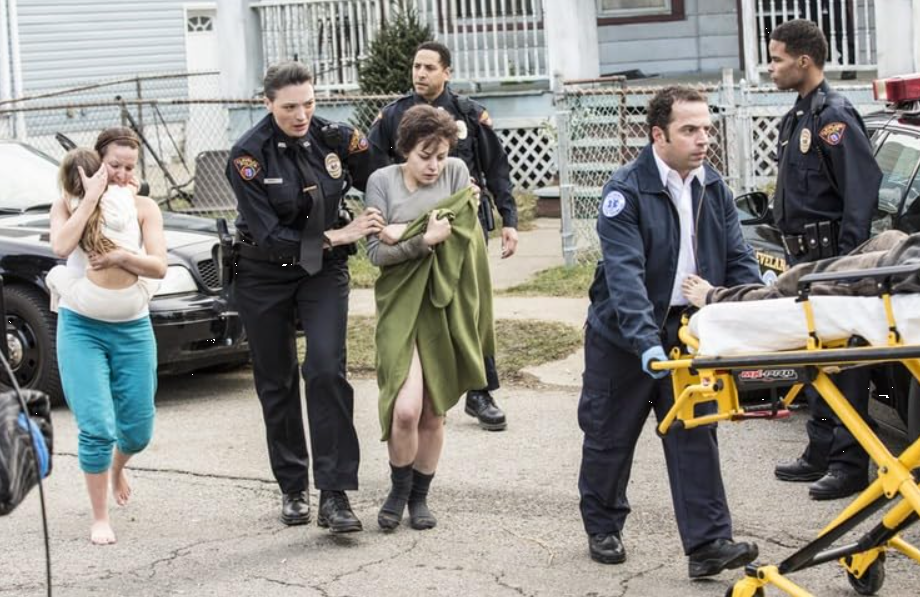
STREAMING NOW ON NETFLIX: STEPPING OUT OF THE DARKNESS AFTER YEARS IN A LIVING HELL
Eleven years held captive in a dark basement. Unimaginable torture. Then a sudden breath of freedom. When a decade of darkness ends in an overwhelming emotional reunion, Cleveland Abduction (2015) does not merely retell a headline. It puts you inside the moment a woman steps into sunlight after the world had already written her off as gone.
On Netflix now, the Lifetime drama — based on Michelle Knight’s memoir Finding Me: A Decade of Darkness, a Life Reclaimed — follows the first of three young women stolen off the streets of Cleveland by Ariel Castro. Taryn Manning delivers a gut-wrenching, masterclass performance as a survivor reclaiming her life. The frame that stays with viewers is simple and devastating: she embraces her loved ones in tears after stepping into the sunlight. The terrifying reality of what she survived is revealed in the seconds that follow.
In August 2002, Michelle Knight was 21, a single mother who had lost custody of her young son, Joey. She was walking toward a court date that might have given her a path back to him when she accepted a ride from a man she recognized — the father of a schoolmate. That ordinary decision became the last ordinary moment of her old life. Castro lured her with the promise of a puppy for her boy. Once inside the house on Seymour Avenue, the door closed. Chains, darkness, and years of captivity began.
Cleveland Abduction does not linger on spectacle. It stays with Michelle’s point of view: the disorientation of a woman who believed she was late for a hearing, the crushing realization that no one was coming, the small, stubborn acts of endurance that kept her alive. Manning plays her with a rawness that never turns into performance for its own sake. You see the girl who still wanted her son. You see the woman who learned to survive inside a house that looked, from the street, like any other house on the block.
Less than a year later, Castro abducted Amanda Berry, then 16, the day before her 17th birthday. In April 2004 he took Gina DeJesus, 14, walking home from school. The three women were held in the same house for the better part of a decade. The film treats their bond as the story’s quiet engine. They became sisters in a place designed to isolate them. When Amanda became pregnant, Michelle delivered the baby and performed CPR under threat that the child would not be allowed to live if she failed. That sequence is among the hardest to watch — not because it is graphic, but because it is so human. A captive woman fighting to keep another captive’s child breathing.
The outside world moved on. Missing-person flyers faded. Neighbors passed the boarded windows. Police knocked once and left. Inside, time was measured in beatings, in forced silence, in the rare moments the women could speak to one another without being overheard. Cleveland Abduction makes that claustrophobia felt. The camera stays close. The house feels smaller with every year.
Then came May 6, 2013. Castro left the house and failed to lock the inner door. Amanda Berry forced her way to the front, called for help through a crack in the storm door, and a neighbor kicked it open. She ran into the street with her six-year-old daughter and dialed 911 with the words that would flash around the world: she had been kidnapped, she had been missing for ten years, and she was free now. Officers entered the house. Michelle Knight stepped into a hallway and into an officer’s arms. Gina followed. After eleven years for Michelle, ten for Amanda, nine for Gina, they walked out into daylight.
That is the image the caption promises — and the one Manning earns. The reunion is not tidy. It is messy, loud, tear-soaked. A woman who had been starved of ordinary touch collapses into the arms of people who had spent a decade not knowing if she was alive. The sunlight looks almost too bright. The film lets that brightness sit there, then immediately reminds you what it cost to reach it.
Raymond Cruz plays Castro with a chilling banality — not a movie monster, but a man who could smile at neighbors and then return to the rooms he had turned into a prison. Katie Sarife and Samantha Droke give Gina and Amanda distinct, lived-in presence so the three women never blur into a single “victim” figure. Joe Morton and Pam Grier appear in the aftermath as the system that finally arrives too late and then tries, imperfectly, to help. The movie was shot with the real Michelle Knight’s involvement. Manning has said meeting her was more nerve-wracking than almost any other encounter of her career. That care shows. The performance does not decorate suffering. It inhabits the long, grinding work of staying a person when every day was designed to erase you.
After the rescue, Castro pleaded guilty to hundreds of counts and was sentenced to life plus 1,000 years. He died by suicide in prison a month later. Michelle Knight — who later changed her name — testified in court with her captor in the room. She wrote the memoir that became this film. The other survivors have, in their own ways, rebuilt lives that no one had the right to take from them. Cleveland Abduction is not their whole story. It is one woman’s account of the years before the door opened, and of the first stunned minutes after it did.
What the film understands, and what keeps it from feeling like another true-crime product, is that survival is not a single heroic act. It is eleven years of choosing, again and again, not to disappear inside yourself. It is delivering a baby in a locked house. It is holding another woman’s hand in the dark. It is walking into sunlight with a body that still remembers every locked door.
Streaming now on Netflix, Cleveland Abduction runs just under 90 minutes. That brevity is part of its force. It does not explain every horror. It does not need to. The lead actress’s face in the reunion scene does the work: relief so large it looks like pain, love so delayed it looks like disbelief, a woman reclaiming a life the world had already filed away.
The caption is right. After years in a living hell, she steps out of the darkness. The frame that follows — the embrace, the tears, the sudden ordinary sky — is the moment the movie has been building toward. What it proves, without speechifying, is that some people walk out of the worst rooms ever built and still know how to hold the people they love.
Watch it if you can bear it. Then sit with the silence after the credits. That silence belongs to three women who spent a decade waiting for a door that finally, impossibly, opened.