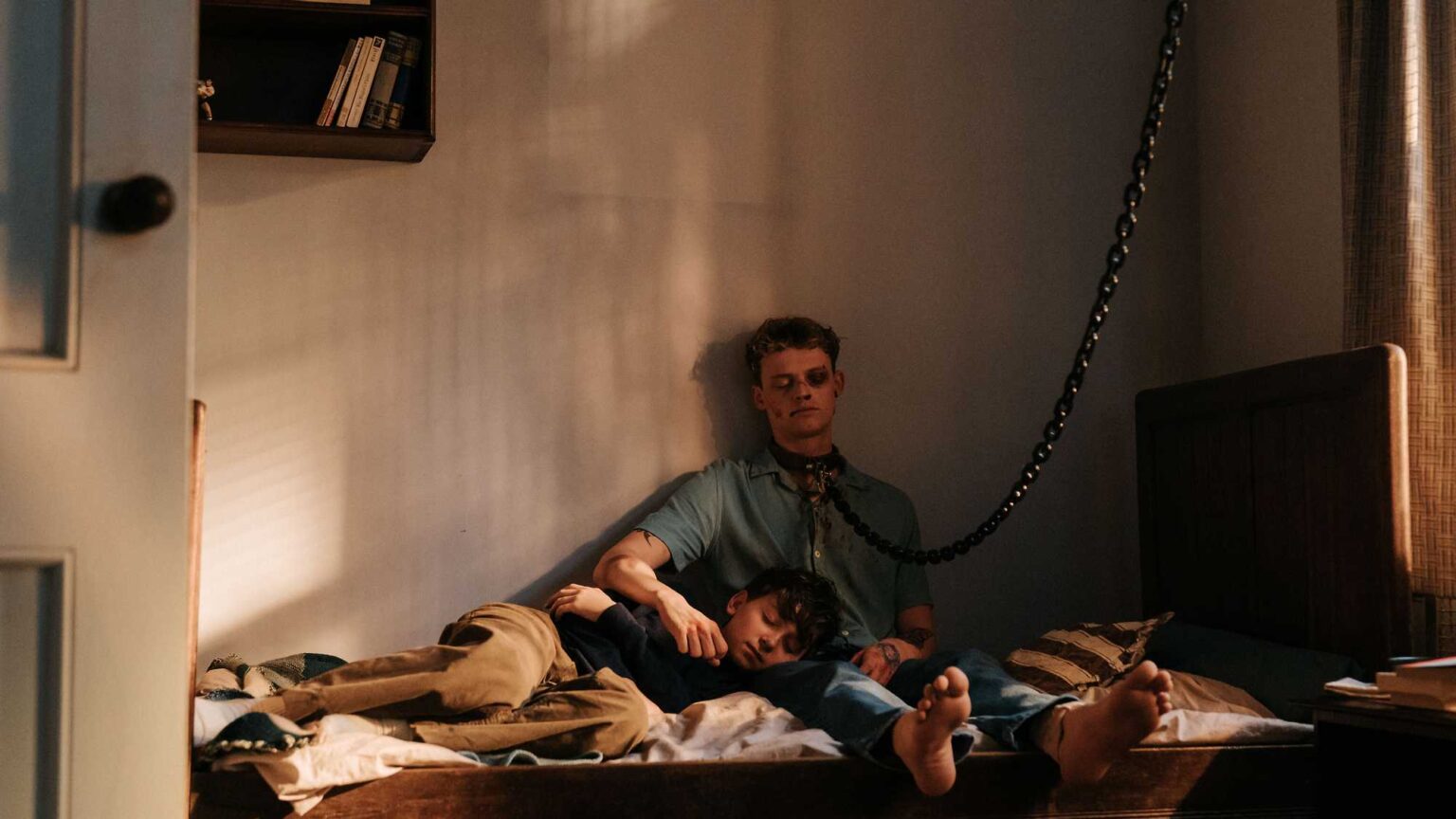
THE CHILLING NETFLIX PSYCHOLOGICAL THRILLER SCENE THAT WILL LEAVE YOU COMPLETELY SPEECHLESS!
A heavy iron chain locked tight around his neck, yet a child rests peacefully in his lap. On the screen, a rebellious delinquent (Anson Boon) sits battered and exhausted in the quiet afternoon light of his captor’s home. What appears to be an impossibly tender moment of warmth actually masks a terrifying psychological web. The disturbing truth behind why he refuses to unlock his chains when the door is left open reveals…
In the unsettling new psychological thriller Good Boy (also known in some territories as Heel), directed by Oscar-nominated Polish filmmaker Jan Komasa, audiences are confronted with one of the most quietly devastating images in recent cinema. A young man, bruised and broken, sits in the soft glow of an ordinary family living room. Around his neck is a thick iron chain, heavy enough to weigh down both body and spirit. On his lap, a young boy rests with the easy trust of childhood. The camera lingers. The silence stretches. And something in the viewer’s chest tightens.
That young man is Tommy, played with raw, feral intensity by rising British star Anson Boon. Before the chain, Tommy was the kind of teenager who made people cross the street. Foul-mouthed, drug-fueled, addicted to the dopamine hit of social media notoriety, he filmed his own recklessness—car crashes, fights, public humiliation—and posted it for likes. One chaotic night of excess leaves him separated from his friends, stumbling through the streets. He never makes it home. He wakes up in a basement, chained like an animal.
His captors are not the sadistic strangers of conventional horror. They are Chris and Kathryn, a seemingly respectable couple living in a large, isolated countryside house with their young son, Jonathan. Stephen Graham brings a quiet, unsettling conviction to Chris, a man who believes with absolute sincerity that he is saving Tommy from himself. Andrea Riseborough’s Kathryn is more spectral, a woman who has retreated so far into the role of wife and mother that she seems half-absent from her own life. And then there is the boy, Jonathan (Kit Rakusen), whose presence turns the entire premise into something far more disturbing than a simple kidnapping.
The chain is not merely a restraint. It is a statement. Even when Tommy begins to “progress,” even when he is allowed upstairs and given the limited freedom of a ceiling-mounted track system that lets him move through the house, the metal remains locked around his neck. The weight of it is constant. Anson Boon has spoken about the physical and emotional toll of wearing the real chain for nearly every scene, describing how it pulled him down, how it changed the way he moved, the way he thought. The production used lighter versions for certain sequences and built in safety mechanisms, but Boon preferred the real thing whenever possible. The authenticity shows.
What makes the film so disquieting is not the violence, though there is violence. It is the gradual, almost tender process of forced rehabilitation. Tommy is made to watch his own social media videos until the bravado curdles into shame. He is given books. He is invited to family movie nights. Classical music plays. Etiquette lessons appear. When he resists, the consequences are swift and calculated. When he complies, small privileges are granted. The line between punishment and care blurs until even the audience begins to question which side of the chain is more free.
And then there is the child.
The scene the caption describes—the one that has viewers pausing, rewinding, staring in silence—is not an isolated moment of sentimentality. It is the emotional core of the film’s central horror. Tommy, the boy who once hurt other children for content, sits with Jonathan. The chain still hangs heavy. The afternoon light is soft. The house is quiet. What should feel like a hostage situation begins to look, for a fleeting, terrifying second, like something closer to family. The child’s trust is genuine. Tommy’s protectiveness, when it emerges, is not entirely performative. The film does not rush to explain it. It simply lets the image sit there, heavy as the chain itself.
Why doesn’t he leave when the opportunity finally appears? Why, when the locks can be manipulated, when the door stands open, when the path to the outside world is suddenly clear, does Tommy hesitate? The answer is not simple Stockholm syndrome, though the film understands that concept intimately. It is something more layered and more devastating. The life waiting outside the gates is the same life that left him unconscious in the street. The people who once shared his chaos have moved on. The digital applause has already faded. Inside the house, for all its cruelty, there is structure. There is attention. There is a child who looks at him without the judgment of the outside world. There is, in the most twisted sense, a version of belonging.
Komasa and co-writers Bartek Bartosik and Naqqash Khalid refuse to offer easy moral comfort. The film never endorses the couple’s methods. It never excuses Tommy’s past. Instead, it forces the audience to sit inside the discomfort of watching a young man who was never given consistent care now receive a grotesque parody of it—and, against every rational instinct, begin to respond. The performances make the unease almost unbearable. Boon is extraordinary, shifting from snarling aggression to hollow compliance to something far more ambiguous. Graham plays conviction without cartoonish villainy. Riseborough’s quiet presence carries the weight of unspoken grief. And Rakusen’s Jonathan is the film’s secret weapon: a child who has been raised inside this strange moral experiment and treats it as normal.
By the time the afternoon light falls across that chained figure and the peaceful child in his lap, the film has already done its work. Viewers are no longer simply watching a thriller. They are being asked to confront uncomfortable questions about control, rehabilitation, parental failure, social media’s corrosion of accountability, and the human need for connection even under the most distorted conditions. The door may be open. The chain may, in theory, be unlockable. But the psychological web is tighter than any metal.
Good Boy does not shout its horrors. It sits with them in the quiet of a family home, in the weight of an iron collar, in the trusting weight of a child on a broken young man’s lap. And long after the screen goes dark, that image remains—impossible, tender, and utterly chilling. It is the kind of scene that does not merely shock. It leaves you speechless, staring at the reflection of a society that still has not decided what it means to save someone, or whether some forms of salvation are simply another kind of cage.