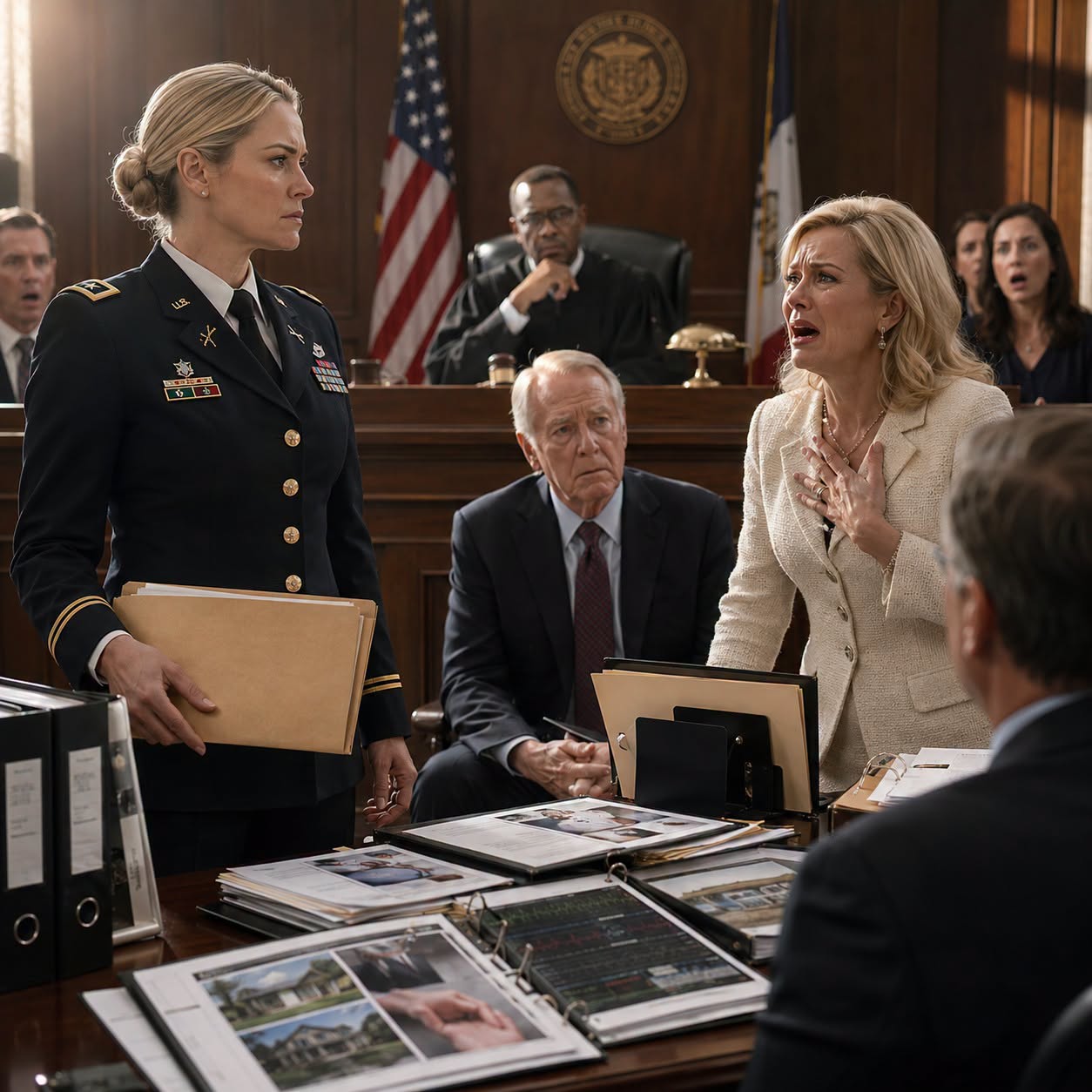
PART 3 – Soul Theft: A gripping, jaw-dropping military thriller novel about a veteran daughter who returns home to expose her stepmother’s meticulously hidden soul-stealing fraud in a single relentless courtroom ambush that will leave readers gasping at every twist, with betrayal, military precision, and quiet courage that reclaims what was never truly lost.
PART 3: The Soul That Could Not Be Stolen
The gavel remained suspended in Judge Bennett’s hand, frozen mid-air like a blade held by a surgeon who had already decided the cut.
Every eye in the courtroom—mine, my father’s, Diane’s, Eric Lawson’s, even the bailiff’s—had locked onto that single object as if it might decide the fate of a man’s entire life.
I watched Diane’s blood-orange nails dig deeper into the cracked coffee cup until blood began to well along her knuckles. Eric’s polished face had gone the color of old ash. The gallery, once buzzing with whispers, now held its breath so completely that I could hear the faint tick of the grandfather clock in the corner and the soft scrape of my own boots as they shifted on the marble.
I didn’t move. I didn’t need to. The evidence lay on the table like a loaded revolver with the safety already off.
Judge Bennett cleared his throat. “Ms. Grant… the court will recess for fifteen minutes to review these documents.”
Diane’s voice cracked for the first time all morning. “Your Honor, this is a lie. She’s using military records to bully an elderly man—”
“Ms. Grant,” the judge said, voice like gravel under tires, “the court has just received bank statements, LLC filings, and certified deed transfers. You will be seated. You will not speak again unless I call on you. Is that understood?”
She sat. The chair creaked like a dying animal.
I sat too, but my gaze never left my father.
Six months ago he had been the man who once carried me on his shoulders through this very courthouse parking lot, laughing when I begged him to do it harder. Now he looked at me across the table, eyes wide and glistening, the trembling in his hands finally still. Walter’s files had done what I never could—they had stripped away the last layer of her carefully painted devotion.
When the fifteen minutes ended, Judge Bennett called us forward again.
He read the summary with the same flat precision I had once used on war criminals: “Ms. Diane Grant, you stand accused of multiple counts of fraud, embezzlement, and undue influence over a vulnerable adult. The evidence is overwhelming. Your LLCs will be frozen. All transfers will be reversed. And the court finds that you have no right to remain as power of attorney or healthcare proxy.”
Diane’s face collapsed inward. For a moment she looked not like a woman who had stolen a soul, but like one who had just realized the soul had already been stolen from her by the man she married.
Judge Bennett turned to my father. “Mr. Grant, do you wish to be declared incompetent, or do you wish to retain the protections your daughter has provided?”
Robert Grant stood. Slowly. The way a man stands when he finally remembers who he is.
“I choose my daughter,” he said, voice steady for the first time in years. “And I choose to live the rest of my life exactly as I choose—without her shadow.”
A low sob escaped Diane’s throat. Eric tried to object, but the judge waved him silent.
I stepped forward and offered my father my hand. He took it. His grip was weak but certain.
As we walked out, the courthouse doors swinging open to let in the warm Georgia afternoon, he stopped beside me.
“You always were the best shot in the family,” he murmured.
I smiled for the first time all day.
“No, Dad. You taught me how to aim true.”
The sun spilled across the marble steps like forgiveness. Diane stood behind us, already being led away in cuffs—not by me, but by the system I had helped build. I didn’t watch her go. I didn’t need to.
My father and I walked down the steps together, boots and dress shoes side by side on the same pavement where I had once left for West Point, where I had once left my heart. Behind us, the courthouse doors closed with a final, heavy sound that sounded almost like a life sentence being lifted.
We didn’t speak again until we reached my car. Only then did he say the words I had waited twenty-seven years to hear.
“You came home.”
I looked at him—really looked—and saw the boy I had left behind, finally grown into the man who had always been waiting.
“Yes, Dad. I came home.”
And for the first time in my life, the house on the hill felt like mine in every way that mattered.
THE END