THE THIN LINE BETWEEN DEMONIC VOICES AND PREMEDITATED CRIME
The courtroom at the Plymouth County Superior Court in Massachusetts has recently become the center of national attention across the United States. The trial of former nurse Lindsay Clancy—the woman accused of strangling her three young children to death—has entered its most intense phase. No longer merely a battle between the prosecution and defense over physical evidence, the proceedings have transformed into a fierce “psychiatric war.” The jury remains deeply torn between two opposing perspectives: on one side, the tragic image of a grieving mother entirely ruined by severe postpartum psychosis to the point of losing all control over her actions; on the other, the portrait of a calculating killer who acted with structure, organization, and a clear awareness of her crime.
The tragic event that unfolded on the afternoon of January 24, 2023, in the quiet town of Duxbury once shocked international media. Lindsay Clancy, 36, then a labor and delivery nurse at Massachusetts General Hospital, used exercise bands to strangle her three biological children: Cora (5 years old), Dawson (3 years old), and Callan (8 months old). After committing the horrific act, Lindsay climbed to the second floor and jumped out of a window into the backyard in an attempt to commit suicide, resulting in a severe spinal cord injury that left her completely paralyzed from the waist down. Her husband, Patrick Clancy, returned home after being away for about 25 minutes to pick up medication and takeout at his wife’s request, only to witness the most horrifying scene of his life.
At trial, the defense does not deny that Lindsay took the lives of the three children. However, defense attorney Kevin Reddington argues that Lindsay bears no criminal responsibility because she was suffering from an extremely severe onset of postpartum psychosis, combined with an overload and compounding side effects from a barrage of psychiatric medications prescribed to her in the months leading up to the event.
Dr. Phillip Resnick’s Shocking Analysis: “She Was Merely a Controlled Puppet”
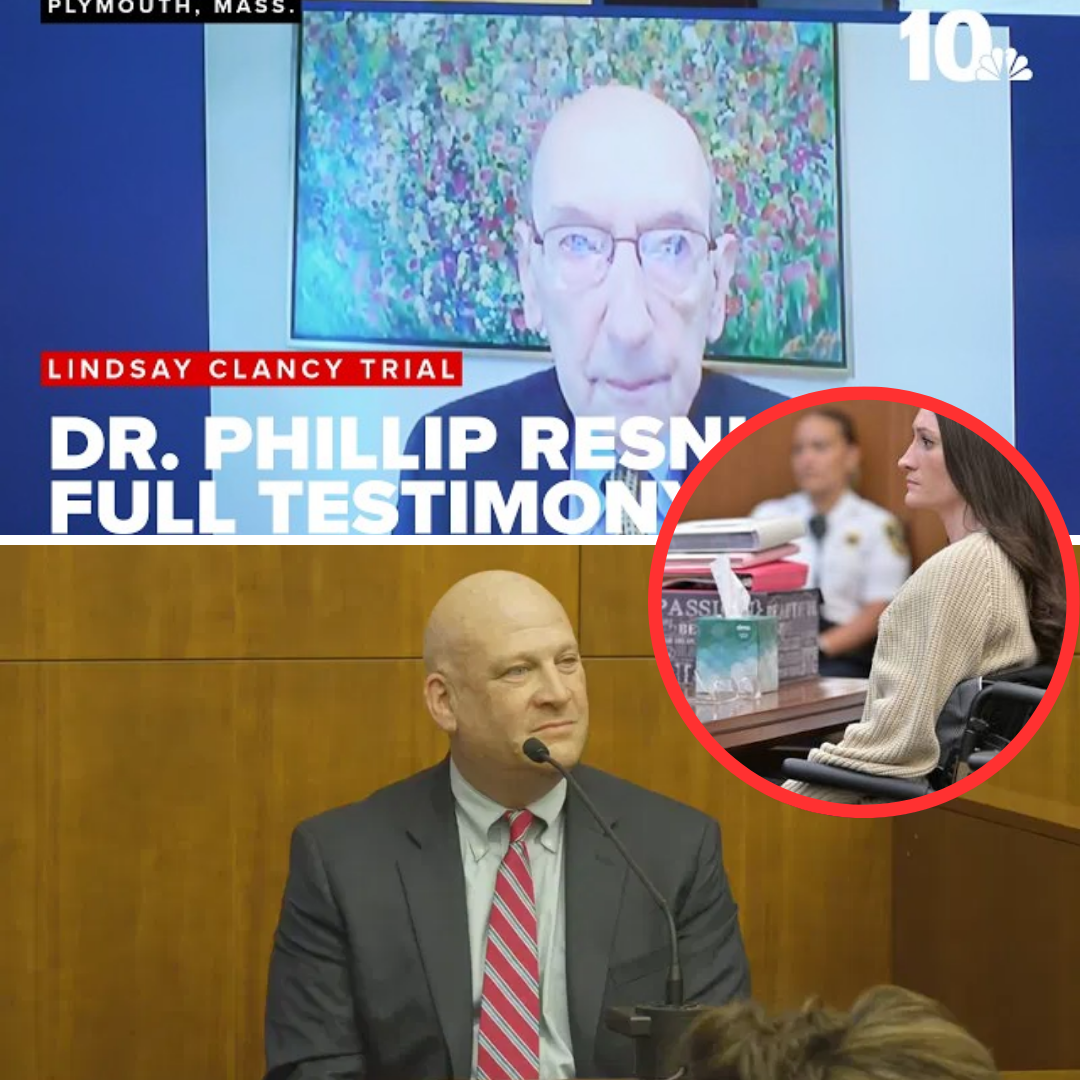
To bolster their defense of criminal irresponsibility, the defense called to the witness stand one of America’s most renowned forensic psychiatrists—Dr. Phillip Resnick. He was previously a key expert witness in the 2001 Andrea Yates trial (the Texas mother who drowned her five children in a bathtub and was ultimately found not guilty by reason of insanity).
Based on hours of direct interviews with Lindsay Clancy as well as a thorough review of her medical records, Dr. Resnick testified to the jury that Lindsay was in a state of severe psychosis on the exact day of the tragedy. According to him, Lindsay was driven by a “command hallucination”—a male voice inside her head threatening that if she did not kill her children immediately, she would lose her last chance and her children would suffer far worse fates.
“Lindsay was suffering from a catastrophic combination of major depression, hypomania, and an insidious onset of bipolar disorder after giving birth to Callan,” Dr. Resnick analyzed via video link. “On January 24, she was completely deprived of the capacity to perceive reality. In her delusional mind, Lindsay possessed no malice or desire for revenge. She was consumed by the distorted belief that she was ‘helping’ her children, sending them to heaven to protect them from a cruel world when she herself felt she was dying or unable to continue being a mother.”
Dr. Resnick pointed out that in the weeks preceding the tragedy, Lindsay had repeatedly expressed panic, terror, severe insomnia, and had confessed to her mother and husband that she harbored thoughts of harming herself and her children. She had actively sought medical help at McLean Hospital, undergoing dozens of prescription adjustments involving potent antidepressants and anti-anxiety medications such as Zoloft, Prozac, Klonopin, Trazodone, among others. The resulting chemical imbalance in her brain caused by rapid, continuous medication changes, according to Dr. Resnick, acted as the detonator triggering an acute episode of postpartum psychosis, transforming a mother who profoundly loved her children into a “puppet” entirely manipulated by hallucinatory voices.
The Prosecution’s Fierce Counterattack and Dr. Avram Mack: The Words “Go to God”
However, the narrative of a completely insane mother was sharply challenged when the prosecution called its rebuttal expert witness—Dr. Avram Mack, a state-appointed forensic psychiatrist tasked with conducting an independent evaluation of Lindsay Clancy.
In stark contrast to his defense counterpart, Dr. Avram Mack presented conclusions that stunned the courtroom into silence. Following two direct interviews with Lindsay at Tewksbury Hospital, along with a meticulous examination of her journals, text messages, and web browsing history, Dr. Mack testified definitively: Lindsay Clancy was not suffering from bipolar disorder, was not in a manic state, and was absolutely NOT insane at the time she committed the crime.
Dr. Mack acknowledged that Lindsay had experienced a severe depressive episode and prolonged anxiety disorder. However, he emphasized that suffering from mental illness does not equate to lacking the ability to appreciate the wrongfulness of one’s conduct or losing self-control under the legal standard of criminal responsibility.
The most chilling detail in Dr. Mack’s testimony was Lindsay’s own recount of the exact moment she turned on her children. Lindsay stated that late that afternoon, she heard a male voice urging her to kill the children so she could commit suicide. She then led each child one by one into the basement and strangled them using exercise bands.
“While strangling each of her children, Lindsay stated that she said out loud the words: ‘Go to God,’” Dr. Mack calmly testified before the court.
According to Dr. Mack, these words were not those of someone lost in uncomprehending delirium, but rather evidence that the defendant knew full well her actions would end her children’s lives and send them to the afterlife. Dr. Mack argued that Lindsay’s entire sequence of actions that day demonstrated meticulous organization, calculation, and concealment:
-
She proactively looked up driving times on her phone from their home to a CVS pharmacy and a Greek restaurant in a neighboring town.
-
She waited for the precise moment to ask her husband to run these two errands, ensuring she would have at least 25 to 30 minutes completely alone in the house with all three children.
-
She went upstairs and called her husband on the phone using a completely normal, calm tone to confirm he was at the restaurant, checking how much time remained before he returned.
-
Immediately following the call, she carried out the crime swiftly, sequentially, and thoroughly.
Dr. Mack also described Lindsay’s demeanor during his evaluations at Tewksbury Hospital: “The defendant was fully alert, cooperative, maintained good eye contact, and exhibited logical thought processes and completely coherent speech. She expressed depression and fatigue regarding her current circumstances, complaining about hospital food or reluctance to bathe due to her paraplegia, but she displayed no persistent signs of delusions or hallucinations indicative of schizophrenia or severe psychosis.”
Fierce Cross-Examination: Attacks on Expertise and Medication Side Effects
Dr. Avram Mack’s damning testimony sparked an intensely heated cross-examination from defense attorney Kevin Reddington. The courtroom turned into a veritable battleground as Reddington relentlessly pressed Dr. Mack with sharp questions aimed at undermining the credibility and objectivity of the expert’s conclusions.
Reddington launched his attack by homing in on Dr. Mack’s professional background. He highlighted that the majority of Dr. Mack’s career and research centered on Child and Adolescent Psychiatry, rather than specialized subspecialties in maternal-fetal medicine or postpartum psychiatric disorders in women.
“How many published research studies do you have on postpartum psychosis? How many postpartum mothers experiencing an acute psychotic onset directly after giving birth have you personally treated?” Reddington sharply demanded.
Not stopping there, the defense attorney accused Dr. Mack of conducting a “one-sided and severely flawed evaluation” by interviewing only Lindsay Clancy while she was detained and medicated at the psychiatric hospital, completely failing to directly interview her husband (Patrick Clancy), her parents, or the healthcare colleagues who had interacted with her in the months leading up to the tragedy.
Another intense debate erupted over the Diagnostic and Statistical Manual of Mental Disorders (DSM-5). Reddington accused Dr. Mack of deliberately downplaying the devastating impact of the psychiatric “medication cocktail” Lindsay had ingested. Prior to the tragedy, Lindsay had been prescribed up to 12 different medications over the span of a few months. Sudden withdrawal or rapid dosage adjustments are well-documented in medical literature to cause delirium, loss of impulse control, and extreme psychotic rebounds.
“Are you just making this all up? Did she not tell you that those medications destroyed her mind?” Reddington shouted before the court when Dr. Mack suggested that Lindsay’s anxieties over medication side effects were merely normal psychological reactions rather than symptoms of psychosis.
Hidden Journal Entries and a Complex Psychological Picture
The drama in the courtroom reached a fever pitch as digital evidence and entries from Lindsay Clancy’s personal journals were presented to the jury.
The prosecution cited excerpts from Lindsay’s digital journal and phone notes, where she recorded melancholy feelings alongside striking moments of clarity. In several notes written in late 2022, Lindsay wrote about feeling overwhelmed raising three young children, grieving her lost personal freedom, fearing her return to a high-stress medical job, and even harboring quiet resentment toward motherhood.
In particular, prosecutors highlighted that Lindsay had admitted to doctors feeling that “the kids were draining her life energy” and envying the freedom of childless individuals. Digital search history revealed that Lindsay had searched for methods of harm, calculated travel times for her husband’s route, and looked up legal statutes regarding criminal responsibility.
In contrast, the defense presented evidence illustrating how desperately Lindsay had fought against her depression. She had voluntarily enrolled in mindfulness classes, sought out therapists, maintained daily gratitude journals, and repeatedly begged her family and doctors for help. “This is not the portrait of a cold-blooded murderer,” attorney Reddington emphasized. “This is the unanswered cry for help of a mother being eroded day by day by mental illness until her brain completely collapsed.”
A Divided Society and a Bitter Dilemma for the Jury
The Lindsay Clancy case has not only divided experts inside the courtroom but has also sparked fierce debate across American society. It touches a raw nerve regarding how the healthcare system addresses maternal mental health post-childbirth.
Outside the Plymouth County Courthouse, hundreds of women dressed in pink gathered peacefully to express solidarity with Lindsay Clancy. They held signs reading: “She Needed Help” and “Postpartum Psychosis is Real.” Many among them were mothers who had survived postpartum depression themselves, speaking out against the healthcare system’s neglect of maternal mental health crises—where women’s distress is often dismissed as routine exhaustion rather than properly diagnosed and treated.
Conversely, outraged observers argue that no mental illness can excuse the heartless taking of three innocent, helpless young lives. Many express concern that attributing this crime to postpartum depression sets a dangerous precedent, stigmatizing millions of mothers who fight mental illness daily while remaining devoted, protective parents.
Now, the heavy burden rests on the shoulders of the 12 jurors. They face one of the most agonizing legal and moral decisions imaginable:
-
First-Degree Murder Conviction: Reaching this verdict would mean finding that Lindsay Clancy was fully sane, acted with premeditation, motive, and intent. This conviction carries a mandatory sentence of life imprisonment without the possibility of parole.
-
Second-Degree Murder Conviction: Rejecting deliberate premeditation while finding that the homicides resulted from extreme atrocity, cruelty, or conscious disregard for human life.
-
Not Guilty by Reason of Insanity (NGRI): Finding that Lindsay was mentally incapacitated by severe postpartum psychosis and hallucinations at the time of the offense. Under this verdict, she would avoid prison and instead be committed to a state psychiatric hospital for indefinite treatment under judicial and medical supervision.
-
Hung Jury: If the jurors fail to reach a unanimous verdict, a mistrial will be declared, forcing the Commonwealth to decide whether to retry the case from the beginning.