Analyzing the True-Crime Artistry of ‘Accused’
Cinema, Trauma, and the Architecture of Delusion: Analyzing the True-Crime Artistry of ‘Accused’
True-crime television as a genre frequently struggles with empathy, often reducing complex human tragedies to sensational headlines and procedural formulas. In the four-part miniseries Landscapers, created by Ed Sinclair and directed by Will Sharpe, the true story of Susan and Christopher Edwards is examined not as a gruesome crime saga, but as an avant-garde character study on the protective boundaries of human fantasy. Starring Academy Award winner Olivia Colman alongside David Thewlis, the series re-evaluates the 1998 murder of Patricia and William Wycherley in Mansfield, Nottinghamshire, offering a haunting exploration of codependency, childhood trauma, and the fragile illusions human beings construct to survive unbearable realities.
Rather than adhering to standard investigative tropes, the production subverts expectations through metatheatrical storytelling, visual abstraction, and deeply internalized performances, creating a sobering meditation on legal truth versus psychological reality.
The Mansfield Murders and the Discovery of the Wycherleys
In October 2013, police in Nottinghamshire exhumed two bodies from the rear garden of a modest semi-detached house in Forest Town, Mansfield. The remains belonged to William and Patricia Wycherley, an elderly couple who had vanished without a trace fifteen years earlier. For a decade and a half, their daughter Susan and her husband Christopher maintained the illusion that the Wycherleys were still alive, systematically redirecting pension checks, forging correspondence, and liquidating assets to settle mounting debts.
The silence surrounding the deaths collapsed not through high-level detective work, but through a desperate international phone call made by Christopher from a dreary apartment in Lille, France, where the couple had fled after running out of funds. When Christopher phoned his stepmother to request financial assistance, he admitted that two bodies were buried in the Mansfield garden, claiming his wife had been provoked into a tragic confrontation years prior.
When law enforcement initiated an extradition process, initial media coverage framed the Edwardses as calculating opportunists who executed an elderly couple for financial gain. However, as investigators probed deeper into the couple’s quiet, insular lives, the simplistic narrative of cold-blooded greed began to fracture, revealing a far more complex and disturbing psychological reality.
Olivia Colman and David Thewlis: The Symbiosis of Shared Fantasy
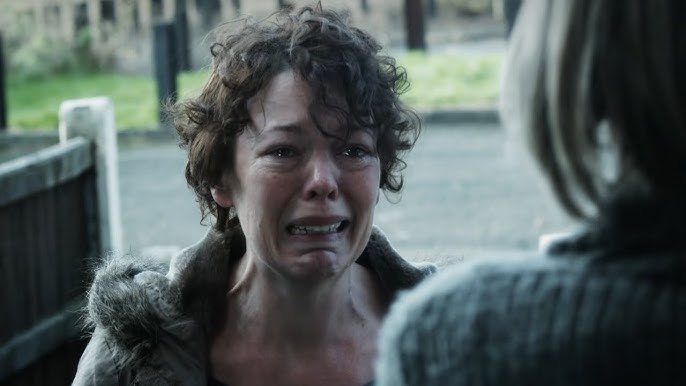
At the narrative heart of Landscapers is a remarkable dual performance by Olivia Colman and David Thewlis. Colman portrays Susan Edwards as a fragile, emotionally arrested woman living in a state of permanent psychological dissociation. Traumatized by severe, long-term childhood abuse, Susan escapes the harshness of reality by retreating into the codified, moral simplicity of classic Hollywood cinema—particularly Westerns starring Gary Cooper and mid-century French romances.
David Thewlis’s Christopher serves as the dutiful, fiercely protective husband whose absolute devotion to Susan leads him to validate and actively inhabit her elaborate fantasy world. Rather than accumulating wealth for personal luxury, the couple spent hundreds of thousands of pounds of stolen money on authentic movie memorabilia, rare signatures, and vintage cinema posters, plunging themselves into severe poverty while surrounding themselves with celluloid artifacts.
Colman captures Susan’s profound vulnerability with extraordinary precision. She presents a woman whose polite, demure exterior conceals an overwhelming, unhealed trauma. The onscreen chemistry between Colman and Thewlis transforms what could have been a tabloid crime story into a tragic romance, demonstrating how two isolated individuals constructed a shared delusion to insulate themselves from a hostile world.
Metatheatrical Direction and Narrative Deconstruction
Director Will Sharpe elevates Landscapers far above conventional true-crime dramatizations by employing bold, theatrical techniques that actively challenge the objectivity of the genre. The series routinely breaks the fourth wall: practical set walls collapse to reveal camera crews, actors step off interior soundstages into black-and-white Western landscapes, and the visual palette shifts dynamically to reflect Susan’s internal romanticism.
This stylistic choice serves a rigorous narrative purpose. By visually highlighting the artificial nature of cinematic storytelling, Sharpe prompts the viewer to question the validity of every narrative presented—including those constructed by the police and the judicial system. The investigating officers are depicted with dry, slightly absurd humor, illustrating how standard police procedures often force nuanced, disordered human motives into rigid prosecutorial templates.
When the courtroom trial sequence transforms into a literal theatrical soundstage, the series underscores how the legal process operates as its own form of performance, where competing narratives fight for dominance regardless of emotional or psychological truth.
Unearthing Systemic Failure and Childhood Abuse
The emotional core of the series lies in the gradual exposure of Susan’s history of severe childhood sexual abuse at the hands of her father, William Wycherley, alongside the silent complicity of her mother. During the 2014 trial, the prosecution categorized the killings as a premeditated double murder driven by financial avarice, emphasizing the double burial and the systematic financial fraud that followed.
However, Landscapers rigorously examines the defense’s perspective: that a sudden violent confrontation erupted within the home, and that Susan’s subsequent actions were the panicked, dissociative coping mechanisms of a deeply traumatized victim reverting to survival instincts.
By centering Susan’s childhood history, the series poses uncomfortable questions regarding institutional oversight, social isolation, and the limitations of the criminal justice system. The court ultimately convicted both Susan and Christopher of murder, sentencing them to life imprisonment with a minimum term of 25 years. Yet, the narrative leaves the audience with a profound sense of tragic ambiguity, demonstrating that while the legal system can establish statutory guilt, it remains fundamentally ill-equipped to measure the depth of psychological trauma that drives such catastrophic outcomes.
A Benchmark in Empathetic True-Crime Storytelling
Landscapers stands as a vital evolution in modern true-crime television. By rejecting gratuitous violence and sensationalism in favor of psychological depth, stylistic innovation, and deep empathy, the production offers a sobering meditation on trauma, memory, and devotion.
Olivia Colman’s transformative performance anchors the series, ensuring that Susan Edwards is viewed not merely as a perpetrator in a high-profile scandal, but as a deeply wounded human being who sought sanctuary in cinema when reality proved unbearable. Through its brilliant blend of theatricality and emotional realism, Landscapers remains a haunting, unforgettable examination of the extraordinary lengths to which human beings will go to protect one another from the darkness of their pasts.