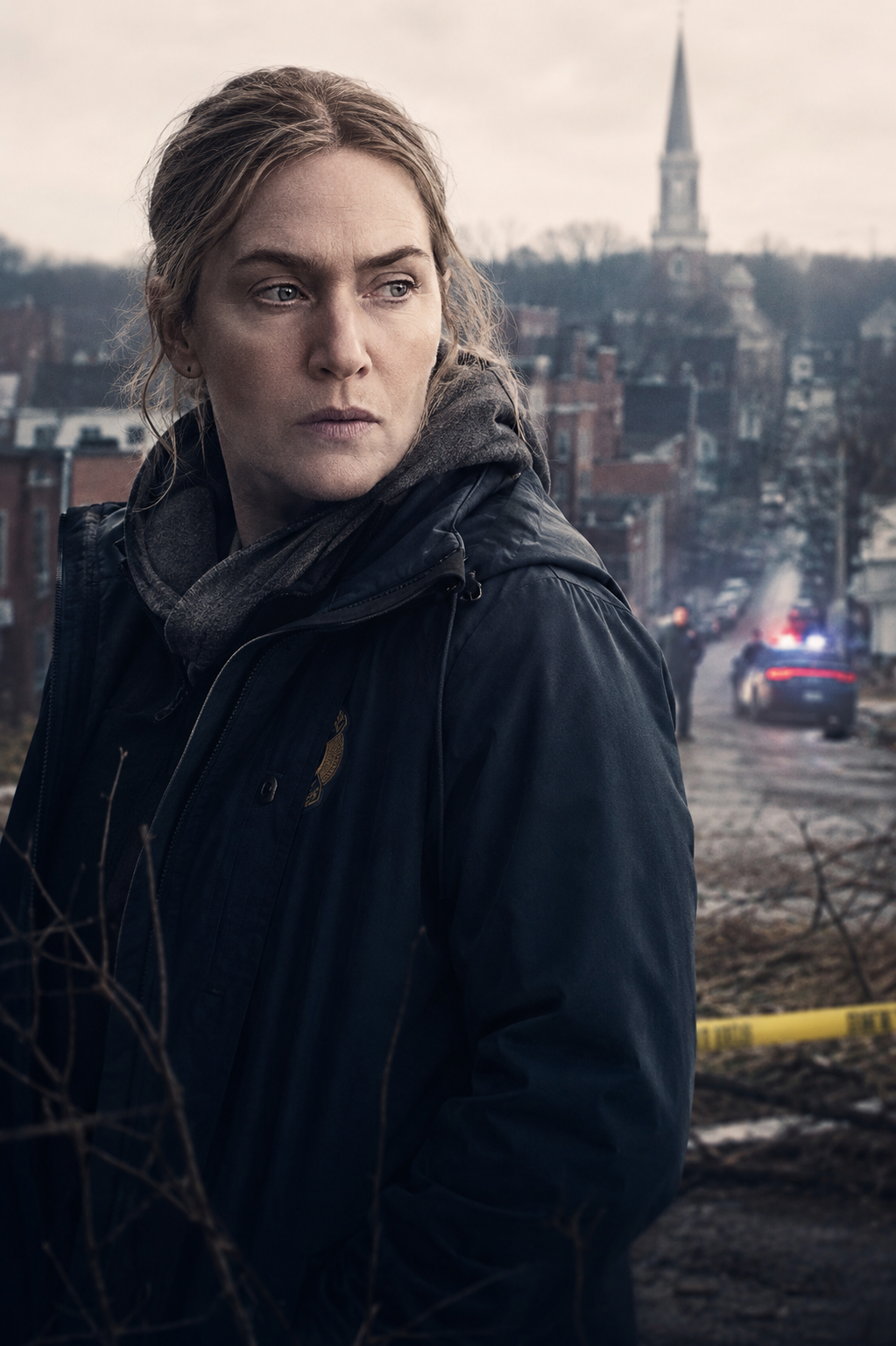
THE REAL LEGACY OF KATE WINSLET IN ‘MARE OF EASTTOWN’
BEYOND THE CLICKBAIT: THE REAL LEGACY OF KATE WINSLET IN ‘MARE OF EASTTOWN’
Unpacking the Clickbait and Correcting the Streaming Record
A viral social media post has recently gained traction online, boasting breathless headlines about a “darkest Netflix detective thriller” starring Academy Award-winner Kate Winslet. Formatted with alarm emojis, sensationalized plot teasers, and a prominent “Watch full show here” call to action, the caption promises a story of a brutal small-town murder, hidden lies, and a shocking climax involving an unthinkable suspect.
While the plot description loosely references one of the most critically acclaimed television events of recent years, the caption contains a fundamental error: the show in question is not a Netflix original. The series being described is Mare of Easttown, the groundbreaking seven-part limited series produced by and broadcast exclusively on HBO (and streaming on Max).
The misattribution of major prestige television series to Netflix is a well-documented tactic employed by digital clickbait syndicates. By pairing high-profile celebrity names with the world’s largest streaming brand keyword, automated content aggregators generate algorithmic reach, tricking users into clicking external links that lead to ad-cluttered blogs, survey traps, or unauthorized streaming portals.
Behind the generic, sensationalized marketing language lies a masterclass in crime drama that deserves to be understood beyond simple internet hype.
The Premise: Uncompromising Realism in Small-Town Pennsylvania
Created and written by Brad Ingelsby and directed by Craig Zobel, Mare of Easttown premiered in early 2021 to massive viewership and universal critical acclaim. Rather than relying on stylized Hollywood tropes, the series distinguishes itself through an uncompromising commitment to grounded realism, atmospheric dread, and deep character development.
The narrative centers on Marianne “Mare” Sheehan (played by Kate Winslet), a weary, cynical detective sergeant in Easttown Township, a tight-knit, working-class community in Delaware County, Pennsylvania. Mare is a local legend—famous for a game-winning shot in a high school basketball championship 25 years prior—who now spends her days navigating minor domestic disputes, local drug addiction crises, and cold cases.
The town’s delicate emotional ecosystem fractures following two interconnected tragedies:
-
The Disappearance of Katie Bailey: The daughter of Mare’s former high school teammate, Katie has been missing for over a year without a trace, leading the community to question Mare’s investigative competence and bringing in a county detective, Colin Zabel (Evan Peters), to assist.
-
The Murder of Erin McMenamin: A young, isolated teenage mother, Erin is found murdered in a local creek bed under horrific circumstances, sending shockwaves through the community and exposing a complex web of local secrets.
Unlike generic murder mysteries that treat the victim as a mere plot device, Mare of Easttown dedicates substantial time to exploring Erin’s struggles, the economic hardship of the region, and the pervasive trauma shared by the town’s residents.
Dissecting the Climax: A Tragedy That Hit Devastatingly Close to Home
The viral caption’s claim that “the final piece of evidence points directly to a person nobody ever suspected” touches upon the show’s intricate, emotionally devastating resolution. Throughout the seven episodes, the investigation throws suspicion across multiple figures in Mare’s personal and professional life:
-
Deacon Mark Burton: A local priest with a past allegation of misconduct who was among the last people to see Erin alive.
-
Frank Sheehan: Mare’s ex-husband, who lived near Erin and was falsely rumored to have fathered her child.
-
Dylan Hinchey: Erin’s volatile ex-boyfriend, who attempted to destroy her personal journals to hide financial secrets.
-
Billy and John Ross: Two brothers closely connected to Mare’s family, who become primary suspects when a blood-stained photograph and family cabin secrets come to light.
While the narrative leads viewers to believe that John Ross coerced Erin into a secretive affair and committed the murder to protect his marriage, the final episode delivers a far more heartbreaking twist. Mare discovers that the murder weapon—a antique Colt Special revolver—belonged to an elderly neighbor, Glen Carroll.
Interrogating Carroll reveals that the gun briefly vanished from his shed on the night of the murder and was returned shortly after. Reviewing security footage from the shed, Mare uncovers the true killer: Ryan Ross, the 13-year-old son of John and Lori Ross.
Driven by a desperate child’s desire to keep his parents’ marriage from falling apart after discovering his father’s affair with Erin, Ryan had taken the gun to threaten Erin into staying away from his family. An accidental struggle in the park resulted in the fatal gunshot.
The revelation does not end in a triumphant police victory, but in absolute tragedy. Mare is forced to arrest the young son of her best friend, Lori (Julianne Nicholson), highlighting the core theme of the series: in a small town, every investigation inflicts pain on the people conducting it.
Kate Winslet’s Masterclass: Subverting Hollywood Tropes
At the heart of Mare of Easttown’s success is Kate Winslet’s transformative, Emmy-winning performance. Winslet stripped away all glamour for the role, portraying Mare as a grieving, emotionally guarded woman struggling with the suicide of her son, Kevin, while fighting for custody of her grandson, Drew.
Winslet’s dedication to authenticity extended to every facet of the production:
-
Dialect Mastery: Winslet spent months mastering the notoriously difficult “Delco” (Delaware County) accent, capturing the unique vocal rhythms, vowel shifts, and colloquialisms of southeastern Pennsylvania.
-
Unfiltered Aesthetics: Winslet insisted that her character wear minimal makeup, unstyled hair, and bulky, everyday clothing, going so far as to push back against post-production edits that sought to smooth out her appearance or retouch promotional posters.
-
Complex Emotional Depth: Rather than presenting a bulletproof action hero, Winslet portrayed Mare as a deeply flawed human being who makes serious ethical missteps—including planting evidence to secure custody of her grandson—before confronting her suppressed grief in therapy.
Winslet’s performance, alongside standout supporting turns from Julianne Nicholson, Jean Smart, and Evan Peters, earned the series four Primetime Emmy Awards and solidified its place as a high-water mark for modern television drama.
The Anatomy of Streaming Clickbait and Link Scams
The contrast between the profound artistic merit of Mare of Easttown and the sensationalized “Netflix thriller” caption highlights the mechanics of digital clickbait in the streaming era.
Clickbait operations rely on predictable strategies:
-
Brand Swapping: Using “Netflix” instead of “HBO” because “Netflix” generates higher search volumes across global algorithms.
-
Vague Tropes: Employing generic phrases like “darkest thriller,” “sinister lies,” and “chilling evidence” that can apply to virtually any crime show, bypassing the need for genuine critical analysis.
-
Malicious Links: Attaching “Watch full show here” prompts that lead off-platform to ad-arbitrage domains, malware risks, or illegal streaming sites designed to capture user data.
Understanding these digital tactics allows viewers to bypass misleading social media posts and engage with verified television journalism. Mare of Easttown remains available in its entirety on official HBO streaming platforms, standing as an authentic, brilliant exploration of grief, community, and redemption.