PART 3 — The Day Someone Finally Listened
No one had expected state investigators.
Not the principal.
Not the school board.
And certainly not the families who believed their children would never face consequences.
The lead investigator placed several folders on the table.
“We’ve received multiple reports concerning student safety over the past three years.”
He paused.
“Many of those reports were never properly documented.”
A murmur spread across the room.
One by one, witnesses spoke.
The retired teacher described the complaints she had filed.
The crossing guard testified about children walking home after being intimidated off the bus.
The gas station cashier recalled buying food for Ryan when his lunch money had been stolen.
Each story seemed small on its own.
Together, they revealed a pattern that could no longer be ignored.
The principal lowered her head.
“I should have done more.”
Then Jack stood.
He wasn’t carrying a speech.
Only Ryan’s blue notebook.
“I found this on County Road 47.”
He opened it carefully.
“I won’t read the cruel messages.”
“They’ve already done enough damage.”
Instead, he read the words Ryan had written in pencil.
“Please don’t tell my mom.”
The room grew quiet.
Another page.
“She already cries every night.”
A third.
“I’m trying to be strong until things get better.”
Several parents wiped away tears.
Ryan stared at the floor.
Embarrassed.
Ashamed.
Jack gently closed the notebook.
“No child should have to protect the adults who are supposed to protect him.”
The investigator turned toward Ryan.
“You’ve been carrying this alone for a long time.”
Ryan nodded.
“I didn’t want anyone getting in trouble because of me.”
The investigator smiled kindly.
“Speaking up doesn’t create trouble.”
“It helps stop it.”
The three boys sat silently.
For the first time, they looked uncomfortable.
Their parents listened as evidence showed repeated bullying, messages, witness statements, and ignored complaints.
Consequences followed.
The boys entered a structured behavioral intervention program.
Their families were required to participate in counseling alongside them.
The school introduced anonymous reporting, increased supervision, and staff training to recognize and respond to bullying earlier.
The goal wasn’t simply punishment.
It was preventing another child from feeling as alone as Ryan had.
That evening, Jack finally met Ryan’s mother, Melissa.
She had learned the truth from Ryan himself after the meeting.
“I’m sorry I didn’t see it,” she whispered.
Ryan hugged her tightly.
“You were working so hard.”
“I didn’t want you to think you failed.”
Melissa shook her head through tears.
“The only thing that would’ve broken my heart…”
“…would’ve been knowing you carried all this by yourself.”
She looked at Jack.
“Thank you for walking beside my son.”
Jack smiled.
“He did the hard part.”
“He kept walking.”
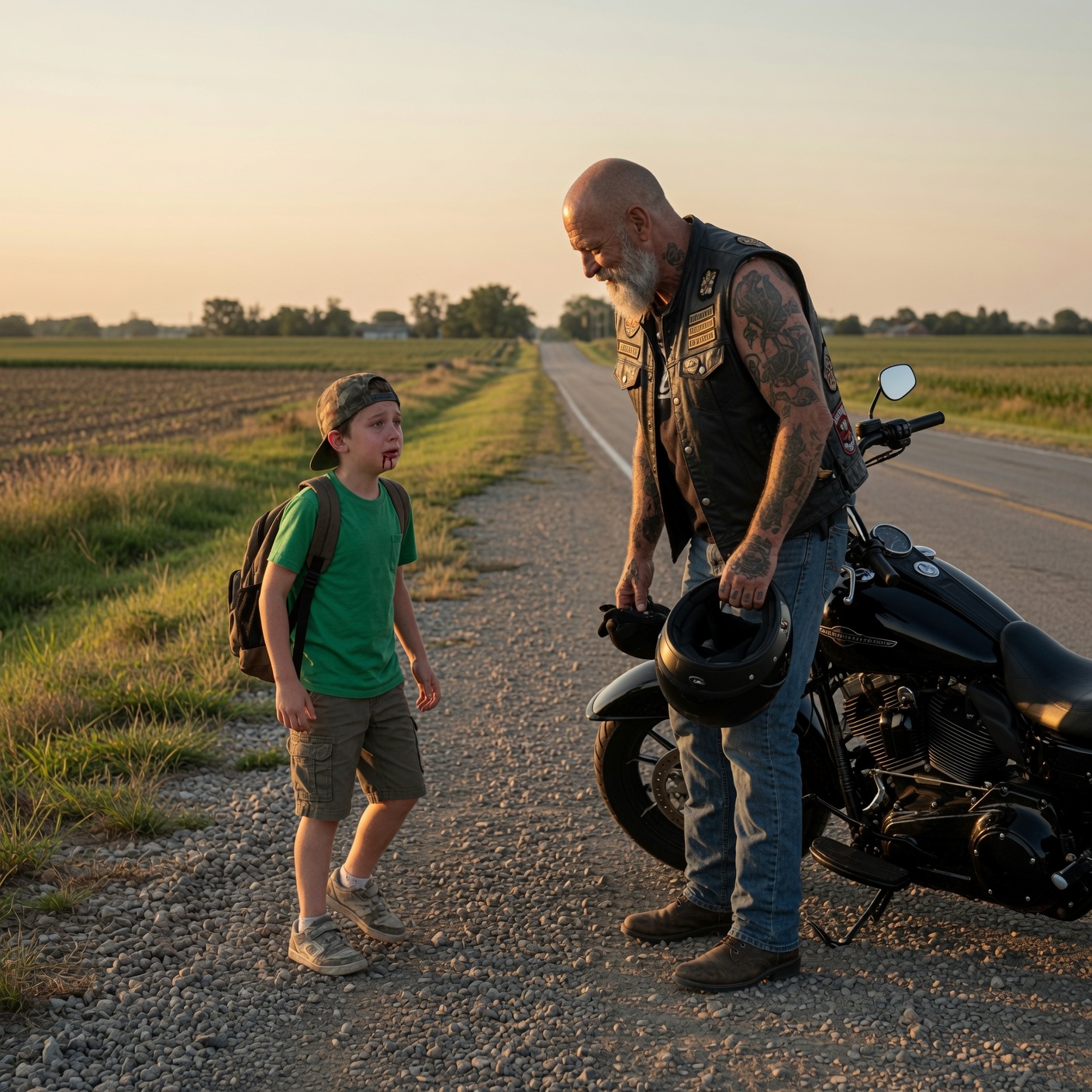
Months later, County Road 47 looked the same.
The fields still stretched for miles.
The wind still bent the tall grass.
But one thing had changed.
Every afternoon, a small group of students walked home together.
Ryan was never alone anymore.
Jack occasionally rode past on his motorcycle.
Ryan always waved.
Jack always honked once in return.
One spring afternoon, Ryan handed him a folded note.
Inside, written in neat fifth-grade handwriting, were the words:
“You didn’t rescue me. You helped me believe I was worth rescuing.”
Jack folded the note carefully and tucked it into his vest pocket.
Some people thought strength was measured by how hard you could fight.
But after all his years in the Army, and everything he had seen afterward, Jack believed something different.
Real strength was helping a frightened child discover that he never had to carry his pain alone.
— THE END —