PART 2 — THE PHOTOGRAPH INSIDE HIS VEST
The silver sedan stopped so close to our mailbox that gravel sprayed across the yard.
The driver climbed out before the engine had fully died.
He wore an expensive gray suit that didn’t belong on a dusty county road.
His shoes sank into the mud as he marched toward our porch.
“Ellie!” he shouted.
“We need to talk!”
My daughter didn’t move.
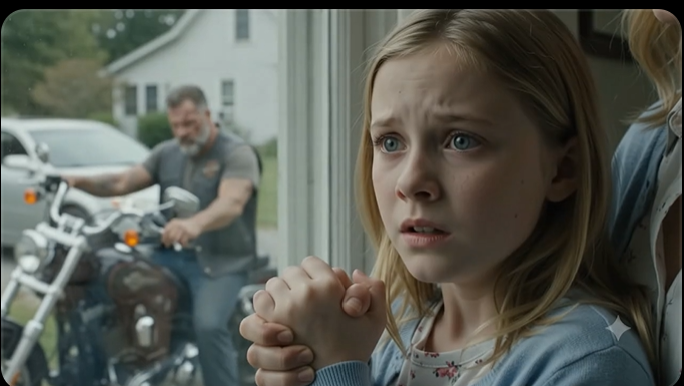
She pressed herself harder against the screen door, both hands covering her ears.
Across the fence, Rook’s Harley continued its slow, uneven rumble.
Potato… potato… potato…
Steady.
Predictable.
The same rhythm every Tuesday afternoon.
The suited man turned toward him.
“I said shut that thing off!”
Rook looked at Ellie instead.
Not the man.
Not the gathering neighbors.
Just the frightened little girl.
His scarred fingers rested lightly on the throttle.
The engine never changed.
It simply kept idling.
By then half the road had gathered outside.
Someone whispered that the biker was trying to intimidate the visitor.
Someone else said the sheriff was already on the way.
The man pointed at Rook.
“You’re interfering with a family matter.”
Still nothing.
Then Ellie surprised me.
She slowly uncovered one ear.
The Harley was still there.
She breathed a little easier.
“Mr. Rook’s home,” she whispered.
“He’s still home.”
Only then did I understand.
After the break-in that had happened months earlier, Ellie had become terrified whenever strange cars stopped near our house.
Her therapist had suggested creating one familiar sound she could trust.
Every Tuesday afternoon, Rook parked outside while repairing motorcycles in his garage.
The deep rumble of his Harley became Ellie’s signal that everything was normal.
Safe.
If the engine stopped unexpectedly…
Her panic attacks returned.
The suited man couldn’t have known.
Rook did.
The deputy finally arrived.
“What seems to be the problem?”
The man immediately pointed toward Rook.
“He’s harassing me.”
Before anyone could answer, Rook slowly reached inside his leather vest.
Several neighbors gasped.
The deputy rested a hand near his holster.
Instead of pulling out a weapon…
Rook removed an old, faded photograph.
Its corners had been folded so many times they were almost white.
His hand shook.
“Before anybody decides who’s bothering whom…”
“…look at this.”
The deputy took the picture.
It showed a much younger Rook sitting beside a hospital bed.
Next to him smiled a little girl with curly blonde hair.
She looked almost exactly like Ellie.
On the back, written in fading blue ink, were seven words.
“Keep the engine running. She sleeps easier.”
The deputy frowned.
“Who’s this little girl?”
Rook swallowed.
“My daughter.”
The silence that followed felt heavier than the summer heat.
“My wife left with her sixteen years ago.”
“I never saw either of them again.”
He looked toward Ellie.
“When your mom moved in next door…”
“I heard your daughter crying every night.”
“The sound was exactly the same.”
“So I started working on my motorcycle every Tuesday.”
“I hoped she’d notice the engine.”
“I hoped she’d know someone familiar was nearby.”
He smiled sadly.
“I never intended for her to know it was me.”
The suited man suddenly looked uncomfortable.
He quietly admitted he wasn’t a relative at all.
He worked for the property management company that owned the neighboring farmland.
He had arrived without calling first to pressure us into selling a strip of our land.
Ellie had mistaken him for someone coming to take our house.
Rook hadn’t.
He had recognized panic the instant he saw it.
But the photograph wasn’t the only thing hidden inside his vest.
Behind it was a sealed envelope addressed in a child’s handwriting.
The return address belonged to a town nearly six hundred miles away.
And the postmark…
…was only four days old.