During Dinner With My Son, A Message on My Phone Said, “Please Step Outside Quietly”
For three decades, I believed I knew what being a father meant.
You work. You provide. You answer the late-night phone call. You forgive more than you should. And when your son drifts, you tell yourself he is busy, not gone. That was the story I told myself about Rick.
After Margaret passed, the house in Brooklyn became too quiet in a way I still haven’t found a good word for. Not peaceful. Not empty. Just wrong. The dish rack held one coffee mug instead of two. The television stayed off most nights because there was no one to glance over and say, “Turn that down, Jonathan, I’m trying to read.”
I kept her routines alive for longer than I care to admit. I wiped the counter twice. I folded the towel the way she liked. I set one plate, one fork, one cup, then stood there looking at them as if enough repetition might bring her back. A year passed with Rick barely calling. When he did, it was short. When Emma spoke, it was pleasant. And when I asked about the grandchildren, there was always something in the way. A busy week. A rough bedtime. A renovation. A cold. A better time soon.
That “soon” stretched so far I stopped trusting the word.
Then one evening, while drying Margaret’s favorite mug, the phone rang. Rick. For a moment, I simply stared at his name like it belonged to another century.
His voice came through softer than I expected, uncertain in that old familiar way. “Dad… it’s been too long.”
I sat down slowly in the armchair Margaret bought because she said I was getting stubborn about my back. “Yes,” I said. “It has.”
“Emma and I have been talking. We miss having you around. We want to do dinner tonight. Just us. Start over.”
People talk about hope like it arrives grandly. It doesn’t. Sometimes it comes disguised as a pause on the other end of the phone and the phrase we miss family.
I said yes. I shaved, put on the navy suit Margaret loved, and picked up the bottle of aged whiskey I had been saving. I rode forty minutes out to Montclair, where the streets got wider, the lawns neater, and the houses bigger than anything Rick had ever grown up inside. By the time the car stopped, I was staring at stone columns and a front door large enough to make a man feel like a delivery mistake.
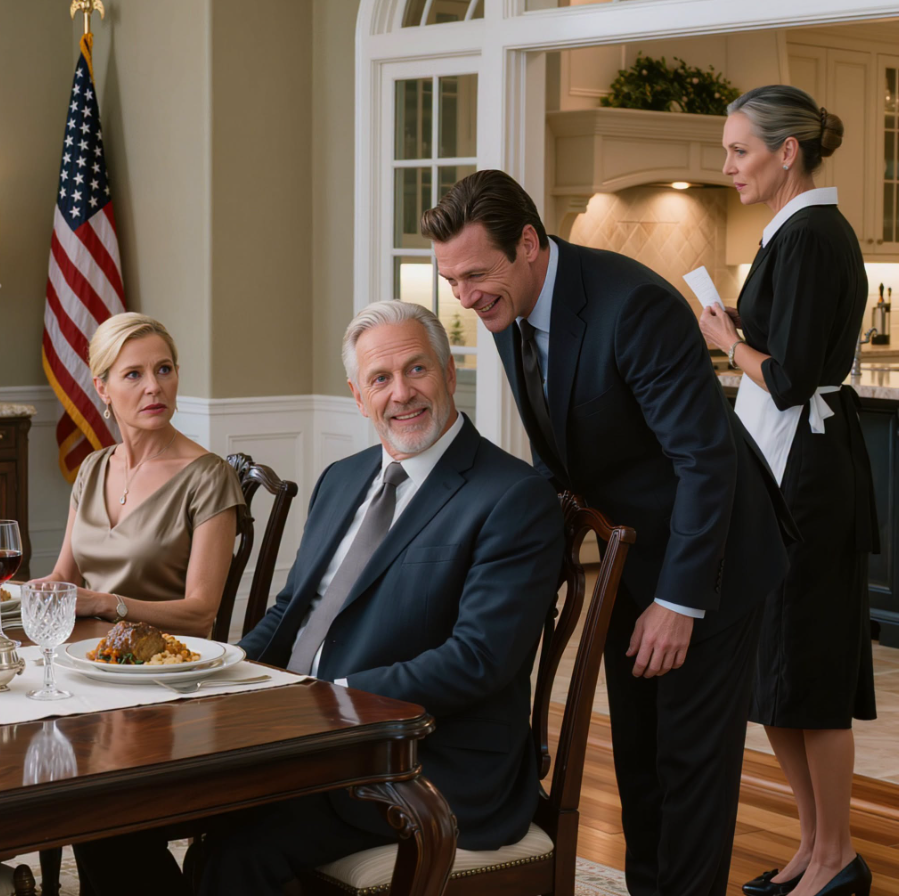
The housekeeper opened before I could ring. She was gracious, professional, maybe in her fifties, with tired kind eyes. “Mr. Miller,” she said warmly. “They’re expecting you.”
Inside, everything glowed. Marble floors. Fresh flowers. Rick came down smiling. Emma followed in silk and perfume. They hugged me. They praised the whiskey. And for fifteen dangerous minutes, I let myself think maybe I had been wrong. Maybe grief had just stretched us thin. Maybe all families needed was one good table and one honest evening to find their way back.
The Polished Trap
The dining room looked like a magazine spread. White linen. Crystal glasses. A pot roast that smelled exactly like the one Margaret made. Emma sat to my left; Rick to my right. The housekeeper, whose name I learned was Elena, moved silently in and out of the kitchen.
The conversation started as light as the wine. But as the first course transitioned into the second, the focus shifted.
“Dad,” Rick said, swirling his whiskey—the expensive bottle I’d brought, though he was pouring it like water. “We’ve been thinking about the Brooklyn house. It’s a lot of stairs for you. A lot of maintenance.”
“It’s home, Rick,” I said.
“Of course, of course,” Emma chimed in, her smile never reaching her eyes. “But we want you closer. We’ve been looking at some… luxury transitions. Places where you wouldn’t have to worry about a thing. And with the market where it is, the Brooklyn property is sitting on a goldmine of equity.”
Then came the questions about succession. About legal planning. About what I wanted “for the future.” At first, it sounded like concern. Then it started sounding like inventory.
Rick poured the whiskey himself. He filled my glass too generously. He laughed too brightly when I slowed down between sips. I remember thinking the room had become oddly warm. Not dizzy, exactly. Just softened at the edges, as though the chandelier light had thickened.
I reached into my jacket for my phone, mostly out of instinct, and saw the notification. A number I didn’t know.
Please step out for a moment. Don’t discuss it at the table.
I read it twice. The room continued exactly as before—Emma smiling, Rick talking about real-estate opportunities, plates warm, silver quiet. But inside me, something turned sharp.
“Everything okay?” Rick asked.
“Just a little lightheaded,” I said. “The whiskey is hitting harder than I expected.”
I stood. Not too fast. I walked past the kitchen door. Elena was at the sink, hands in soap, eyes lowered. She did not look at me. That was how I knew. Not the message. Not the whiskey. Her silence. She didn’t stop me. She just kept washing the same glass as if the most important thing she could do for me was pretend not to see me leaving.
The Cold Reality
I went out the back door. The street beyond the hedges felt colder and more honest than anything inside that house. I kept walking until I was a block away, then ordered a ride and got in without looking back. Only then did I call the number.
The voice that answered was calm and low. It was Elena.
“You left,” she said.
“Yes.”
“Good.”
I asked the obvious question. “Why did you send that message?”
“Because I heard them discussing it in the pantry,” she said. “Mr. Miller, your son is in deep with some very bad people. This house… the cars… it’s all built on a house of cards that’s collapsing. They need your signature on a power of attorney and a deed transfer. They were going to wait until you were… ‘relaxed’ enough not to read the fine print.”
My throat went dry. “How deep?”
“Millions,” she whispered. “They’ve already leveraged everything they own. They need yours now.”
I stared out the window at the passing lights. The dinner wasn’t hospitality; it was staging. The whiskey wasn’t generosity; it was strategy. And the son who had looked so relieved to see me had not been trying to bring me home. He had been trying to guide me toward the one signature that would solve his debts by rendering me homeless.
My rideshare driver asked if I was all right. I said no.
Then I looked down at Margaret’s old photo in my wallet. She always knew when I was about to be a fool. I realized then that I couldn’t just run. If I ran, they would find another way, a more desperate way. I needed to end the story tonight.
I made one more call. Not to Rick. To my old friend Elias, a man who had spent forty years in the District Attorney’s office.
“Elias,” I said. “I need a favor. And I need a few witnesses.”
The Return
Twenty minutes later, I was back on that curved driveway. I walked toward the front door. Inside, they welcomed me too quickly.
“Dad, where did you go?” Rick asked, his voice tight with a panic he was trying to mask as concern.
“Just needed air,” I said. “Old age makes the lungs greedy.”
Emma touched my arm. “Sit down. We were worried. We have something we wanted to go over with you—just some paperwork to make sure you’re protected.”
I returned to the table. The same glasses. The same polished room. Only now every kind gesture looked like choreography.
Rick placed a leather-bound folder on the table. It looked official. Respectable. “It’s just a formality, Dad. To make sure Emma and I can help you with the medical stuff if, God forbid, something happens. And a few updates to the estate.”
He handed me a pen. A heavy, gold-plated thing. “Just sign at the tabs, and we can put all this business behind us. Let’s focus on being a family again.”
I held the pen. I looked at the line. It was a Power of Attorney form, nestled beneath a ‘Living Will’ cover sheet. My son’s hand was shaking, just a fraction.
“You know, Rick,” I said, my voice steady. “Your mother always said you were a terrible liar. You used to get a little twitch in your left eyelid when you tried to tell her you hadn’t broken the neighbor’s window.”
The silence that hit the room was physical. Emma’s smile vanished. Rick’s eyes went wide.
“What are you talking about, Dad?”
“I’m talking about the debt,” I said. “I’m talking about the fact that you invited me here to strip me of the only thing I have left of your mother.”
Rick reached for the folder, but I pinned it to the table with my palm.
“Dad, you’re confused. The whiskey—”
“The whiskey was a nice touch,” I interrupted. “But I didn’t drink as much as you hoped.”
Three firm knocks landed at the front door. Not hesitant. Not social. Measured. Formal.
Emma stood up, her face pale. “Who is that at this hour?”
I looked at my son. “That’s the end of the evening, Rick.”
The door opened. It wasn’t just Elias. There were two uniformed officers and a man in a sharp suit from the state’s financial crimes division. Elena had done more than just text me; she had provided Elias with the documents she’d found in Rick’s office an hour earlier.
Rick didn’t fight. He didn’t scream. He just sank into his chair, looking smaller than I had ever seen him. He looked like the boy who had broken the window, only this time, his father couldn’t pay for the glass.
The Final Course
The house was eventually sold. The luxury cars were seized. Emma left for her parents’ home in Connecticut a week after the indictments were handed down.
I went back to Brooklyn.
The house is still quiet. The dish rack still holds one coffee mug. But the silence feels different now. It’s no longer the silence of waiting for someone to return. It’s the silence of a man who knows exactly where he stands.
I still go to the cemetery every Sunday. I sit by Margaret’s stone and I tell her about the world. I don’t tell her everything—I don’t tell her that our son is serving three to five for fraud. I don’t tell her that I had to testify against the boy we raised.
Instead, I tell her that I’m taking care of the house. I tell her I’m keeping the counters clean.
And sometimes, when the wind catches the trees just right, I can almost hear her. She isn’t saying “turn it down.” She’s saying “well done.”
I still have that gold-plated pen. I keep it in a drawer in the kitchen. I never use it. It serves as a reminder of the night I stepped away from a signature and found my way back to the truth.
Being a father means many things. You work. You provide. You forgive. But sometimes, being a father means being the only one left to hold the mirror up, even if the reflection breaks your heart.
The pot roast that night had been delicious. It was a shame we never got to finish it. But some dinners are meant to end early, especially when the price of the meal is your soul.
I sat in my armchair that night, the one Margaret bought for my back, and I turned off the lights. For the first time in a year, I didn’t feel lonely. I just felt at peace.
The message from the unknown number is still saved on my phone. Sometimes I look at it when I feel myself getting soft, when I start to miss the version of Rick I wanted him to be.
Please step out for a moment.
I did. And in stepping out, I finally walked home.
Epilogue
A month later, a small envelope arrived at my door. No return address. Inside was a simple note: He would have taken everything. I couldn’t let that happen. Be well, Mr. Miller.
I went to the local park the next day. I saw a woman sitting on a bench, feeding the birds. She looked like Elena, but I didn’t approach her. I didn’t want to complicate her life any more than I already had. I just nodded from a distance. She didn’t look up, but she paused, a single crust of bread held between her fingers, and for a second, the world felt balanced again.
The signature I didn’t give saved my life. But the message I did receive saved my spirit. And in the end, that was the only inheritance that mattered.